|

Lennox International (LII) Elliott Wave analysis  —  Correction ahead before the next rally

LII stock enters a wave IV corrective phase, offering potential buying opportunities before a strong bullish wave V rally resumes.

Lennox International (LII) has been in a strong uptrend for many years, following a clear Elliott Wave impulsive structure. The stock recently completed wave III on the monthly chart and is now entering a corrective phase marked as wave IV. This pullback is a healthy part of the overall bullish cycle and offers opportunities for long-term investors.

Expected Elliott Wave structure

The ongoing correction is likely to unfold as a three-wave structure, which is highly probable due to the principle of alternation, given that Wave II was a flat correction.. The first leg, wave ((A)), is expected to drive prices lower in the short term. After that, a wave ((B)) recovery may follow before wave ((C)) completes the correction. Once wave IV ends, wave V is expected to begin, likely pushing prices to new highs. This upcoming rally could offer strong potential for long-term investors.
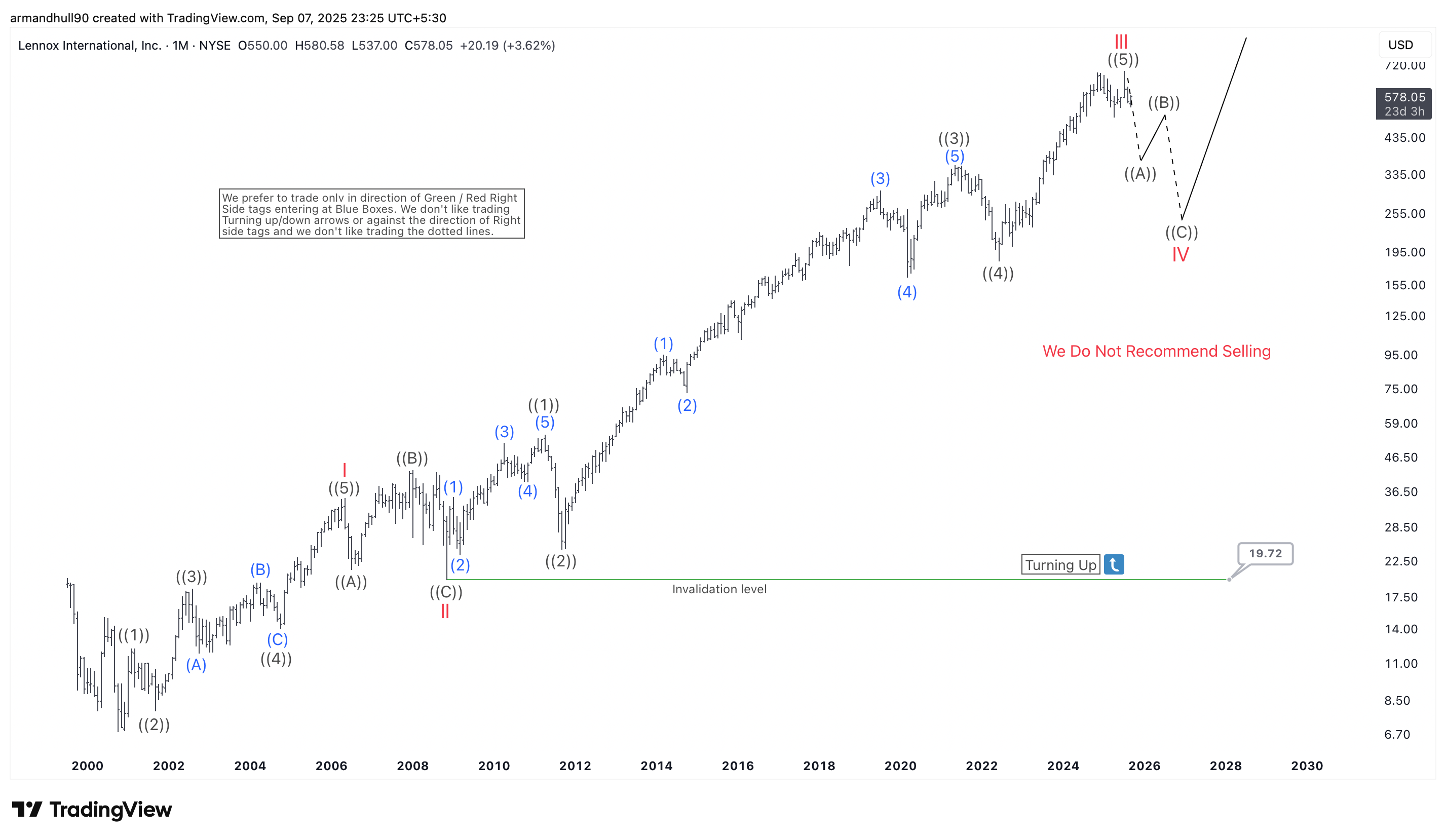
At present, LII is trading near $578 and showing early signs of weakness as the correction begins. However, the broader uptrend remains intact as long as prices stay above the invalidation level at $19.72. Traders should avoid aggressive selling during this phase and instead prepare to enter when wave IV nears completion. Watching Fibonacci retracement zones and blue box buying areas can help identify possible reversal levels.

Final outlook

LII remains in a larger bullish cycle despite the ongoing corrective phase. Patience will be key, as a deeper pullback in wave IV can create attractive entry setups before the next rally in wave V begins.

Author

Elliott Wave Forecast Team

Elliott Wave Forecast Team

ElliottWave-Forecast.com

More from Elliott Wave Forecast Team
Share:

Editor's Picks

AUD/USD cracks 0.7000 as Bullock dulls RBA hike, CPI looms

The Aussie Dollar tumbled over 0.40% against the US Dollar on Tuesday, even though the Reserve Bank of Australia raised rates to 4.60%, but a mild-dovish tilt by RBA Governor Bullock cleared the path to push the pair below the 0.7000 threshold.

USD/JPY consolidates near 157.50 as a bullish USD counters intervention risks

USD/JPY struggles to capitalize on the overnight bounce from a one-week low, consolidating around 157.50 in the Asian session on Tuesday. Trump's concerns about the Japanese Yen's weakness fueled speculation about another US-Japan joint intervention. This, along with the hawkish BoJ, underpins the JPY and caps the currency pair. Meanwhile, rising Fed rate-hike bets and oil-driven inflation fears continue to push US bond yields to multi-year highs, keeping the US Dollar pinned near a two-month high and supporting the pair.

Gold trims gains; back toward $4,150

Gold now surrenders some of its initial advance and retests the $4,150 zone per troy ounce on Tuesday. Meanwhile, the move higher in the yellow metal comes despite the firmer US Dollar and rising US Treasury yields across the board, while escalating geopolitical tensions appear to limit the downside potential.

Ethereum sees profit-taking near $2,700 ahead of key US economic data
Ethereum (ETH) has shown signs of profit-taking near $2,700 over the past few days, with rising exchange deposits and a slowdown in exchange-traded fund (ETF) inflows ahead of US inflation and labor market data releases. The top altcoin's Exchange Reserves, which track the total amount of a crypto asset held across exchange wallets, have increased by roughly 125K ETH since Friday.
Silver is more volatile than Gold ahead of PCE and NFP. This chart shows the positioning gap
The market’s attention is focused on American data this week, but there’s something only those with a trained eye may be looking at: Gold and Silver positioning gap. Financial markets are moving on fears, mostly related to persistently high energy prices driven by the Middle East war. Sure, the US Dollar (USD) is strong, but at what cost?
Silver is more volatile than Gold ahead of PCE and NFP. This chart shows the positioning gap
The market’s attention is focused on American data this week, but there’s something only those with a trained eye may be looking at: Gold and Silver positioning gap. Financial markets are moving on fears, mostly related to persistently high energy prices driven by the Middle East war. Sure, the US Dollar (USD) is strong, but at what cost?