Japanese Yen selling bias remains unabated; USD/JPY moves closer to 150.00
- The Japanese Yen attracts sellers for the third consecutive day amid a positive risk tone.
- A modest USD bounce from a multi-month low further lends support to the USD/JPY pair.
- The divergent BoJ-Fed expectations might cap the pair ahead of central bank event risks.

The Japanese Yen (JPY) extends its steady intraday descent through the early European session on Tuesday, lifting the USD/JPY pair to a fresh two-week high, around the 149.85 region in the last hour. The global risk sentiment remains well supported by the optimism over China's stimulus measures and hopes for a Ukraine peak deal, which, in turn, is seen undermining the safe-haven JPY. Apart from this, a modest US Dollar (USD) recovery from a multi-month low touched on Monday lends additional support to the currency pair.
Meanwhile, the markets have been pricing in the possibility that the Bank of Japan (BoJ) will continue raising interest rates this year. The bets were reaffirmed by positive results from Shunto spring wage negotiations, which, along with worries about the potential economic fallout from US President Donald Trump's trade tariffs, could limit deeper JPY losses. Furthermore, bets for further policy easing by the Federal Reserve (Fed) should cap the USD and the USD/JPY pair ahead of the highly-anticipated BoJ and the Fed policy decisions on Wednesday.
Japanese Yen continues losing ground amid upbeat market mood; BoJ-Fed decisions in focus
- Ahead of talks on Ukraine with Russian President Vladimir Putin, US President Donald Trump expressed optimism that both sides will be able to come to a ceasefire and ultimately a peace deal. This comes on top of China's special action plan to boost domestic consumption announced over the weekend and remains supportive of the upbeat market mood.
- Japan’s Finance Minister Katsunobu Kato spoke at his regular press conference on Tuesday and said that bond markets should dictate yield movements. Kato added that the government would respond appropriately while allowing market forces to drive bond price fluctuations. This follows a brief spike in the 40-year Japanese government bond yield to a record high.
- The preliminary results of Japan's annual spring labor negotiations, which concluded on Friday, showed that firms largely agreed to union demands for strong wage growth for the third consecutive year. This is expected to boost consumer spending and contribute to rising inflation, which, in turn, gives the Bank of Japan headroom to keep raising interest rates.
- In contrast, traders are now pricing in the possibility of 25 basis points Fed rate cuts each at the June, July, and October policy meetings amid concerns about a tariff-driven US economic slowdown, signs of a cooling labor market, and easing inflation. This might cap the attempted US Dollar recovery from its lowest level since October 2024 touched on Monday.
- On the economic data front, the US Census Bureau reported on Monday that Retail Sales in the US grew by 0.2% in February compared to the downwardly revised decline of 1.2% the prior month. This, however, was well short of expectations for a 0.7% rise, signaling consumer caution and compelling evidence for the Fed to resume its policy easing cycle soon.
- Traders now look forward to Tuesday's US economic docket – featuring the release of Building Permits, Housing Starts, and Industrial Production data – for some impetus. The focus, however, will remain glued to the crucial BoJ-Fed rate decisions on Wednesday, which will play a key in determining the next leg of a directional move for the USD/JPY pair.
USD/JPY could accelerate the positive move once the 150.00 psychological mark hurdle is cleared
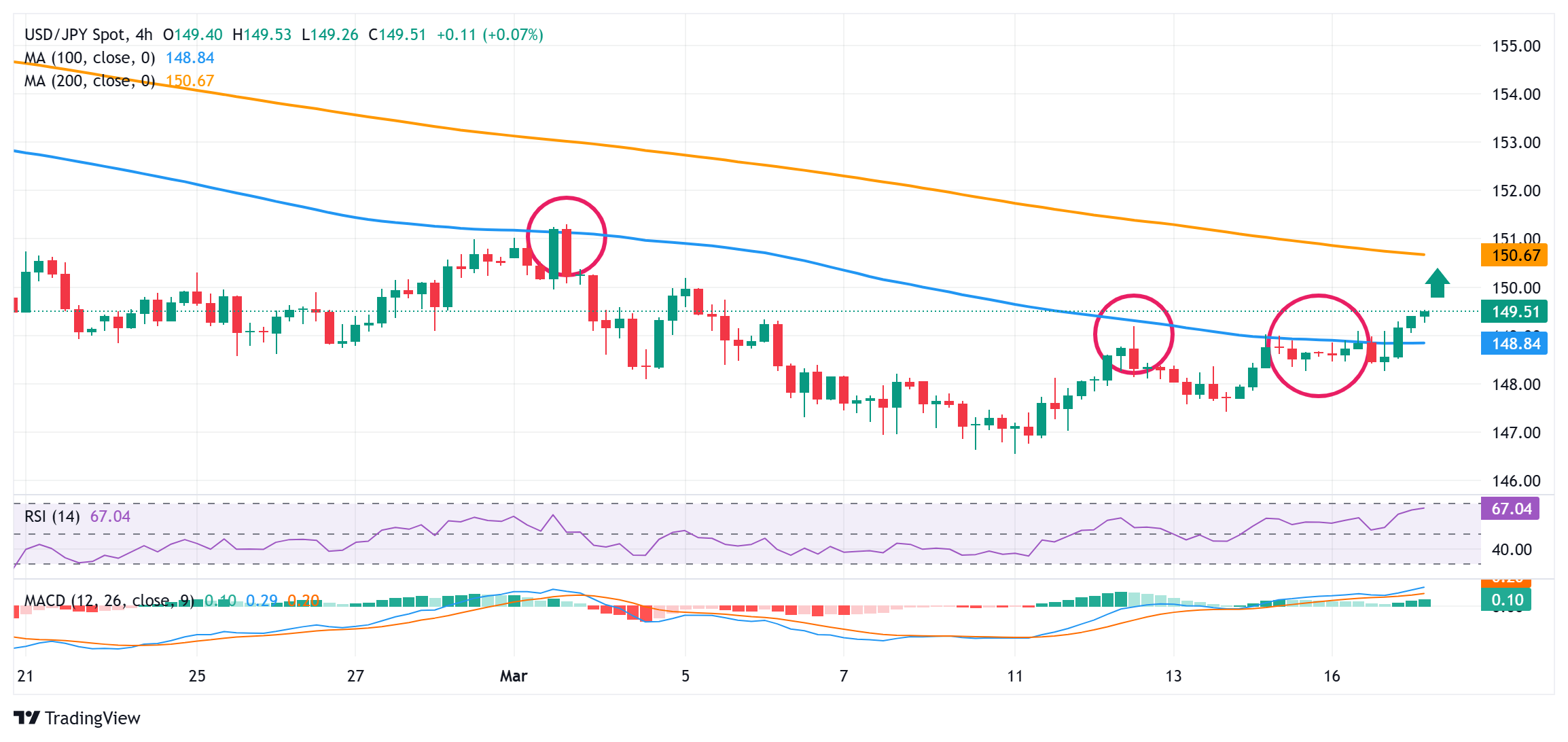
From a technical perspective, the overnight breakout above the 100-period Simple Moving Average (SMA) on the 4-hour chart and subsequent strength above the 149.00 mark could be seen as a key trigger for bulls. Moreover, oscillators on the said chart have been gaining positive traction and support prospects for additional gains. Hence, some follow-through strength, back towards reclaiming the 150.00 psychological mark, looks like a distinct possibility. Any further move up, however, is more likely to confront stiff resistance and remain capped near the 150.75-150.80 region, representing the 200-period SMA on the 4-hour chart.
On the flip side, the 149.20 area, followed by the 149.00 mark and the 148.80 region (200-period SMA on the 4-hour chart) now seem to protect the immediate downside. A convincing break below the said support levels will suggest that the recent move-up witnessed over the past week or so has run out of steam and drag the USD/JPY pair to the 148.25-148.20 support en route to the 148.00 mark. The downward trajectory could extend further towards the 147.70 area, 147.20 region, and the 147.00 mark before spot prices eventually drop to retest a multi-month low, around the 146.55-146.50 region touched on March 11.
Economic Indicator
BoJ Interest Rate Decision
The Bank of Japan (BoJ) announces its interest rate decision after each of the Bank’s eight scheduled annual meetings. Generally, if the BoJ is hawkish about the inflationary outlook of the economy and raises interest rates it is bullish for the Japanese Yen (JPY). Likewise, if the BoJ has a dovish view on the Japanese economy and keeps interest rates unchanged, or cuts them, it is usually bearish for JPY.
Read more.Next release: Wed Mar 19, 2025 03:00
Frequency: Irregular
Consensus: 0.5%
Previous: 0.5%
Source: Bank of Japan
Author

Haresh Menghani
FXStreet
Haresh Menghani is a detail-oriented professional with 10+ years of extensive experience in analysing the global financial markets.