Japanese Yen remains on the front foot amid hawkish BoJ expectations; USD/JPY seems vulnerable below mid-144.00s
- The Japanese Yen reverses a major part of the modest Asian session dip amid BoJ rate hike bets.
- Dovish Fed expectations keep the USD bulls on the defensive and benefit the lower-yielding JPY.
- Receding safe-haven demand might cap any further JPY appreciation and support the USD/JPY pair.

The Japanese (JPY) retains its positive bias heading into the European session and climbs to a nearly two-week high against a mildly softer US Dollar (USD) in the last hour. The growing acceptance that the Bank of Japan (BoJ) will raise interest rates again in 2025 turns out to be a key factor underpinning the JPY. Apart from this, hopes for a US-Japan trade deal lend support to the JPY.
Meanwhile, hawkish BoJ expectations mark a sharp divergence in comparison to bets that the Federal Reserve (Fed) will lower borrowing costs further this year. This keeps the USD bulls on the defensive and further benefits the lower-yielding JPY, which seems rather unaffected by the receding safe-haven demand on the back of the latest optimism led by the US-China trade truce for 90 days.
Japanese Yen builds on its steady intraday ascent amid BoJ rate hike bets
- Investors looked past Moody's downgrade of the US sovereign credit rating to “Aa1” from “Aaa” on Friday amid rising trade optimism, which, in turn, prompts fresh selling around the safe-haven Japanese Yen during the Asian session on Tuesday.
- The US and China agreed to significantly lower tariffs and initiated a 90-day pause to finalize a broader deal, which marked the de-escalation of a disruptive standoff between the world's two largest economies and boosted the global risk sentiment.
- Bank of Japan Deputy Governor Shinichi Uchida said on Monday that Japan's underlying inflation is likely to re-accelerate after a period of slowdown and that the central bank will keep raising interest rates if the economy, prices improve as projected.
- Moreover, the BoJ's Summary of Opinions from the last meeting revealed that policymakers haven't given up on hiking interest rates further, and some board members saw scope to resume rate hikes if developments over US tariffs stabilise.
- Japan's Finance Minister Katsunobu Kato hinted at plans to speak with US Treasury Secretary Bessent on FX at the G7 finance leaders’ meeting later this week. However, Kyodo News reported that Bessent, is not expected to attend the meeting.
- The US Consumer Price Index (CPI) and the Producer Price Index (PPI) released last week pointed to signs of easing inflation, while the disappointing US monthly Retail Sales data increased the likelihood of several quarters of sluggish growth.
- Two Fed officials –New York Fed President John Williams and Atlanta Fed President Raphael Bostic – suggested on Monday that policymakers may not lower interest rates before September on the back of a murky economic outlook.
- Moreover, Fed Vice Chair Philip Jefferson also backed a wait-and-see approach and warned against temporary price increases becoming sustained inflation. Investors, however, are still pricing in two 25-basis-point rate cuts by the year-end.
- Trump announced on his Truth Social platform that Russia and Ukraine have agreed to start negotiations towards a ceasefire immediately and stressed that the conditions of the bilateral talks will be negotiated between the two parties directly.
- The Israeli military announced that it had begun extensive ground operations in an expanded offensive against Hamas and issued evacuation orders to people in the southern city of Khan Yunis – the second-largest city in Gaza.
- This keeps geopolitical risks in play and should limit any meaningful JPY depreciation, warranting caution before placing fresh bullish bets around the USD/JPY pair and confirming that a one-week-old downtrend has run its course.
USD/JPY could accelerate the fall once the 144.30 confluence support is broken
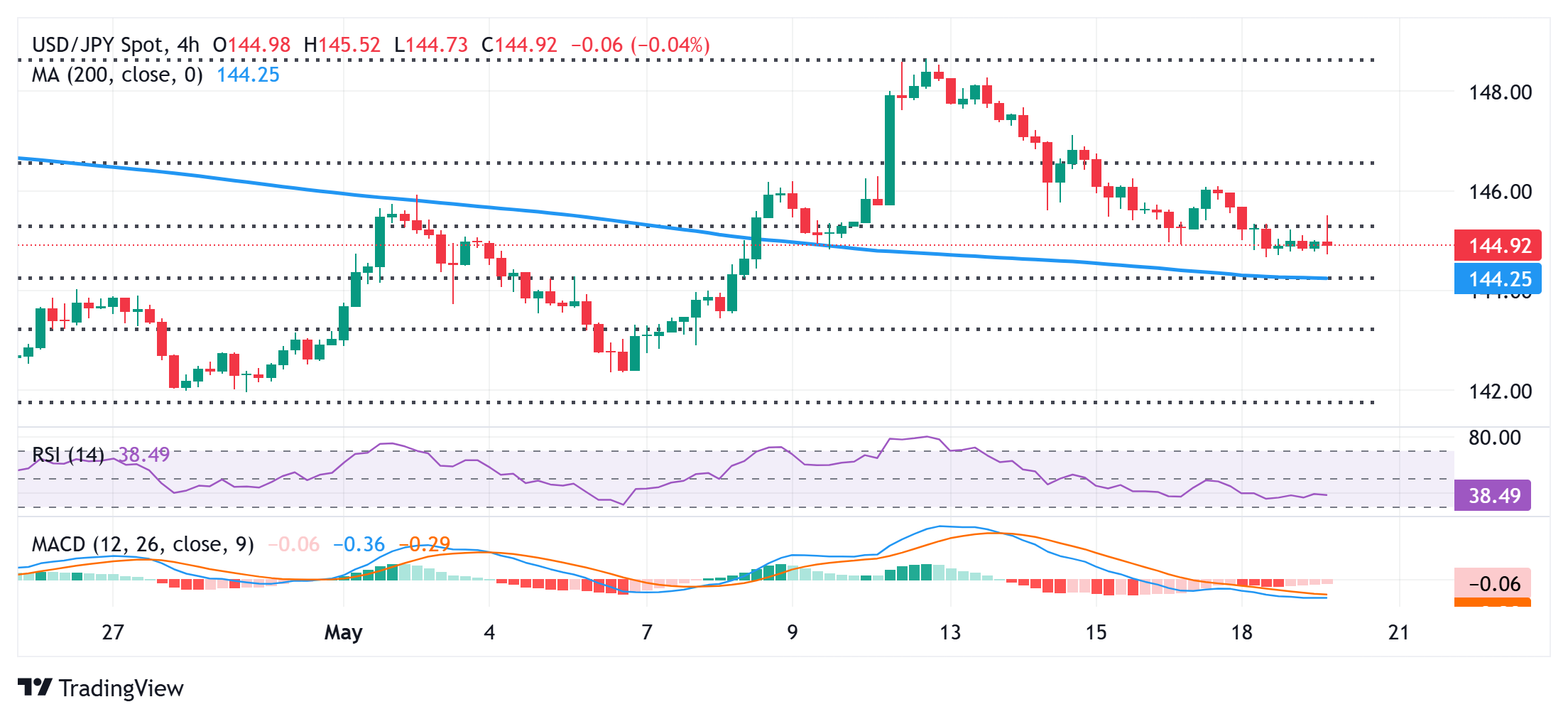
From a technical perspective, acceptance below the 38.2% Fibonacci (Fibo.) retracement level of the April-May upward move and negative oscillators on hourly charts favor the USD/JPY bears. Hence, any subsequent move up might still be seen as a selling opportunity and remain capped ahead of the 146.00 round figure. A sustained strength beyond the latter, however, might trigger a short-covering move and lift spot prices to the 146.60 area, or the 23.6% Fibo. level, en route to the 147.00 mark.
On the flip side, the 144.65 area, or over a one-week low touched on Monday, now seems to protect the immediate downside. This is closely followed by the 144.30-144.25 confluence, comprising the 200-period Simple Moving Average (SMA) on the 4-hour chart and the 50% retracement level. A convincing break below will be seen as a fresh trigger for bearish traders and drag the USD/JPY pair below the 144.00 mark, towards the next relevant support near the 143.75-143.70 region.
US Dollar PRICE Today
The table below shows the percentage change of US Dollar (USD) against listed major currencies today. US Dollar was the strongest against the Australian Dollar.
| USD | EUR | GBP | JPY | CAD | AUD | NZD | CHF | |
|---|---|---|---|---|---|---|---|---|
| USD | -0.11% | -0.07% | -0.27% | -0.04% | 0.63% | 0.19% | -0.17% | |
| EUR | 0.11% | 0.05% | -0.15% | 0.08% | 0.75% | 0.31% | -0.07% | |
| GBP | 0.07% | -0.05% | -0.21% | 0.02% | 0.67% | 0.28% | -0.08% | |
| JPY | 0.27% | 0.15% | 0.21% | 0.22% | 0.89% | 0.45% | 0.14% | |
| CAD | 0.04% | -0.08% | -0.02% | -0.22% | 0.68% | 0.24% | -0.10% | |
| AUD | -0.63% | -0.75% | -0.67% | -0.89% | -0.68% | -0.43% | -0.77% | |
| NZD | -0.19% | -0.31% | -0.28% | -0.45% | -0.24% | 0.43% | -0.34% | |
| CHF | 0.17% | 0.07% | 0.08% | -0.14% | 0.10% | 0.77% | 0.34% |
The heat map shows percentage changes of major currencies against each other. The base currency is picked from the left column, while the quote currency is picked from the top row. For example, if you pick the US Dollar from the left column and move along the horizontal line to the Japanese Yen, the percentage change displayed in the box will represent USD (base)/JPY (quote).
Author

Haresh Menghani
FXStreet
Haresh Menghani is a detail-oriented professional with 10+ years of extensive experience in analysing the global financial markets.

















