Japanese Yen extends the range play against USD; BoJ rate hike bets favor bulls
- The Japanese Yen struggles to capitalize on the overnight gains amid a modest USD recovery.
- A positive risk tone turns out to be another factor acting as a headwind for the safe-haven JPY.
- The divergent BoJ-Fed expectations warrant caution before placing bullish bets around USD/JPY.

The Japanese Yen (JPY) extends its sideways consolidative price move against the broadly rebounding US Dollar (USD) through the early European session on Thursday amid mixed cues. A generally positive tone around the equity markets is seen acting as a headwind for the safe-haven JPY. Any meaningful JPY depreciation, however, seems elusive amid rising bets for an imminent rate hike by the Bank of Japan (BoJ), bolstered by Governor Kazuo Ueda's remarks earlier this week.
Adding to this, a survey showed on Wednesday that private sector output in Japan recorded modest expansion for the eighth consecutive month in November, backing the case for further BoJ policy normalization. This marks a significant divergence in comparison to dovish US Federal Reserve (Fed) expectations, which might keep a lid on the attempted USD recovery and act as a headwind for the USD/JPY pair. Traders now look to US economic releases for short-term impetuses.
Japanese Yen bulls seem hesitant but not ready to give up amid hawkish BoJ expectations
- Bank of Japan Governor Kazuo Ueda gave the clearest hint so far of an impending rate hike and said on Monday that the central bank would consider the pros and cons of raising its policy rate at its December 18-19 meeting. Ueda added that real interest rates were deeply negative, and another hike would still leave borrowing costs low.
- Japan’s S&P Global Composite PMI was finalized at 52.0 for November, marking the strongest reading since August. It also signaled an eighth consecutive month of private-sector expansion amid a quicker rise in services and a slower contraction in manufacturing. Moreover, business confidence strengthened to its highest level since January.
- This, in turn, reaffirmed bets that the BoJ will raise its rate by a quarter percentage point, to 0.75% this month. Moreover, Prime Minister Sanae Takaichi's massive spending plan, to be funded by new debt issuance, pushed the yield on 30-year Japanese government bonds to a record high on Thursday and should benefit the Japanese Yen.
- The US Dollar, on the other hand, dropped to its lowest level since late October on Wednesday amid the growing acceptance that the Federal Reserve (Fed) will lower borrowing costs at the end of next week's policy meeting. The expectations were reaffirmed by weaker-than-expected US private-sector employment details released on Wednesday.
- The Automatic Data Processing (ADP) reported that private-sector employers shed 32,000 jobs in November, compared to the 47,000 increase (revised from 42,000) in the previous month. This figure came in below expectations for an addition of 5,000 and also marked the largest monthly decline since early 2023, pointing to a weakening US labor market.
- Traders now look forward to Thursday's US economic docket, featuring Challenger Job Cuts and the usual Weekly Initial Jobless Claims. The focus, however, will remain glued to the US Personal Consumption Expenditure (PCE) Price Index on Friday, which will drive the near-term USD demand and provide a fresh impetus to the USD/JPY pair.
USD/JPY bears need to wait for break below 155.00 before positioning for further losses
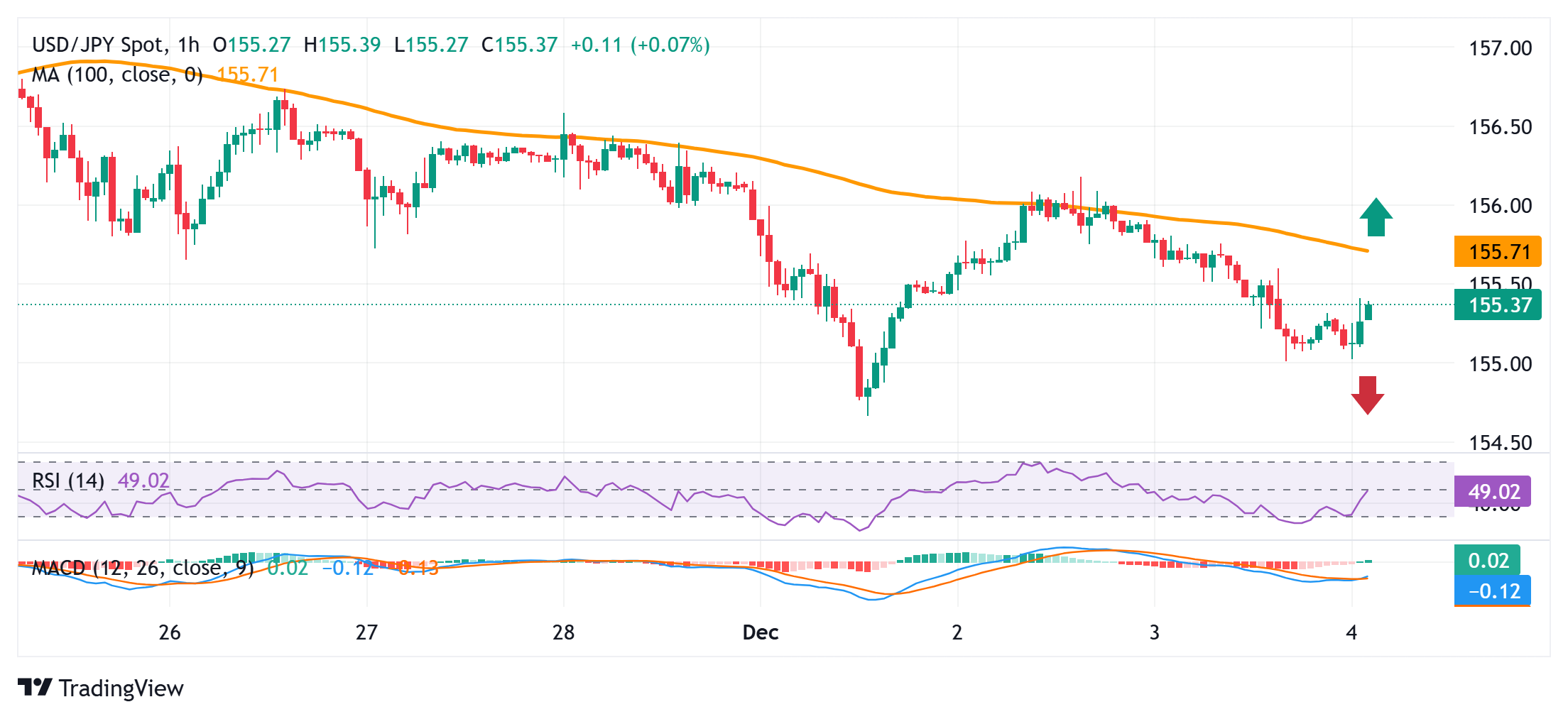
The overnight slide followed Tuesday's failure to find acceptance above the 100-hour Simple Moving Average (SMA) and the 156.00 round figure, which, in turn, favors the USD/JPY bears. However, slightly positive oscillators on the daily chart suggest that any further decline could find decent support near the 155.00 psychological mark. A convincing break below the latter will reaffirm the negative outlook and set the stage for an extension of the recent pullback from the 158.00 neighborhood, or the highest level since January touched last month.
On the flip side, the 100-hour SMA, currently pegged near the 155.70 region, could act as an immediate hurdle and cap any attempted recovery move. This is closely followed by the 156.00 mark, above which a fresh bout of short-covering could lift the USD/JPY pair to the next relevant hurdle near the 156.60-156.65 region en route to the 157.00 round figure. The momentum could extend further towards mid-157.00s before spot prices make a fresh attempt to conquer the 158.00 mark.
Fed FAQs
Monetary policy in the US is shaped by the Federal Reserve (Fed). The Fed has two mandates: to achieve price stability and foster full employment. Its primary tool to achieve these goals is by adjusting interest rates. When prices are rising too quickly and inflation is above the Fed’s 2% target, it raises interest rates, increasing borrowing costs throughout the economy. This results in a stronger US Dollar (USD) as it makes the US a more attractive place for international investors to park their money. When inflation falls below 2% or the Unemployment Rate is too high, the Fed may lower interest rates to encourage borrowing, which weighs on the Greenback.
The Federal Reserve (Fed) holds eight policy meetings a year, where the Federal Open Market Committee (FOMC) assesses economic conditions and makes monetary policy decisions. The FOMC is attended by twelve Fed officials – the seven members of the Board of Governors, the president of the Federal Reserve Bank of New York, and four of the remaining eleven regional Reserve Bank presidents, who serve one-year terms on a rotating basis.
In extreme situations, the Federal Reserve may resort to a policy named Quantitative Easing (QE). QE is the process by which the Fed substantially increases the flow of credit in a stuck financial system. It is a non-standard policy measure used during crises or when inflation is extremely low. It was the Fed’s weapon of choice during the Great Financial Crisis in 2008. It involves the Fed printing more Dollars and using them to buy high grade bonds from financial institutions. QE usually weakens the US Dollar.
Quantitative tightening (QT) is the reverse process of QE, whereby the Federal Reserve stops buying bonds from financial institutions and does not reinvest the principal from the bonds it holds maturing, to purchase new bonds. It is usually positive for the value of the US Dollar.
Author

Haresh Menghani
FXStreet
Haresh Menghani is a detail-oriented professional with 10+ years of extensive experience in analysing the global financial markets.

















