Japanese Yen remains on the back foot against USD; bears seem reluctant amid flight to safety
- The Japanese Yen attracts some intraday sellers, though the downside seems limited.
- Rising geopolitical tensions and trade uncertainties should benefit the safe-haven JPY.
- The divergent BoJ-Fed policy expectations could contribute to capping the USD/JPY.

The Japanese Yen (JPY) stalls its intraday retracement slide from over a one-week high against the rebounding US Dollar (USD) amid a combination of supporting factors. Despite reports that the Bank of Japan (BoJ) will keep the benchmark rate steady at 0.5% at its upcoming meeting next week, traders seem convinced that the central bank will stick to the path toward policy normalization amid the broadening inflation. This, along with a fresh wave of the global risk-aversion trade, acts as a tailwind for the safe-haven JPY.
Investors remain on edge amid the persistent uncertainty surrounding US President Donald Trump's trade policies. Adding to this, a sharp escalation of geopolitical tensions in the Middle East temper investors' appetite for riskier assets. Meanwhile, signs of cooling inflation in the US reaffirmed market bets that the Federal Reserve (Fed) will lower borrowing costs further in 2025. This might keep a lid on the USD recovery move and benefit the lower-yielding JPY, warranting caution before placing bullish bets around the USD/JPY pair.
Japanese Yen bulls not ready to give up as rising Middle East tensions underpin safe-haven assets
- Israel launched a pre-emptive attack against Iran. The Israeli Air Force conducted dozens of strikes across Iran, targeting nuclear and missile sites as well as military headquarters. Following the attack, Israeli Minister of Defense Israel Katz declared a special state of emergency in the country and warned that a missile and drone attack on Israel and its civilian population would occur soon.
- US Secretary of State Marco Rubio said in a statement that Israel took unilateral action and that the US is not involved in strikes against Iran. Meanwhile, Iran's Defence Minister Aziz Nasirzadeh had threatened to strike US bases in the region if conflict erupts over its nuclear program. This raises the risk of a broader regional conflict and should benefit the safe-haven Japanese Yen.
- On the trade-related front, US President Donald Trump said on Wednesday that he will set unilateral tariff rates and inform trading partners within two weeks. Moreover, Trump's expanded steel tariffs, currently at 50%, apply to a range of household appliances, including dishwashers, washing machines, refrigerators, and more, adding a layer of uncertainty to the markets.
- Bloomberg News, citing sources familiar with the matter, reported that the Bank of Japan is expected to hold its benchmark rate steady at 0.5% at its upcoming meeting next week. The source further added that officials are seeing slightly stronger inflation than they had anticipated earlier this year, which could pave the way for future interest rate hike discussions.
- In contrast, traders ramped up bets that the Federal Reserve would resume its rate-cutting cycle in September after data released on Thursday pointed to signs of cooling inflation and a potential weakening in the labor market. The US Bureau of Labour Statistics reported that the Producer Price Index remained muted in May and rose 0.1% from a month earlier, vs. a 0.2% decline in April.
- In the 12 months through May, the PPI advanced 2.6% after rising 2.5% in April. A separate report showed US Initial Weekly Jobless Claims held steady at 248K last week, while continuing claims jumped to 1.951 million, or the highest level since November 2021. This comes on top of a marginal rise in US consumer prices, backing the case for further monetary policy easing by the Fed.
- The dovish outlook drags the US Dollar to its lowest level since March 2022 during the Asian session on Friday and weighs heavily on the USD/JPY pair. Traders now look forward to the Preliminary release of the Michigan US Consumer Sentiment Index and Inflation Expectations. The focus, however, will remain on developments surrounding Trump's trade policies and the Middle East conflict.
USD/JPY needs to surpass the 144.00 immediate resistance to back the case for further recovery
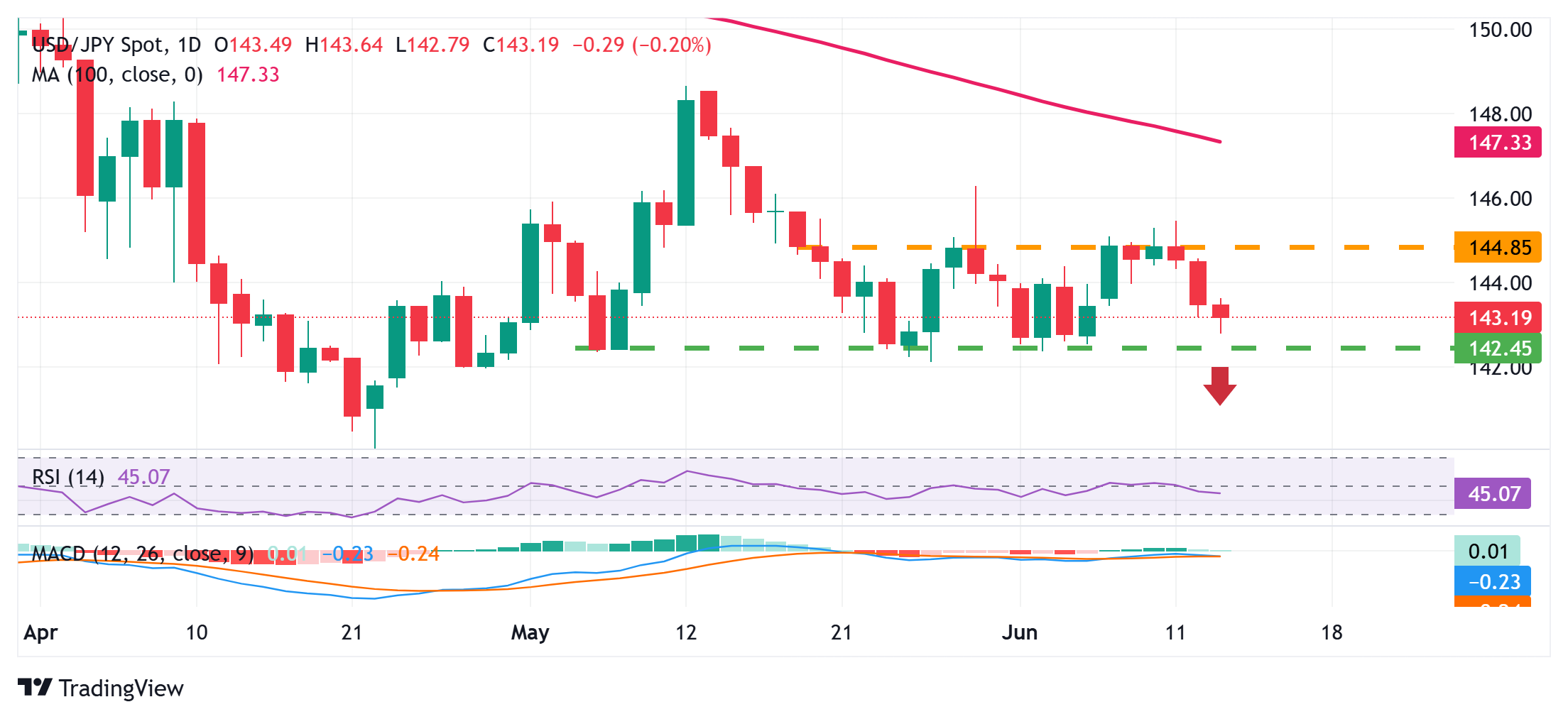
From a technical perspective, this week's failures to find acceptance above the 145.00 psychological mark and the subsequent fall favor the USD/JPY bears amid negative oscillators on hourly/daily charts. However, it will still be prudent to wait for some follow-through selling below the 142.65 and the 142.35 horizontal support before positioning for deeper losses. Spot prices might then weaken below the 142.00 round figure, towards the 141.65 intermediate support en route to the sub-141.00 levels.
On the flip side, recovery beyond the Asian session peak, around the 143.50-143.55 area, is likely to confront a stiff barrier near the 144.00 mark. A sustained strength beyond the latter might trigger a short-covering move and allow the USD/JPY pair to climb to the 144.50 area en route to the 145.00 round figure. The subsequent move-up could lift spot prices to the 145.45 zone, or a two-week high touched on Wednesday.
US Dollar PRICE Today
The table below shows the percentage change of US Dollar (USD) against listed major currencies today. US Dollar was the strongest against the New Zealand Dollar.
| USD | EUR | GBP | JPY | CAD | AUD | NZD | CHF | |
|---|---|---|---|---|---|---|---|---|
| USD | 0.49% | 0.60% | 0.10% | 0.27% | 0.95% | 1.00% | 0.09% | |
| EUR | -0.49% | 0.15% | -0.33% | -0.13% | 0.56% | 0.49% | -0.40% | |
| GBP | -0.60% | -0.15% | -0.54% | -0.38% | 0.32% | 0.32% | -0.53% | |
| JPY | -0.10% | 0.33% | 0.54% | 0.20% | 0.86% | 0.89% | -0.01% | |
| CAD | -0.27% | 0.13% | 0.38% | -0.20% | 0.66% | 0.74% | -0.15% | |
| AUD | -0.95% | -0.56% | -0.32% | -0.86% | -0.66% | 0.02% | -0.84% | |
| NZD | -1.00% | -0.49% | -0.32% | -0.89% | -0.74% | -0.02% | -0.86% | |
| CHF | -0.09% | 0.40% | 0.53% | 0.00% | 0.15% | 0.84% | 0.86% |
The heat map shows percentage changes of major currencies against each other. The base currency is picked from the left column, while the quote currency is picked from the top row. For example, if you pick the US Dollar from the left column and move along the horizontal line to the Japanese Yen, the percentage change displayed in the box will represent USD (base)/JPY (quote).
Author

Haresh Menghani
FXStreet
Haresh Menghani is a detail-oriented professional with 10+ years of extensive experience in analysing the global financial markets.