Japanese Yen recovers its losses, supported by a softer US Dollar
- The Japanese Yen recovers its daily losses on Tuesday.
- Japanese Finance Minister Shunichi Suzuki voiced worries regarding the adverse effects of the weak Japanese Yen.
- The US Dollar edges lower due to a decline in US Treasury yields.


The Japanese Yen (JPY) halted its three-day losing streak on Tuesday as investors' expectations emerged that the Bank of Japan (BoJ) may raise interest rates earlier than expected against the backdrop of the weak JPY. However, the interest rate differential between Japan and the United States (US) puts pressure on the JPY as investors seek higher returns offered by other assets. This could bolster the strength of the USD/JPY pair.
Japanese Finance Minister Shunichi Suzuki expressed concerns about the negative implications of the weak JPY. Suzuki also said that market discussions are centered on long-term rates as they increase, focusing on appropriate national debt policies in Japan. There are hopes for wage hikes to surpass the inflation pace. He stated that he is closely monitoring FX movements, per Reuters.
The US Dollar (USD) trades steadily, as there were no major economic data releases from the United States (US). The higher US Treasury yields have provided support to the Greenback. The US Federal Reserve (Fed) remains cautious about inflation and the possibility of rate cuts in 2024.
Daily Digest Market Movers: Japanese Yen depreciates due to the hawkish Fed
- A BoJ survey showed on Monday that approximately 70% of firms reported experiencing drawbacks from the BoJ's 25-year-long monetary easing measures, notably citing a weak JPY that increased import costs. However, around 90% of the firms also acknowledged benefits stemming from the BoJ's prolonged easing, including low borrowing costs. Among Japan's large manufacturers, exchange rate stability emerged as the primary factor they desired from the central bank's monetary policy.
- The yield on the 2-year Japanese government bond stands at 0.34%, according to FactSet. This means policy rates are predicted to reach 0.25% in the second half of the year and 0.5% next year.
- On Monday, Loretta Mester, President of the Federal Reserve Bank of Cleveland, told Bloomberg that she no longer believes three rate cuts in 2024 are appropriate. Mester highlighted that inflation risks are skewed to the upside and emphasized that there is no harm in spending additional time gathering data on inflation, given the strength of the economy.
- According to the CME FedWatch Tool, the probability of the Federal Reserve implementing a 25 basis-point rate cut in September has seen a slight uptick to 49.6%, compared to 48.6% a week ago.
- Market sentiment emerges that the BoJ might reduce bond purchases at the June policy meeting. BOJ Governor Kazuo Ueda also indicated that there are no immediate plans to sell the central bank’s ETF holdings.
Technical Analysis: USD/JPY rises to around a major level of 156.50
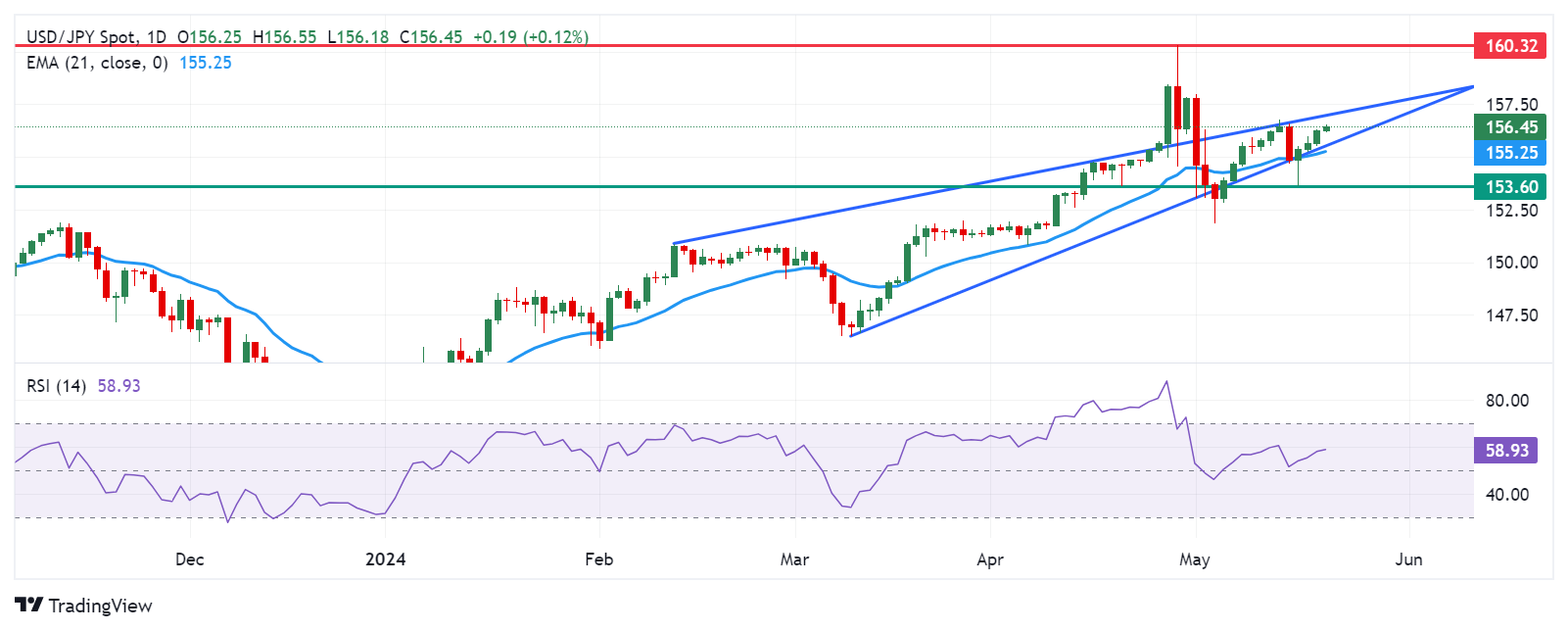
The Japanese Yen traded around 156.50 against its counterpart US Dollar on Tuesday. The daily chart for USD/JPY showed an ascending triangle formation. Additionally, the 14-day Relative Strength Index (RSI) indicated a bullish sentiment, holding slightly above the 50 mark.
The USD/JPY pair could retest the upper boundary of the ascending triangle around the psychological barrier at 157.00. A break above this level could support the pair to approach the high of 160.32, a level never seen since April 1990.
On the downside, the lower threshold of the ascending triangle appears as the immediate support, around the major level of 155.50, followed by the 21-day Exponential Moving Average (EMA) at 155.25. A break below this level could exert downward pressure on the USD/JPY pair to move toward the throwback support at 153.60.
USD/JPY: Daily Chart
Japanese Yen price today
The table below shows the percentage change of the Japanese Yen (JPY) against listed major currencies today. Japanese Yen was the strongest against the New Zealand Dollar.
| USD | EUR | GBP | CAD | AUD | JPY | NZD | CHF | |
| USD | -0.09% | -0.04% | 0.05% | 0.03% | -0.12% | 0.06% | -0.05% | |
| EUR | 0.09% | 0.04% | 0.13% | 0.10% | -0.05% | 0.15% | 0.03% | |
| GBP | 0.04% | -0.04% | 0.09% | 0.06% | -0.09% | 0.10% | -0.01% | |
| CAD | -0.05% | -0.13% | -0.11% | -0.01% | -0.18% | 0.01% | -0.09% | |
| AUD | -0.03% | -0.12% | -0.09% | 0.00% | -0.17% | 0.01% | -0.10% | |
| JPY | 0.09% | 0.06% | 0.10% | 0.19% | 0.17% | 0.20% | 0.09% | |
| NZD | -0.06% | -0.15% | -0.10% | -0.01% | -0.04% | -0.19% | -0.10% | |
| CHF | 0.05% | -0.04% | 0.01% | 0.10% | 0.07% | -0.08% | 0.11% |
The heat map shows percentage changes of major currencies against each other. The base currency is picked from the left column, while the quote currency is picked from the top row. For example, if you pick the Euro from the left column and move along the horizontal line to the Japanese Yen, the percentage change displayed in the box will represent EUR (base)/JPY (quote).
Japanese Yen FAQs
The Japanese Yen (JPY) is one of the world’s most traded currencies. Its value is broadly determined by the performance of the Japanese economy, but more specifically by the Bank of Japan’s policy, the differential between Japanese and US bond yields, or risk sentiment among traders, among other factors.
One of the Bank of Japan’s mandates is currency control, so its moves are key for the Yen. The BoJ has directly intervened in currency markets sometimes, generally to lower the value of the Yen, although it refrains from doing it often due to political concerns of its main trading partners. The current BoJ ultra-loose monetary policy, based on massive stimulus to the economy, has caused the Yen to depreciate against its main currency peers. This process has exacerbated more recently due to an increasing policy divergence between the Bank of Japan and other main central banks, which have opted to increase interest rates sharply to fight decades-high levels of inflation.
The BoJ’s stance of sticking to ultra-loose monetary policy has led to a widening policy divergence with other central banks, particularly with the US Federal Reserve. This supports a widening of the differential between the 10-year US and Japanese bonds, which favors the US Dollar against the Japanese Yen.
The Japanese Yen is often seen as a safe-haven investment. This means that in times of market stress, investors are more likely to put their money in the Japanese currency due to its supposed reliability and stability. Turbulent times are likely to strengthen the Yen’s value against other currencies seen as more risky to invest in.
Author
Akhtar Faruqui
FXStreet
Akhtar Faruqui is a Forex Analyst based in New Delhi, India. With a keen eye for market trends and a passion for dissecting complex financial dynamics, he is dedicated to delivering accurate and insightful Forex news and analysis.