Japanese Yen bears seem hesitant amid rising BoJ rate hike bets
- The Japanese Yen struggles to capitalize on its modest intraday gains against a rebounding USD.
- Japan’s fiscal and growth concerns turn out to be a key factor undermining demand for the JPY.
- The divergent BoJ-Fed policy outlooks limit losses for the JPY and cap the upside for USD/JPY.

The Japanese Yen (JPY) stalls its intraday pullback against the rebounding US Dollar (USD) and trades with a mild positive bias during the first half of the European session on Thursday. This marks the second straight day of the uptick and is sponsored by the growing acceptance of an imminent interest rate hike by the Bank of Japan (BoJ). This marks a significant divergence compared to dovish US Federal Reserve (Fed) expectations, which caps the attempted USD recovery and acts as a headwind for the USD/JPY pair.
Meanwhile, expanded fiscal spending under Prime Minister Sanae Takaichi’s administration has exacerbated concerns about Japan's public finances. Moreover, investors opt to wait for more cues about the BoJ's policy tightening path. This, in turn, might hold back the JPY bulls from placing aggressive bets as the focus remains glued to the outcome of a two-day BoJ monetary policy meeting, due next Friday.
Japanese Yen bulls have the upper hand vs USD amid divergent BoJ-Fed policy outlooks
- Bank of Japan Governor Kazuo Ueda reiterated earlier this week that the likelihood of the central bank's baseline economic and price outlook materialising had been gradually increasing.
- Moreover, Wednesday's release of the Corporate Goods Price Index indicated that inflation in Japan remains above the historic levels and backs the case for a further BoJ policy normalization.
- The market is now actively pricing in the possibility of a BoJ rate hike as early as next week, which marks a big divergence in comparison to the US Federal Reserve's dovish interest rate cut.
- The US central bank, in a widely expected move, lowered interest rates at the end of a two-day meeting on Wednesday and projected one more quarter-percentage-point rate cut in 2026.
- Meanwhile, Fed Chair Jerome Powell told reporters that the US labor market has significant downside risks and that the central bank does not want its policy to push down on job creation.
- Traders were quick to react and are now pricing in two more rate cuts by the Fed in 2026. This keeps the US Dollar depressed and continues to underpin the lower-yielding Japanese Yen.
- Investors remain worried about Japan's deteriorating fiscal condition amid Prime Minister Sanae Takaichi's reflationary push and massive spending plan to boost sluggish economic growth.
- In fact, the revised Gross Domestic Product report showed that Japan's economy shrank 0.6% in the July-September period and by 2.3% on a yearly basis, or its fastest pace since Q3 2023.
- This, however, was offset by expectations that higher wages will increase household purchasing power and boost spending, which should fuel demand-driven inflation and bolster the economy.
- Traders now look to the release of the usual US Weekly Initial Jobless Claims, which, along with the US Trade Balance data, could provide some impetus to the USD and the USD/JPY pair.
USD/JPY struggles to capitalize on intraday move up beyond 156.00
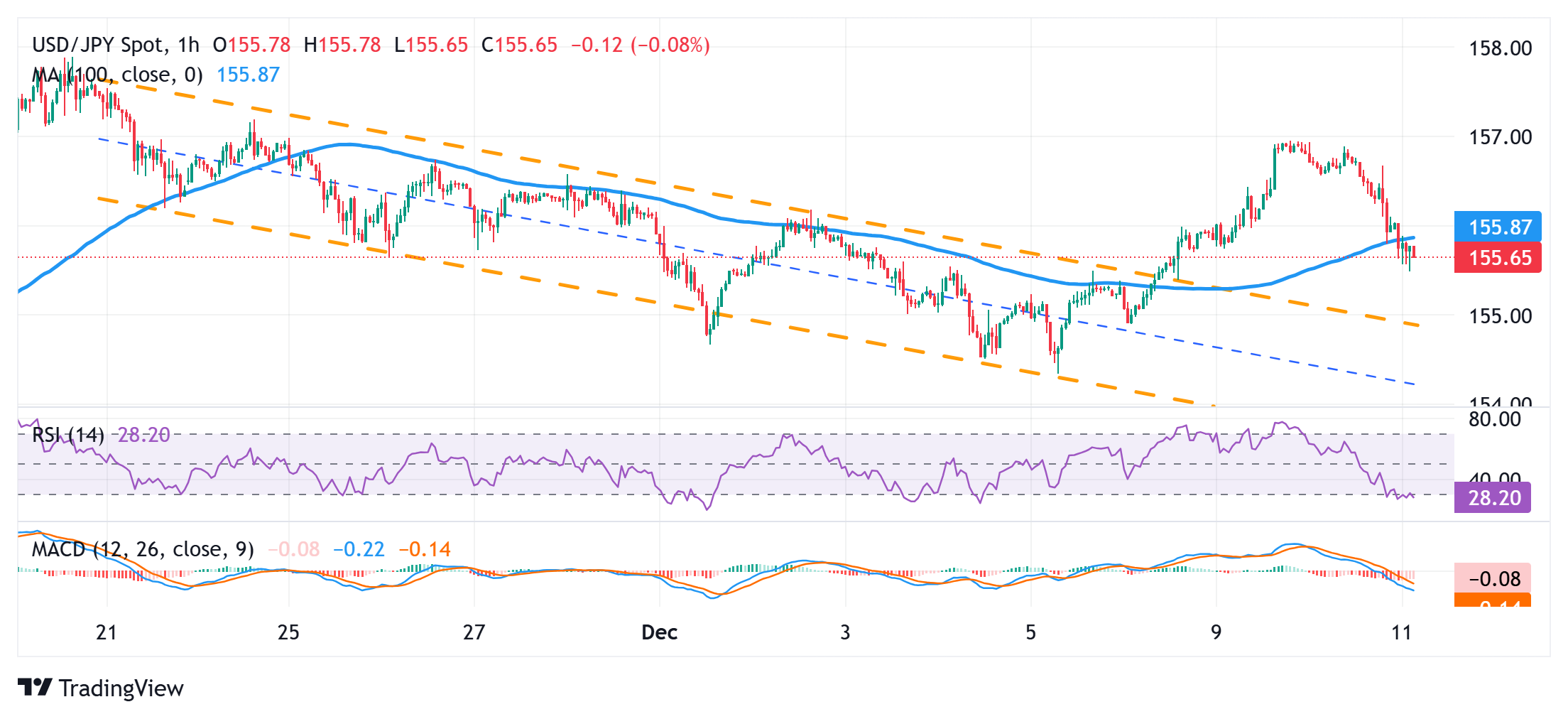
An intraday breakdown below the 156.00 mark and the 100-hour Simple Moving Average (SMA) backs the case for further losses amid negative oscillators on hourly charts. That said, technical indicators on the daily chart are holding in positive territory and suggest that any further decline is more likely to attract some buyers near the 155.35-155.30 hurdle breakpoint. The latter represented the top boundary of a short-term trading range and should act as a key pivotal point. Some follow-through selling, leading to a subsequent fall below the 155.00 psychological mark, might shift the near-term bias in favor of the USD/JPY bears.
On the flip side, a sustained strength back above the 156.00 mark could lift spot prices to the 156.60-156.65 region en route to the 157.00 neighborhood, or a two-week high touched on Tuesday. Some follow-through buying should pave the way for additional gains. The USD/JPY pair might then surpass the 157.45 intermediate hurdle and aim towards challenging a multi-month peak, around the 158.00 neighborhood, touched in November.
US Dollar Price Today
The table below shows the percentage change of US Dollar (USD) against listed major currencies today. US Dollar was the strongest against the Australian Dollar.
| USD | EUR | GBP | JPY | CAD | AUD | NZD | CHF | |
|---|---|---|---|---|---|---|---|---|
| USD | 0.06% | 0.14% | 0.09% | 0.14% | 0.67% | 0.37% | -0.04% | |
| EUR | -0.06% | 0.08% | 0.04% | 0.08% | 0.61% | 0.31% | -0.10% | |
| GBP | -0.14% | -0.08% | -0.04% | 0.00% | 0.53% | 0.23% | -0.18% | |
| JPY | -0.09% | -0.04% | 0.04% | 0.05% | 0.58% | 0.26% | -0.12% | |
| CAD | -0.14% | -0.08% | -0.00% | -0.05% | 0.53% | 0.22% | -0.18% | |
| AUD | -0.67% | -0.61% | -0.53% | -0.58% | -0.53% | -0.30% | -0.72% | |
| NZD | -0.37% | -0.31% | -0.23% | -0.26% | -0.22% | 0.30% | -0.41% | |
| CHF | 0.04% | 0.10% | 0.18% | 0.12% | 0.18% | 0.72% | 0.41% |
The heat map shows percentage changes of major currencies against each other. The base currency is picked from the left column, while the quote currency is picked from the top row. For example, if you pick the US Dollar from the left column and move along the horizontal line to the Japanese Yen, the percentage change displayed in the box will represent USD (base)/JPY (quote).
Author

Haresh Menghani
FXStreet
Haresh Menghani is a detail-oriented professional with 10+ years of extensive experience in analysing the global financial markets.

















