Japanese Yen remains stronger due to hawkish mood surrounding the BoJ, US data eyed
- The Japanese Yen advances due to rising odds of a further rate hike by the BoJ.
- Due to political uncertainty, the Yen may face challenges; Prime Minister Fumio Kishida will not seek re-election in September.
- The US Dollar faces pressure from declining US Treasury yields and increasing bets on a Fed rate cut.

The Japanese Yen (JPY) bounced back against the US Dollar (USD) on Friday, potentially due to the recent growth in Japan’s second-quarter GDP, which lends support to the possibility of a near-term interest rate hike by the Bank of Japan (BoJ).
However, the JPY might encounter challenges due to political uncertainty in Japan, sparked by reports that Prime Minister Fumio Kishida will not seek re-election as party leader in September, effectively concluding his term as prime minister.
The USD/JPY pair edges lower as the US Dollar loses ground amid lower Treasury yields. Additionally, traders fully price in a 25 basis point rate reduction by the US Federal Reserve for September, according to the CME FedWatch tool.
However, the Greenback received support as recent better-than-expected US economic data eased market concerns about a recession in the United States (US). Furthermore, the preliminary US Michigan Consumer Sentiment Index for August and Building Permits for July will be eyed later in the North American session.
Daily Digest Market Movers: Japanese Yen advances due to a hawkish mood surrounding the BoJ
- On Thursday, the US Census Bureau reported that US Retail Sales climbed 1.0% month-over-month in July, a sharp turnaround from June's 0.2% decline, surpassing the projected 0.3% increase. Moreover, Initial Jobless Claims for the week ending August 9 reached 227,000, lower than the forecast of 235,000 and down from 234,000 the previous week.
- On Thursday, Japanese Economy Minister Yoshitaka Shindo stated that the economy is anticipated to recover gradually as wages and income improve. Shindo also added that the government will collaborate closely with the Bank of Japan to implement flexible macroeconomic policies.
- Japan's Gross Domestic Product (GDP) grew by 0.8% quarter-on-quarter in Q2, surpassing market forecasts of 0.5% and rebounding from a 0.6% decline in Q1. This marked the strongest quarterly growth since Q1 of 2023. Meanwhile, the annualized GDP growth reached 3.1%, exceeding the market consensus of 2.1% and reversing a 2.3% contraction in Q1. This was the strongest yearly expansion since Q2 of 2023.
- Federal Reserve Bank of Chicago President Austan Goolsbee expressed growing concern on Wednesday about the labor market rather than inflation, noting recent improvements in price pressures alongside weak jobs data. Goolsbee added that the extent of rate cuts will be determined by the prevailing economic conditions, per Bloomberg.
- US headline Consumer Price Index (CPI) rose 2.9% year-over-year in July, slightly down from the 3% increase in June and below market expectations. The Core CPI, which excludes food and energy, climbed 3.2% year-over-year, a slight decrease from the 3.3% rise in June but aligned with market forecasts.
- Japanese Prime Minister Fumio Kishida announced at a press conference on Wednesday that he will not seek re-election as the leader of the Liberal Democratic Party (LDP) in September. Kishida emphasized the need to combat Japan's deflation-prone economy by promoting wage and investment growth and achieving the goal of expanding Japan's GDP to ¥600 trillion.
- Rabobank's senior FX strategist, Jane Foley, observes that this week's series of US data releases, along with next week's Jackson Hole event, should provide the market with clearer insights into the potential responses of US policymakers. However, their main expectation is that the Fed will reduce rates by 25 basis points in September and likely cut them again before the end of the year.
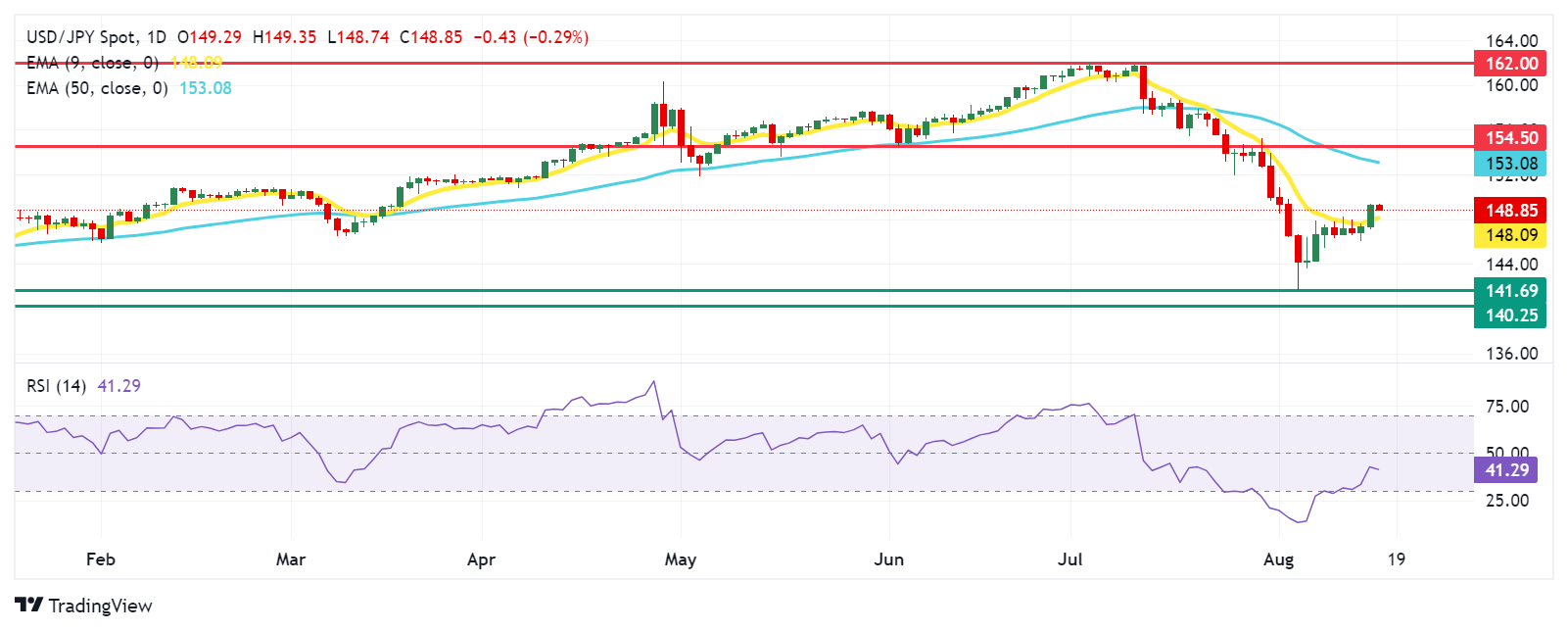
Technical Analysis: USD/JPY falls toward 148.50; next support at nine-day EMA
USD/JPY trades around 148.80 on Friday. According to the daily chart analysis, the pair is above the nine-day Exponential Moving Average (EMA), signaling a short-term bullish trend. Still, the 14-day Relative Strength Index (RSI) remains below 50, and an additional rise would confirm the bullish momentum.
In terms of support levels, the USD/JPY pair may encounter immediate support at the nine-day EMA, around 148.09. If the pair falls below this level, it could strengthen the bearish outlook and push the pair toward the seven-month low of 141.69 recorded on August 5. A continued decline could bring the pair closer to the next support level at 140.25.
On the upside, the USD/JPY pair could aim for the 50-day EMA at 153.08, with the possibility of testing the resistance level at 154.50, which has transitioned from previous throwback support to current pullback resistance.
USD/JPY: Daily Chart
Japanese Yen PRICE Today
The table below shows the percentage change of Japanese Yen (JPY) against listed major currencies today. Japanese Yen was the strongest against the US Dollar.
| USD | EUR | GBP | JPY | CAD | AUD | NZD | CHF | |
|---|---|---|---|---|---|---|---|---|
| USD | -0.11% | -0.23% | -0.24% | -0.09% | -0.30% | -0.46% | -0.14% | |
| EUR | 0.11% | -0.12% | -0.11% | 0.00% | -0.22% | -0.48% | 0.00% | |
| GBP | 0.23% | 0.12% | 0.00% | 0.14% | -0.10% | -0.34% | 0.08% | |
| JPY | 0.24% | 0.11% | 0.00% | 0.20% | -0.07% | -0.34% | 0.07% | |
| CAD | 0.09% | -0.01% | -0.14% | -0.20% | -0.24% | -0.51% | -0.10% | |
| AUD | 0.30% | 0.22% | 0.10% | 0.07% | 0.24% | -0.26% | 0.17% | |
| NZD | 0.46% | 0.48% | 0.34% | 0.34% | 0.51% | 0.26% | 0.44% | |
| CHF | 0.14% | 0.00% | -0.08% | -0.07% | 0.10% | -0.17% | -0.44% |
The heat map shows percentage changes of major currencies against each other. The base currency is picked from the left column, while the quote currency is picked from the top row. For example, if you pick the Japanese Yen from the left column and move along the horizontal line to the US Dollar, the percentage change displayed in the box will represent JPY (base)/USD (quote).
Bank of Japan FAQs
The Bank of Japan (BoJ) is the Japanese central bank, which sets monetary policy in the country. Its mandate is to issue banknotes and carry out currency and monetary control to ensure price stability, which means an inflation target of around 2%.
The Bank of Japan has embarked in an ultra-loose monetary policy since 2013 in order to stimulate the economy and fuel inflation amid a low-inflationary environment. The bank’s policy is based on Quantitative and Qualitative Easing (QQE), or printing notes to buy assets such as government or corporate bonds to provide liquidity. In 2016, the bank doubled down on its strategy and further loosened policy by first introducing negative interest rates and then directly controlling the yield of its 10-year government bonds.
The Bank’s massive stimulus has caused the Yen to depreciate against its main currency peers. This process has exacerbated more recently due to an increasing policy divergence between the Bank of Japan and other main central banks, which have opted to increase interest rates sharply to fight decades-high levels of inflation. The BoJ’s policy of holding down rates has led to a widening differential with other currencies, dragging down the value of the Yen.
A weaker Yen and the spike in global energy prices have led to an increase in Japanese inflation, which has exceeded the BoJ’s 2% target. With wage inflation becoming a cause of concern, the BoJ looks to move away from ultra loose policy, while trying to avoid slowing the activity too much.
Author

Akhtar Faruqui
FXStreet
Akhtar Faruqui is a Forex Analyst based in New Delhi, India. With a keen eye for market trends and a passion for dissecting complex financial dynamics, he is dedicated to delivering accurate and insightful Forex news and analysis.

















