Japanese Yen bulls retain control on hawkish BoJ expectations
- The Japanese Yen strengthens as BoJ’s Tankan Survey reaffirms rate hike bets.
- The risk-on mood and stalled US-Japan trade talks act as a headwind for the JPY.
- Divergent BoJ-Fed policy expectations should cap attempted USD/JPY recovery.


The Japanese Yen (JPY) remains on the front foot heading into the European session and trades near a three-week low touched against its American counterpart earlier this Tuesday. The Bank of Japan's (BoJ) Tankan Survey showed that business confidence at large manufacturers in Japan improved for the first time in two quarters during the April-June period. Moreover, firms expect consumer prices to remain above the central bank's 2% annual target over the next five years. This backs the case for further interest rate hikes by the BoJ and turns out to be a key factor underpinning the JPY.
The JPY bulls, meanwhile, seem unaffected by US President Donald Trump's hints at more tariffs on Japan, which according to Japan’s top trade negotiator Ryosei Akazawa would cause significant damage to the economy. Even the upbeat market mood does little to dent the bullish sentiment surrounding the safe-haven JPY. The USD, on the other hand, hangs near a multi-year low amid bets that the Federal Reserve (Fed) would resume its rate-cutting cycle in the near future. This further benefits the lower-yielding JPY and keeps the USD/JPY pair depressed around the mid-143.00s.
Japanese Yen seems poised to appreciate further as BoJ rate hike bets offset trade jitters
- The Bank of Japan's Tankan Survey showed this Tuesday that business confidence at large manufacturers in Japan rose to 13.0 in the second quarter from 12.0 in Q1, above the market consensus of 10.0. Moreover, the large Manufacturing Outlook for the second quarter arrived at 12.0 versus 12.0 prior, stronger than the 9.0 expected.
- Further details revealed that firms expect consumer prices to rise by 2.4% over the next three years and by 2.3% annually over the next five years. This highlights mounting inflationary pressure in Japan, which may require the BoJ to raise interest rates further and provide a goodish lift to the Japanese Yen during the Asian session.
- Japan’s top negotiator, Ryosei Akazawa, returned after his seventh round of talks in Washington without a major breakthrough. However, Akazawa said he remains committed to reaching an agreement while safeguarding Japan’s economic interests. US President Trump expressed frustration with stalled US-Japan trade negotiations.
- Meanwhile, Trump said that he may move ahead with the 25% tariff on Japanese autos and also lashed out against Japan over its alleged unwillingness to buy American-grown rice. Furthermore, Trump hinted at potentially ending trade talks with Tokyo and threatened to raise tariffs on certain countries by his July 9 deadline.
- The US Dollar registered a hefty 2.6% monthly fall in June, and the selling bias remains unabated on the back of dovish Federal Reserve expectations. The markets are now pricing in a smaller chance that the next rate reduction by the Fed will come in July and see a roughly 74% probability of a rate cut as soon as September.
- Meanwhile, the Senate on Saturday narrowly approved a procedural vote to open debate on Trump’s comprehensive “One Big Beautiful Bill,” which would add approximately $3.3 trillion to the federal deficit over the next decade. This contributes to the bearish sentiment in the USD and further exerts pressure on the USD/JPY pair.
- Traders now look forward to important US macro releases scheduled at the beginning of a new month, starting with the US ISM Manufacturing PMI and Job Openings and Labor Turnover Survey (JOLTS) due later today. The focus, however, will be on the closely-watched US Nonfarm Payrolls (NFP) report on Thursday.
USD/JPY could extend the further below the 143.00 mark amid a bearish technical setup
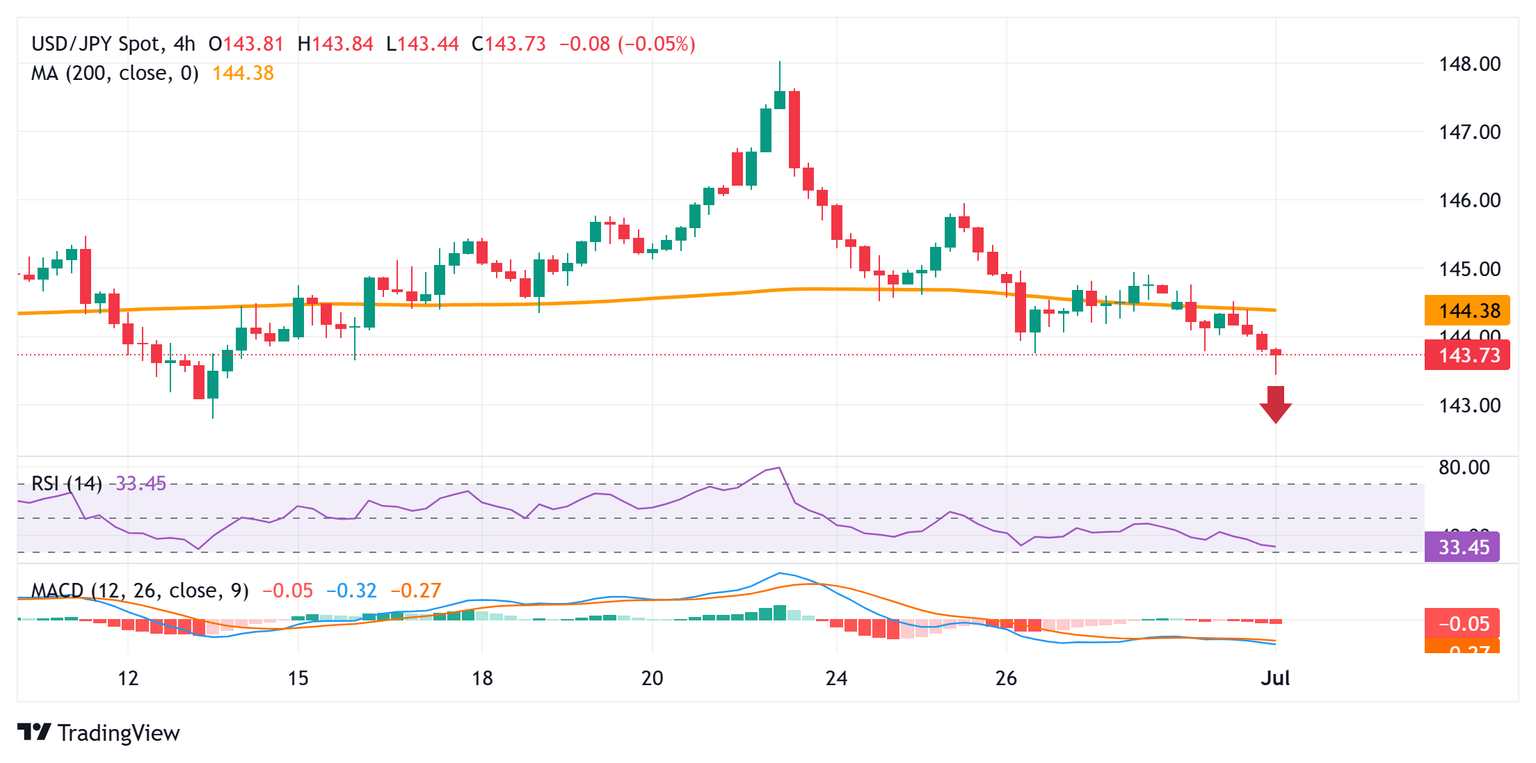
From a technical perspective, an intraday slide below last week's swing low, around the 143.75 region, could be seen as a key trigger for the USD/JPY bears against the backdrop of the recent breakdown through the 200-period Simple Moving Average (SMA) on the 4-hour chart. Moreover, oscillators on 4-hour and daily charts have been gaining negative traction, suggesting that the path of least resistance for spot prices is to the downside. Hence, a subsequent slide towards the 143.00 mark, en route to the next relevant support near the 142.75-142.70 region, looks like a distinct possibility.
On the flip side, the 144.00 round figure now seems to cap any attempted recovery. Any further move up could be seen as a selling opportunity and cap the USD/JPY pair near the 200-period SMA on the 4-hour chart, currently pegged near the 144.40 region. A sustained strength beyond the latter, however, might trigger a short-covering rally and allow spot prices to reclaim the 145.00 psychological mark.
US Dollar PRICE Last 7 days
The table below shows the percentage change of US Dollar (USD) against listed major currencies last 7 days. US Dollar was the strongest against the Canadian Dollar.
| USD | EUR | GBP | JPY | CAD | AUD | NZD | CHF | |
|---|---|---|---|---|---|---|---|---|
| USD | -1.76% | -1.61% | -1.70% | -0.93% | -1.81% | -2.01% | -2.43% | |
| EUR | 1.76% | 0.12% | 0.03% | 0.83% | -0.05% | -0.69% | -0.67% | |
| GBP | 1.61% | -0.12% | -0.08% | 0.72% | -0.16% | -0.81% | -0.93% | |
| JPY | 1.70% | -0.03% | 0.08% | 0.79% | -0.14% | -0.35% | -0.86% | |
| CAD | 0.93% | -0.83% | -0.72% | -0.79% | -0.89% | -1.52% | -1.64% | |
| AUD | 1.81% | 0.05% | 0.16% | 0.14% | 0.89% | -0.65% | -0.76% | |
| NZD | 2.01% | 0.69% | 0.81% | 0.35% | 1.52% | 0.65% | -0.12% | |
| CHF | 2.43% | 0.67% | 0.93% | 0.86% | 1.64% | 0.76% | 0.12% |
The heat map shows percentage changes of major currencies against each other. The base currency is picked from the left column, while the quote currency is picked from the top row. For example, if you pick the US Dollar from the left column and move along the horizontal line to the Japanese Yen, the percentage change displayed in the box will represent USD (base)/JPY (quote).
(This story was corrected on July 01 at 06:51 GMT to say in the US Nonfarm Payrolls (NFP) report is scheduled on Thursday, not Friday)
Author
Haresh Menghani
FXStreet
Haresh Menghani is a detail-oriented professional with 10+ years of extensive experience in analysing the global financial markets.