Is it silly season for stock markets?

The meme stock craze is back, GameStop is higher by 75% at the start of the week, with AMC Entertainment also up nearly 30%. The driver of today’s move in GameStop was a Reddit post by Keith Gill, pertaining to showing a large position in GameStop call options. Those who play the meme stock game have pounced, as all it takes is a screen shot from the poster boy of Meme trading Gill, to cause a market frenzy. The stock is currently trading at $39.80 in the pre-market, on Friday it closed at $23.14. The stock is higher by 109% in the past month and is up by 34% YTD. However, don’t let those numbers trick you into thinking this stock has a sustained trend higher, back in mid-May it surged to $55, before falling back to the $20 mark. It is hard to predict where GameStop and other meme favorites will go next, as it depends on what happens on a few social media accounts. All we can say at this stage is that compared to the meme stock craze in 2021-2022, the latest phase of this craze for GameStop is at a lower price level, and has, so far, been less volatile, although that may not last.
Risk sentiment boosted by tech
Elsewhere, at the more sensible end of the market, big tech is leading stock markets in Europe and the US higher on Monday. There is a positive tone to the start of the month, after a weakening in risk appetite in May. Risk sentiment has been boosted by news that Nvidia will release another chip and continue to boost their AI offerings every year. This has sent the stock higher by 3% on Monday. Nvidia’s supply chain has also been given a boost, ASML is higher by more than 2% and TSMC is also up by 2%. The news about Nvidia’s new chip, the Rubin, alongside updates about how the company is planning to move into CPUs and AI PCs, could help to alleviate concerns about cyclicality in the AI space, which may have weighed on Nvidia’s earnings and share price at some stage. Nvidia’s innovation pipeline should keep fears about cyclicality at bay for now, although the question is whether the broader economy can afford to keep expanding into AI as Nvidia assumes it will. Nvidia has solidified its place at the centre of the AI universe, and this is benefiting stock markets around the world at the start of the new week.
GSK weighs on FTSE 100
The UK’s FTSE 100 is the weakest performer in Europe on Monday. The index has been dragged down by GSK, the healthcare giant, which is down more than 8% after one of its drugs for heartburn was reported to cause cancer. The healthcare sector is the weakest in the UK on Monday, although it is worth noting that all other sectors are higher, as an IPO buzz rips through the UK market.
Why manufacturing survey data may not spell economic gloom
The Eurostoxx index is being led higher by its IT sector, interestingly, the industrial sector is also higher by more than 0.8%, although France and Italy posted weaker than expected Manufacturing sector PMIs for May. Overall, the Eurozone manufacturing sector PMI was marginally lower than forecast for May at 47.3, down from 47.4, but still in contraction territory. The US ISM reading is also worth watching later today. The market is expecting the manufacturing ISM to remain below the crucial 50 level at 49.5, and for the prices component to drop to 59 in May from 60.9 in April. Interestingly, although the survey data has been weak for the manufacturing sector in recent months, the hard data for this sector has outperformed, suggesting that the manufacturing ISM may not be a reliable recessionary indicator. This may explain why the ISM, which used to have a strong relationship with the S&P 500, has diverged in the past year, as you can see below.
ISM manufacturing and S&P 500
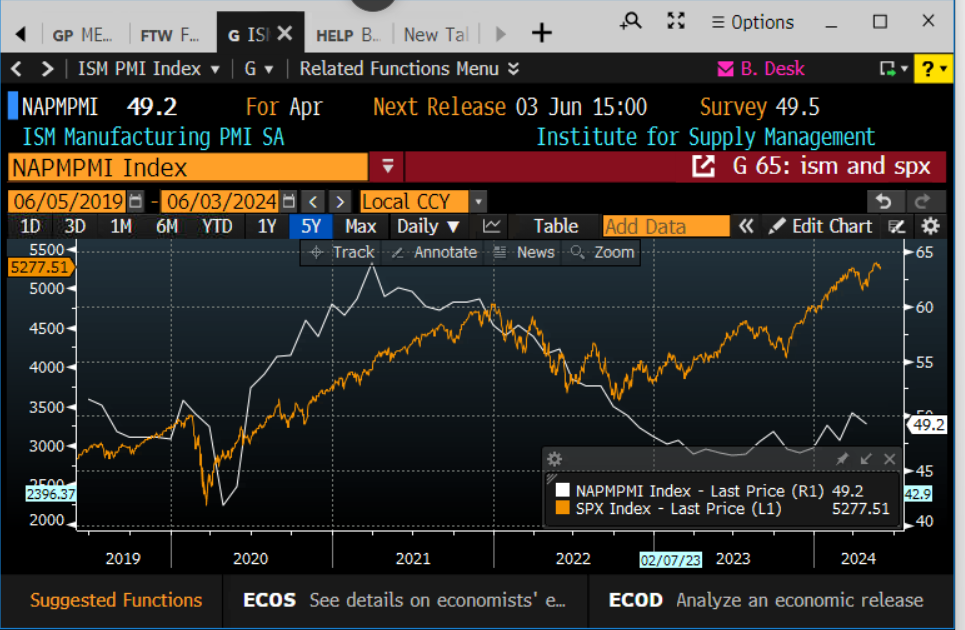
Source: XTB and Bloomberg
Is the momentum trade making a comeback?
The key factors that have driven stock markets to record highs so far this year, faded away in May. For example, momentum has been a big driver of the S&P 500 this year and can be attributed to 12% of the market upside performance so far this year. However, that fell to negative in the last week of May, at -1%, and the decline was even more pronounced for the tech sector, falling to -2.35%. At the start of June, we are seeing momentum as a factor that is driving the S&P 500 rise once again, and if this continues then we may see further upside for stocks as we progress through the month. Factor analysis is only one way to view markets, but it can give you an idea of why markets can shift direction, and it is something that we will keep an eye on in the coming days.
Author

Kathleen Brooks
XTB UK
Kathleen has nearly 15 years’ experience working with some of the leading retail trading and investment companies in the City of London.