How long will it take Rivian to get back to its IPO price?
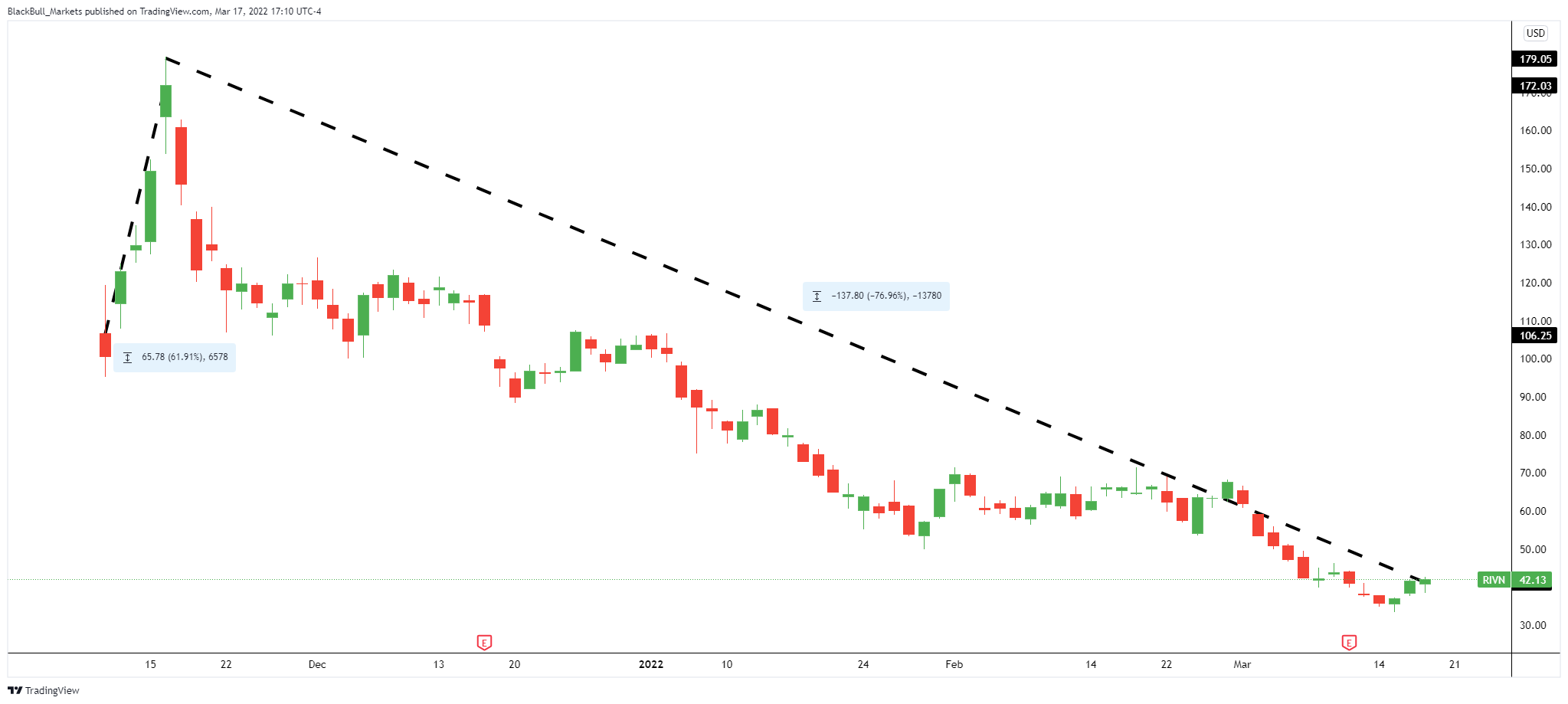
Rivian Automotive (NASDAQ: RIVN), the budding electric vehicle maker, initially bank-rolled by the likes of Ford (NYSE: F) and Amazon (NASDAQ: AMZN), is currently trading 80% lower than its peak since listing on the Nasdaq stock exchange.
Bear in mind that Rivian was listed on the Nasdaq in November 2021, when you had to be very unlucky not to make money in the stock market, especially as a company working in the electric vehicle domain. In a sign of the jubilant (and bygone?) era, within days of listing, investor exuberance had pushed RIVN up by 115%, to US $170 per share. RIVN’s market electricity has fizzled in the following five months and could do with a recharge.
The Rivian stock price is currently trading very close to an all-time low, at US $37.00, 80% lower than its all-time high. In contrast, Tesla (NASDAQ: TSLA), a company which Rivian investors hope can be emulated, is trading 25% lower than its all-time high (US $1,200 vs US $900), which it reached in November 2021 (roughly the same time Rivian reached its all-time high).
RIV only just begun
As illustrated by its latest earnings call, Rivian has a momentous scope for growth.
In its Full Year 2021 earnings call, which was released on March 10, 2022, Rivian reported its first bout of revenue, a tiny US $55 million against a cost of revenue of US $520 million and other operating expenses (mainly R&D and administration) of US $3.7 billion. Consequently, Rivian reported a total net loss (inclusive of all costs) of US $4.7 billion for the full year.
The massive discrepancy between the company’s revenue and costs is a natural part of its growing pains. The automobile industry’s huge barrier to entry means that Rivian expects to be making a net loss for some time. However, it does expect to be profit-neutral by the end of the next financial year, and this might be what is more important for investors following the company.
No fast-charging solution
Rivian is still valued at over US $30 billion and far from a bust. However, it will perhaps take years for the company to charge its stock price back up to its IPO price of US $78.00. Even in the age of outsized valuations for EV companies and some residual investor exuberance in the market, investor confidence is butting up against obstacles such as the infamous chip-shortage affecting numerous car companies and tightening monetary policy from the US Federal Reserve.
To hasten the process and to overcome some of these obstacles on its way back to its IPO price, Rivian may have make better use of its US $18 billion cash reserve and carve out more than its planned 10% takeover of the EV market by 2030.
As it stands, Rivian’s total theoretical capacity at its two factories (600K) could garner 10% of the 2021 electric vehicle market. However, By 2030, electric vehicles sales are predicted to account for 1-in-2 vehicles sold, from a current 1-in-10. To account for 10% of all EVs sold in 2030, Rivian will have to boost production capacity to approximately 3 million vehicles per year.
For interest, Rivian generated its 2021 revenue of US $55 million on delivery of 2500 electric vehicles. The company’s guidance for 2022 expects to deliver 25K vehicles, which is a huge increase on its current production numbers, but fantastically far from the number of pre-orders on its books (83K) and unimaginably far from its 10% goal of 3 million.
Author

Mark O’Donnell
Blackbull Markets Limited
Mark O’Donnell is a Research Analyst with BlackBull Markets in Auckland, New Zealand.