Gold steady in minor loss ahead of Fed rate decision
- Gold sees losses getting contained to only 1% with China and the US top officials set to meet in Switzerland this weekend.
- Strikes and counterstrikes between India and Pakistan took place in early Wednesday.
- Gold remain poised for upside with tail risks plentiful on these China-US talks possibly breaking down.

Gold (XAU/USD) remains in steady trading on Wednesday around $3,390 at the time of writing and for most part in the European session, ahead of the Federal Reserve (Fed) rate decision and after statements from both China and the United States (US) confirmed that trade talks will kick off this weekend. US Treasury Secretary Scott Bessent and US Trade Representative Jamieson Greer both will travel later this week to Switzerland for trade talks with the Chinese delegation, led by Vice Premier He Lifeng, seeking to de-escalate a tariff standoff that has threatened to hammer both economies. In a first phase, no trade talks as such will be held, though rather talks to de-escalate the situation, according to Bessent on Fox News.
The news comes ahead of the Federal Reserve rate decision, which is set to take place on Wednesday during the American session. According to the CME Fedwatch tool, there is a 95.6% probability of a no-change in interest rates, so a rate cut would be a big surprise. Despite pressure from US President Donald Trump on the Fed and its Chairman Jerome Powell to cut rates, it does not look like the Fed will give in to any political demands and will keep rates steady while awaiting the impact of tariffs on the US economy and inflation.
Daily digest market movers: Fed non event
- Gold price snaps a two-day winning streak, as signs of progress on US-China trade talks curbed demand for havens even as military hostilities between India and Pakistan escalated overnight, Bloomberg reports.
- Pakistan said it shot down five Indian airplanes and took soldiers prisoner in retaliation for Indian military strikes early on Wednesday. The prospect of a war between the nuclear-armed neighbors would typically be positive for Gold, although any added haven demand is, at this stage, being canceled out by the trade talks optimism, Bloomberg reports.
- The boss of a US-listed mining company has warned the industry to remain “disciplined” after the price of gold surged to a record high, urging executives to avoid a repeat of the mistakes, the FT reports.
- At 18:00 GMT, the Federal Reserve will release its policy rate decision and statement. Near 18:30 GMT, Fed Chairman Jerome Powell will deliver remarks.
Gold Price Technical Analysis: Crucial positioning ahead of the Fed
Wednesday’s Gold price correction looks granted given that a first step has been taken with both China and the US coming to the negotiating table. However, that does not mean this is the end of the uptrend for Gold and that the precious metal will dip below $3,000 soon. The talks are in a first phase and appear to be only de-escalatory, opening up tail risks for headlines that these talks are not going smooth or could even fall apart.
On the upside, the R1 resistance at $3,469 looks quite far away, though still could see a test if contradicting headlines emerge on the US-China talks or if the Fed meeting holds a surprise. Should some follow-through come, the R2 resistance at $3,508 will come after a fresh all-time high has been set with the break of the current one at $3,500.
On the downside, the Pivot Point at $3,396 is the first level to watch in terms of a daily close below or above the level. Further down, the daily S1 support comes in at $3,358. The technical level at $3,245 should do the trick and hold in case of any sudden reversals if the S2 support at $3,285 does not prove to be strong enough.
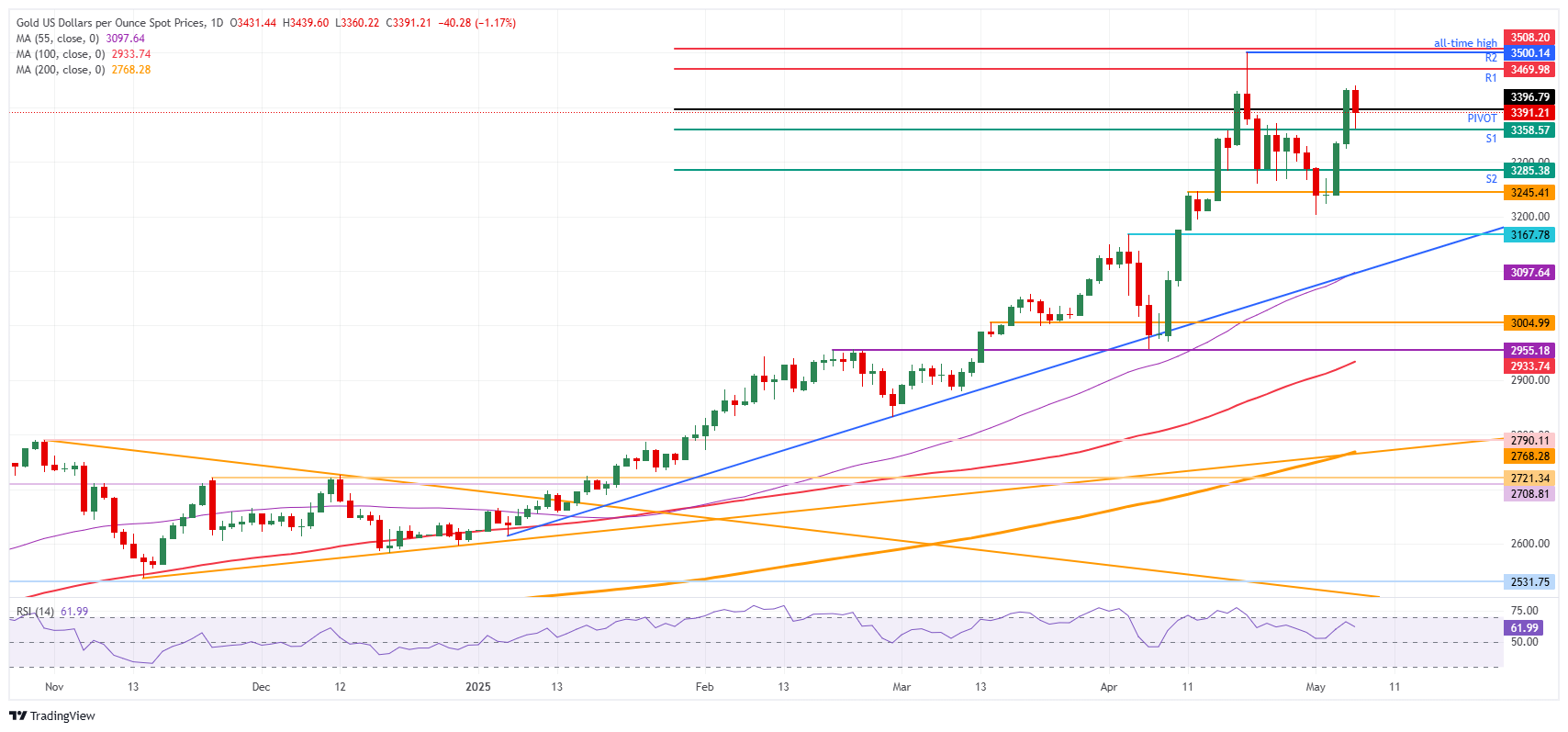
XAU/USD: Daily Chart
Fed FAQs
Monetary policy in the US is shaped by the Federal Reserve (Fed). The Fed has two mandates: to achieve price stability and foster full employment. Its primary tool to achieve these goals is by adjusting interest rates. When prices are rising too quickly and inflation is above the Fed’s 2% target, it raises interest rates, increasing borrowing costs throughout the economy. This results in a stronger US Dollar (USD) as it makes the US a more attractive place for international investors to park their money. When inflation falls below 2% or the Unemployment Rate is too high, the Fed may lower interest rates to encourage borrowing, which weighs on the Greenback.
The Federal Reserve (Fed) holds eight policy meetings a year, where the Federal Open Market Committee (FOMC) assesses economic conditions and makes monetary policy decisions. The FOMC is attended by twelve Fed officials – the seven members of the Board of Governors, the president of the Federal Reserve Bank of New York, and four of the remaining eleven regional Reserve Bank presidents, who serve one-year terms on a rotating basis.
In extreme situations, the Federal Reserve may resort to a policy named Quantitative Easing (QE). QE is the process by which the Fed substantially increases the flow of credit in a stuck financial system. It is a non-standard policy measure used during crises or when inflation is extremely low. It was the Fed’s weapon of choice during the Great Financial Crisis in 2008. It involves the Fed printing more Dollars and using them to buy high grade bonds from financial institutions. QE usually weakens the US Dollar.
Quantitative tightening (QT) is the reverse process of QE, whereby the Federal Reserve stops buying bonds from financial institutions and does not reinvest the principal from the bonds it holds maturing, to purchase new bonds. It is usually positive for the value of the US Dollar.
BRANDED CONTENT
Not all brokers provide the same benefits for Gold trading, making it essential to compare key features. Knowing each broker’s strengths will help you find the ideal fit for your trading strategy. Explore our detailed guide on the best Gold brokers.
Author

Filip Lagaart
FXStreet
Filip Lagaart is a former sales/trader with over 15 years of financial markets expertise under its belt.