Gold stabilizes back inside its range after US Jobs' data
- Gold trades up and down within a range under its record highs.
- US labor market data caused some volatile moves, but the sideways trend holds.
- US inflation data this week could impact Gold as the next Federal Reserve meeting nears.

Gold (XAU/USD) trades at around $2,500 per troy ounce on Monday after retesting its all-time highs on Friday, amid market volatility following the release of a mixed US Nonfarm Payrolls (NFP) employment report.
Gold rises then falls after US Nonfarm Payrolls
Gold rose immediately after the NFP release on Friday, as the headline figure showed the US economy added fewer jobs than expected in August, and July and June’s figures were revised down. The data indicated that the labor market was softening overall and that, therefore, there was a greater chance the Federal Reserve (Fed) would need to make a larger 0.50% cut to interest rates rather than the standard 0.25% in September. Lower interest rates are positive for Gold as they reduce the opportunity cost of holding non-interest-bearing assets.
The precious metal failed to hold its gains, however, as traders processed the rest of the data in the report and its implications for interest rates going forward. The Unemployment Rate, for example, was shown to have actually fallen to 4.2% from 4.3% as anticipated, and wage growth increased by 0.4% in the month, exceeding the forecasted 0.3%. This suggested the labor market was not in as bad shape as first thought and that wage inflation was rising. As a result of the report, the market-based probabilities of the Fed cutting interest rates by 0.50% actually ended up falling from around 40% to about 30%.
As a result, Gold eventually rolled over and ended the week back down at around the $2,500 mark, before inching slightly lower into the $2,490s on Monday.
Gold remains supported, however, by persistent concerns about the outlook for the US economy. Fed Governor Christopher Waller said on Friday that it was now appropriate to start cutting interest rates to keep the economy’s “forward momentum” intact and because the labor market was showing signs of “softening” but – he added – not “deteriorating”. Waller also said he would be in favor of “front-loading cuts”, keeping alive the possibility of a non-standard 0.50% reduction.
US Consumer Price Index (CPI) and Producer Price Index (PPI) data out this week could further color the outlook for interest rates, although analysts are mixed as to how much, with some, such as Deutsche Bank’s Head of Macro Research, Jim Reid, playing down the importance of inflation compared to employment data.
“Wednesday's US CPI and Thursday's PPI will probably help move that debate on, but it seems employment is more important at the moment and Friday's mixed employment report had arguments for both sides, so the swing factor is probably how the committee view labor markets rather than inflation,” said Reid in his “Early Morning Reid” macro note.
Data from the People’s Bank of China (PBoC) continued to show no increase in the bank’s Gold reserves as it has continued its halt on buying since May.
On the geopolitical front, a ceasefire deal between Israel and Hamas seems even less likely after a gunman from Jordan shot dead three Israelis at a border crossing in the West Bank, in the first such killing since the October 7 terrorist attack.
In Ukraine, Russia continues its advance towards the key strategic hub city of Pokrovsk. If successful, it could dramatically impact the war on the eastern front and threaten Ukraine’s whole defensive line in the Donbass. Such an outcome, though still unlikely to occur soon, would nevertheless ratchet up tensions in the region and increase demand for Gold. The Central Bank of Poland (NBP), for example, has been hoarding Gold since the war began, according to data from the World Gold Council (WGC).
Technical Analysis: Continues trading within a range
Gold (XAU/USD) continues trading in a sideways range between the all-time highs of $2,531 and a floor at around the $2,475 level. It is currently plum in the centre of the range.
XAU/USD 4-hour Chart
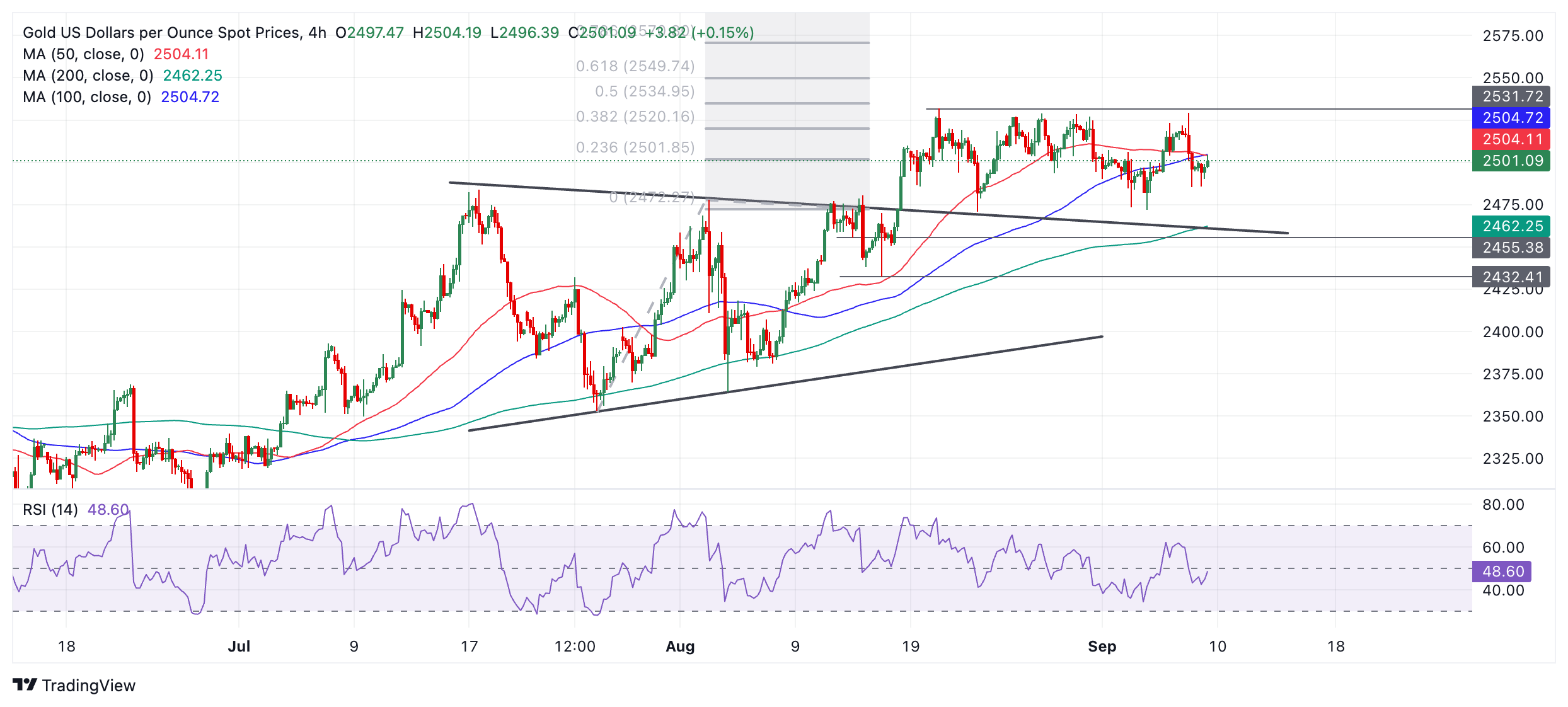
The yellow metal will probably continue trading up and down within this range until it breaks decisively out of one side or another.
A decisive break would be one accompanied by a long green or red candle that broke clearly through the level and closed near its highs or lows, or three candles in a row of the same candle that pierced the level.
However, the longer-term trend of Gold is bullish, slightly enhancing the odds of an upside breakout. Gold has an as-yet unreached bullish target at $2,550, generated after the original breakout from the July-August range on August 14. It will probably finally reach its goal in the end, assuming the uptrend resumes.
A break above the August 20 all-time high of $2,531 would provide more confirmation of a continuation higher toward the $2,550 target.
If Gold continues steadily weakening, however, a decisive break below the range floor and a close below $2,460 would change the picture and suggest that the commodity might be starting a more pronounced downtrend.
Gold FAQs
Gold has played a key role in human’s history as it has been widely used as a store of value and medium of exchange. Currently, apart from its shine and usage for jewelry, the precious metal is widely seen as a safe-haven asset, meaning that it is considered a good investment during turbulent times. Gold is also widely seen as a hedge against inflation and against depreciating currencies as it doesn’t rely on any specific issuer or government.
Central banks are the biggest Gold holders. In their aim to support their currencies in turbulent times, central banks tend to diversify their reserves and buy Gold to improve the perceived strength of the economy and the currency. High Gold reserves can be a source of trust for a country’s solvency. Central banks added 1,136 tonnes of Gold worth around $70 billion to their reserves in 2022, according to data from the World Gold Council. This is the highest yearly purchase since records began. Central banks from emerging economies such as China, India and Turkey are quickly increasing their Gold reserves.
Gold has an inverse correlation with the US Dollar and US Treasuries, which are both major reserve and safe-haven assets. When the Dollar depreciates, Gold tends to rise, enabling investors and central banks to diversify their assets in turbulent times. Gold is also inversely correlated with risk assets. A rally in the stock market tends to weaken Gold price, while sell-offs in riskier markets tend to favor the precious metal.
The price can move due to a wide range of factors. Geopolitical instability or fears of a deep recession can quickly make Gold price escalate due to its safe-haven status. As a yield-less asset, Gold tends to rise with lower interest rates, while higher cost of money usually weighs down on the yellow metal. Still, most moves depend on how the US Dollar (USD) behaves as the asset is priced in dollars (XAU/USD). A strong Dollar tends to keep the price of Gold controlled, whereas a weaker Dollar is likely to push Gold prices up.
Author

Joaquin Monfort
FXStreet
Joaquin Monfort is a financial writer and analyst with over 10 years experience writing about financial markets and alt data. He holds a degree in Anthropology from London University and a Diploma in Technical analysis.