|

Gold technical analysis: Immediate symmetrical triangle in focus, $1281 nearby support

  • Short-term symmetrical triangle limits the moves ahead of $1290 horizontal resistance.
  • The nine-month-old trend-line at $1266 continues to be strong downside support.

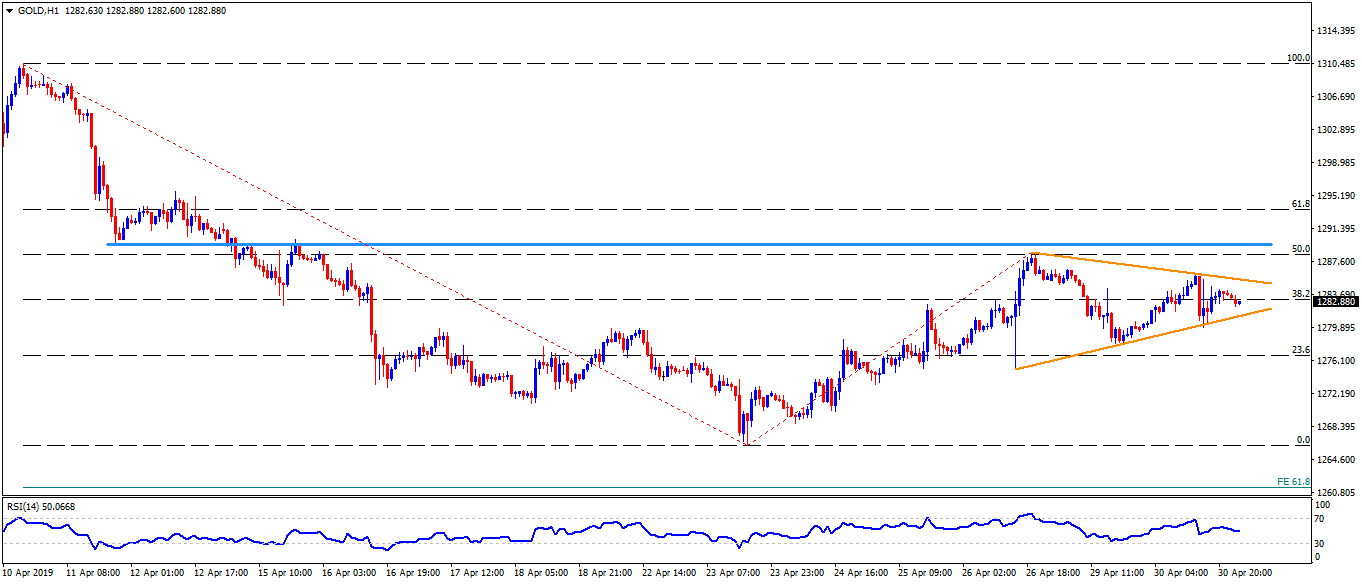
Gold is taking the rounds near $1283 during the early Asian session on Wednesday. The yellow metal has been following a symmetrical triangle technical formation since April 26.

The technical pattern confines the bullion’s moves between $1281 and $1286 with $1290 being an additional resistance to please buyers past-$1286.

Should prices rally beyond $1290, $1296, $1300 and $1306 are likely intermediate halts that can be availed during the quote’s rally towards April month high near $1311.

Alternatively, a downside break of $1281 can trigger fresh selling in direction to $1278, $1273 and $1270 consecutive supports.

Also, April month lows near $1266 join almost nine-month-old upward sloping trend-line and together offers strong support past-$1270, a break of which can recall $1260 level comprising 61.8% Fibonacci expansion (FE) of its previous month moves.

Gold hourly chart
Trend: Sideways

additional important levels

Overview
Today last price1282.84
Today Daily Change3.73
Today Daily Change %0.29%
Today daily open1279.11
 
Trends
Daily SMA201285.77
Daily SMA501299.81
Daily SMA1001292.5
Daily SMA2001251.97
Levels
Previous Daily High1286.85
Previous Daily Low1278.18
Previous Weekly High1288.75
Previous Weekly Low1265.6
Previous Monthly High1327.8
Previous Monthly Low1280.1
Daily Fibonacci 38.2%1281.49
Daily Fibonacci 61.8%1283.54
Daily Pivot Point S11275.91
Daily Pivot Point S21272.71
Daily Pivot Point S31267.24
Daily Pivot Point R11284.58
Daily Pivot Point R21290.05
Daily Pivot Point R31293.25

Author

Anil Panchal

Anil Panchal

FXStreet

Anil Panchal has nearly 15 years of experience in tracking financial markets. With a keen interest in macroeconomics, Anil aptly tracks global news/updates and stays well-informed about the global financial moves and their implications.


More from Anil Panchal
Share:

Editor's Picks

GBP/USD off highs, back to 1.3620

GBP/USD remains slightly on the defensive at the end of the week, receding to the low 1.3600s after hitting fresh tops past 1.3670 earlier in the day. Cable’s correction comes after two daily gains in a row and amid a tepid advance in the Greenback, while poor UK data also accompany the downside.

EUR/USD treads water below 1.1700

EUR/USD now trades with modest losses around 1.1670 following another unsuccessful atempt to advance past 1.1700 the figure in a convincing fashion. The pair’s decline follows a maginal rebound in the US Dollar as market participants continue to assess recent US data as well as developments from the US bond market.

Gold trims gains, recedes to the sub-$4,600 area

Gold rapidly leaves behind Thursday’s inconclusive price action and advances markedly on Friday, briefly surpassing the $4,600 mark per troy ounce to hit three-month peaks. Meanwhile, the precious metal’s solid performance comes despite marginal gains in the buck coupled with another day of rising US Treasury yields across the curve.

Crypto Today: Bitcoin, Ethereum, XRP bulls accelerate rally amid rising ETF inflows

The cryptocurrency market remains bullish on Friday, led by Bitcoin’s surge above $77,000. Altcoins, including Ethereum and Ripple, mirror BTC’s positive outlook, trading near $2,400 and $1.35, respectively.

Week ahead – Fed’s Jackson Hole and Nvidia earnings to dictate markets

Kevin Warsh to make his Jackson Hole debut amid confusing messaging. But a major hawkish surprise unlikely after bond market intervention. Nvidia earnings to also determine market direction as stock rally cools.

$20 billion offered, $2 billion taken: Why Treasury doubled its buyback cap

The US Treasury moved off its own calendar on Wednesday, and that is the part worth sitting with. At 12:32 GMT, the department said it would at least double the size of liquidity support buyback operations in the 10-year to 20-year and 20-year to 30-year sectors, lifting the maximum from $2 billion per operation to at least $4 billion, effective September 9 and running to November 4.