Gold falls as tariff extension boosts risk appetite and dampens safe-haven demand

Gold price falls on hopes that more trade deals will be announced before reciprocal tariffs take effect on August 1.
The FOMC Meeting Minutes will be released on Wednesday, providing insight into interest rates that could influence the price of bullion.
- XAU/USD heads toward triangle support near $3,280 after falling below $3,300.
Gold continues to trade lower on Tuesday, as markets cheer news that reciprocal tariffs will take effect on August 1, rather than July 9.
US President Donald Trump’s consistent tariff threats have temporarily muted demand for the yellow metal, while supporting demand for the US Dollar. The president has announced new tariffs on countries, with Japan at 25% and South Korea at 30% standing out.
The yellow metal is down 1.20% intraday, and the lack of conviction reflects ongoing indecision amid conflicting macro forces and stable US Treasury yields.
The recent price action has been defined by a series of lower highs and higher lows, compressing into a classic triangle structure on the daily chart. This pattern typically precedes a sharp directional move, but the breakout trigger remains elusive.
While safe-haven demand offers some underlying support, stronger-than-expected US labor market data and hawkish Federal Reserve (Fed) expectations have capped any upside extension for Gold.
Gold daily digest market movers: XAU/USD remains alert ahead of FOMC Minutes
- The Federal Open Market Committee will release the Minutes from its last meeting on Wednesday. This report outlines the reasons for maintaining interest rates at the current range of 4.25% to 4.50% in June.
- German Industrial Production data, released on Monday, showed a 1.2% monthly increase in May. Upbeat economic data has helped drive recession fears lower, adding pressure on the yellow metal.
- The BRICS summit in Rio de Janeiro ended on Monday. The emerging market nations that established the bloc are beginning to reduce their reliance on the United States. This initiative includes moving away from using the US Dollar as a receiving currency, a concept known as de-dollarization.
- Trump wrote a post on Truth Social also on Monday stating that “Any country aligning themselves with the Anti‑American policies of BRICS, will be charged an ADDITIONAL 10 % tariff. There will be no exceptions to this policy.”
Gold trades sideways near $3,300 as triangle breakout looms
From a technical standpoint, Gold has fallen below the 50-day Simple Moving Average (SMA) at $3,321, with the 20-day SMA acting as additional resistance at $3,350.
The current structure suggests a slightly bearish bias, with a sustained break below the 23.6% Fibonacci retracement of the April rally at $3,292 increasing downside risk.
Gold (XAU/USD) daily chart
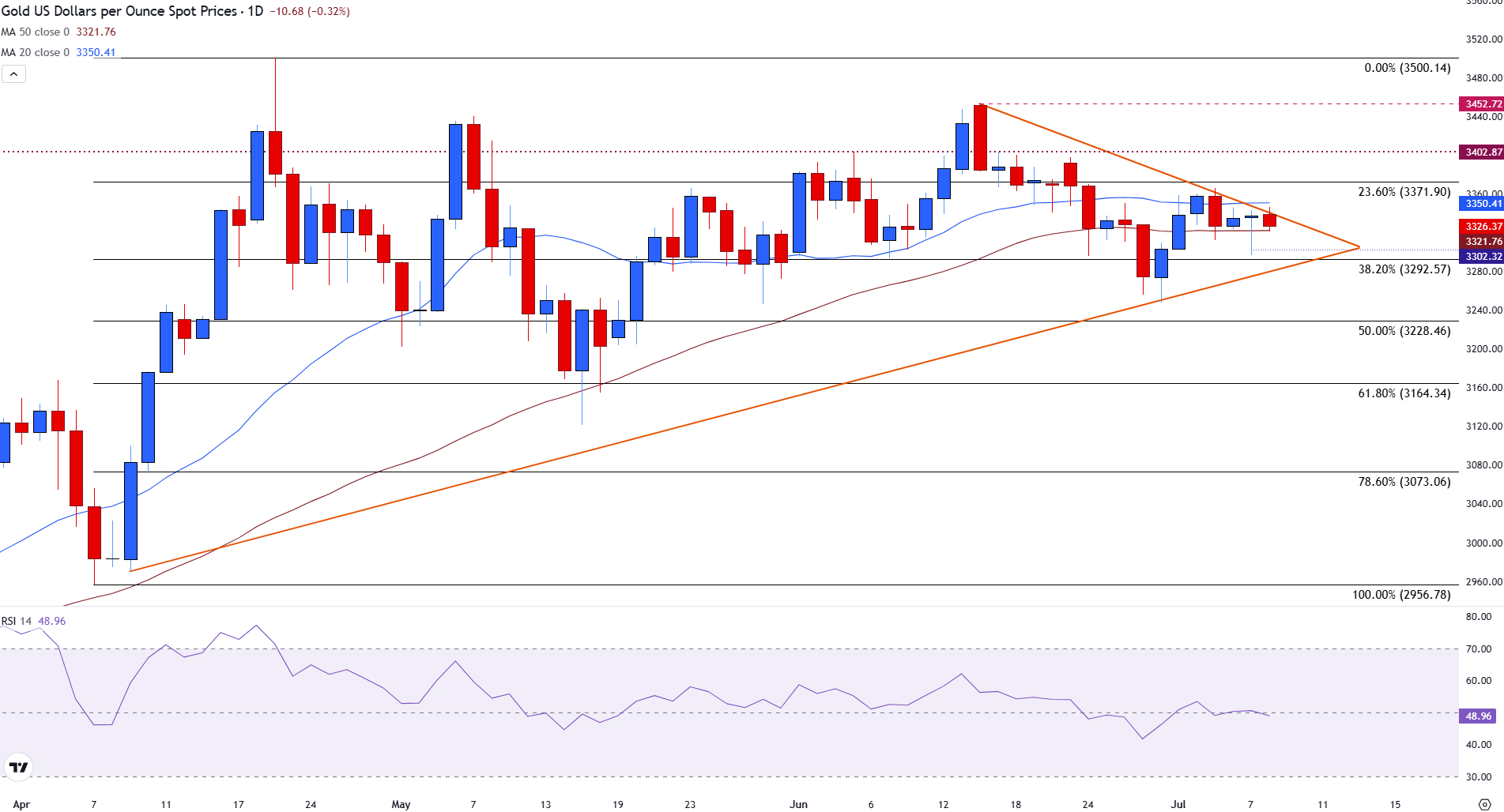
On the upside, the precious metal could stage a strong upward move if it breaks above the upper boundary of the symmetrical triangle, particularly with a decisive close above the 20-day SMA at $3,350.
Additionally, any resurgence in geopolitical tensions or global trade disputes could trigger renewed safe-haven demand, further fueling a rally. If bullish momentum takes hold, XAU/USD may target the $3,375–$3,400 area, with the potential to retest all-time highs if broader risk sentiment deteriorates.
Risk sentiment FAQs
In the world of financial jargon the two widely used terms “risk-on” and “risk off'' refer to the level of risk that investors are willing to stomach during the period referenced. In a “risk-on” market, investors are optimistic about the future and more willing to buy risky assets. In a “risk-off” market investors start to ‘play it safe’ because they are worried about the future, and therefore buy less risky assets that are more certain of bringing a return, even if it is relatively modest.
Typically, during periods of “risk-on”, stock markets will rise, most commodities – except Gold – will also gain in value, since they benefit from a positive growth outlook. The currencies of nations that are heavy commodity exporters strengthen because of increased demand, and Cryptocurrencies rise. In a “risk-off” market, Bonds go up – especially major government Bonds – Gold shines, and safe-haven currencies such as the Japanese Yen, Swiss Franc and US Dollar all benefit.
The Australian Dollar (AUD), the Canadian Dollar (CAD), the New Zealand Dollar (NZD) and minor FX like the Ruble (RUB) and the South African Rand (ZAR), all tend to rise in markets that are “risk-on”. This is because the economies of these currencies are heavily reliant on commodity exports for growth, and commodities tend to rise in price during risk-on periods. This is because investors foresee greater demand for raw materials in the future due to heightened economic activity.
The major currencies that tend to rise during periods of “risk-off” are the US Dollar (USD), the Japanese Yen (JPY) and the Swiss Franc (CHF). The US Dollar, because it is the world’s reserve currency, and because in times of crisis investors buy US government debt, which is seen as safe because the largest economy in the world is unlikely to default. The Yen, from increased demand for Japanese government bonds, because a high proportion are held by domestic investors who are unlikely to dump them – even in a crisis. The Swiss Franc, because strict Swiss banking laws offer investors enhanced capital protection.
Author

Tammy Da Costa, CFTe®
FXStreet
Tammy is an economist and market analyst with a deep passion for financial markets, particularly commodities and geopolitics.