Gold on track for a fourth monthly gain amid growing Fed rate cut expectations
- Gold hovers near two-week highs as traders weigh Fed policy signals.
- Geopolitical uncertainty stays elevated as Russia-Ukraine peace talks remain fragile.
- Technical setup shows XAU/USD attempting a breakout above the upper boundary of a symmetrical triangle on the daily chart.

Gold (XAU/USD) edges higher on Friday after a bout of volatility sparked by the CME trading outage briefly dragged prices lower. At the time of writing, XAU/USD is trading around $4,209, with the metal on track to notch its fourth straight monthly gain.
Overall sentiment remains tilted to the upside as traders price in a greater likelihood of a Federal Reserve (Fed) rate cut in December, following dovish-leaning remarks from key policymakers earlier in the week. At the same time, the Russia-Ukraine peace talks remain fragile, keeping geopolitical risks elevated and offering a supportive backdrop for Gold.
Market movers: CME halt, Fed rate cut bets and geopolitics in focus
- A technical glitch at one of CME Group’s data centers halted trading on its electronic platforms, resulting in a shutdown across global currency, commodity, and futures markets. Gold futures were stuck near $4,221 during the outage, and analysts warn that volatility may pick up once full trading resumes, especially amid month-end positioning and thin post-holiday liquidity.
- Dovish Federal Reserve commentary this week prompted traders to ramp up December rate-cut bets after Fed Governor Christopher Waller said on Monday that a policy easing next month would be appropriate given signs of cooling in the labour market and softer economic activity, while fellow Governor Stephen Miran argued that rising unemployment reflects overly tight policy and repeated his support for larger rate cuts. San Francisco Fed President Mary Daly told The Wall Street Journal she backs a cut at next month’s meeting, warning that the labour market is now more at risk than an inflation flare-up.
- However, uncertainty persists as several other policymakers maintain a more cautious stance, stressing that inflation remains sticky and warning that cutting rates too quickly could risk reigniting price pressure. According to the CME FedWatch Tool, markets are now pricing in roughly an 85% chance of a December rate cut.
- On the geopolitical front, Russia-Ukraine peace efforts remain in focus after President Volodymyr Zelenskiy signalled Kyiv’s readiness to advance a US-backed framework earlier this week. However, Russian President Vladimir Putin struck a guarded tone on Thursday, saying the proposal “could serve as a basis” for future talks but stressing that no final version exists and that hostilities would cease only if Ukrainian forces withdraw.
Technical analysis: Gold consolidates below $4,200 while momentum improves
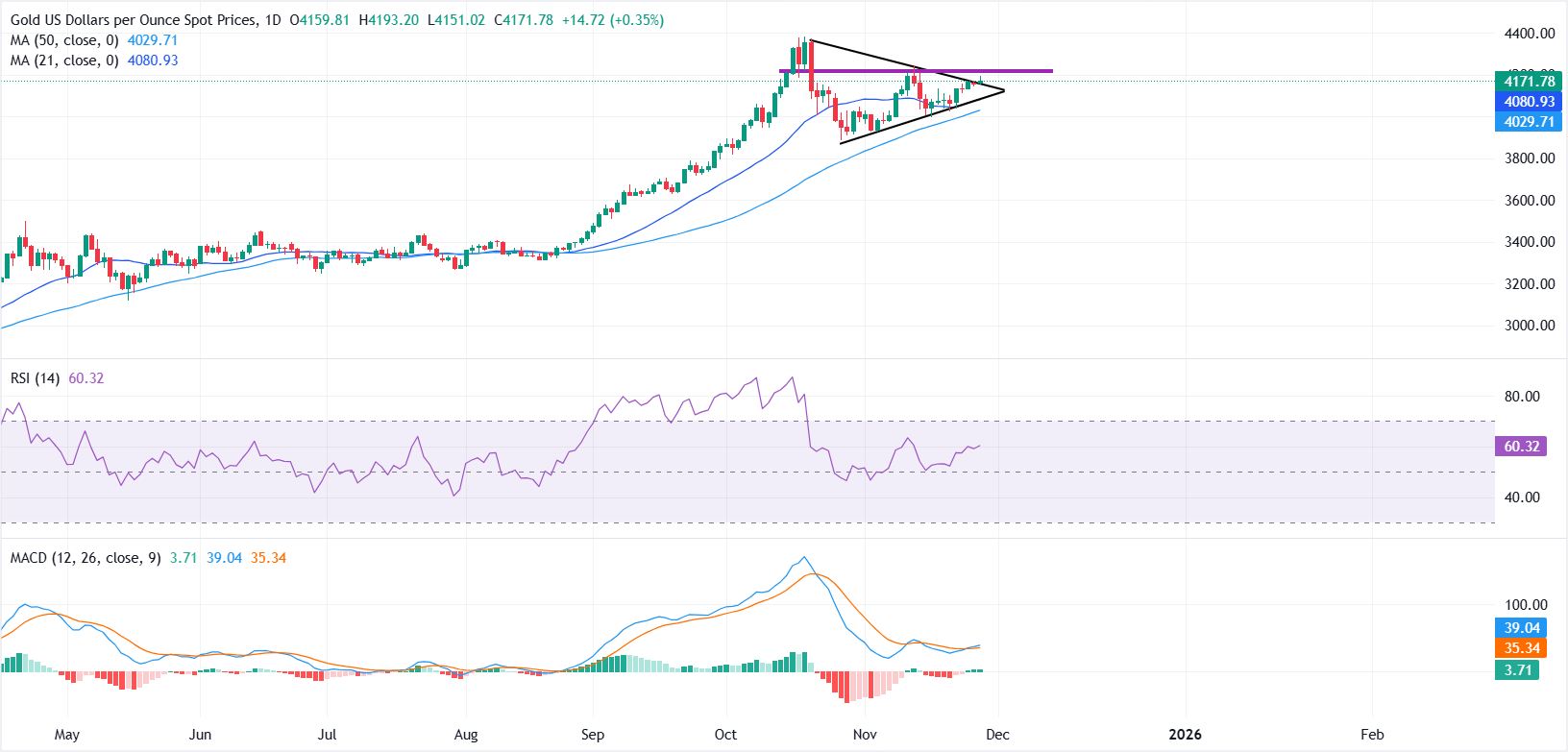
XAU/USD is attempting a breakout from a symmetrical triangle pattern on the daily chart, with prices holding just above the upper boundary of the formation. However, the $4,200 psychological level continues to cap immediate upside attempts, and a decisive daily close above this barrier is needed to confirm bullish continuation.
On the downside, initial support is seen at $4,150, while stronger support lies near the lower boundary of the triangle, where the 21-day Simple Moving Average (SMA) converges.
Momentum signals are improving, with the Relative Strength Index (RSI) pointing north around 60, indicating strengthening buying interest without yet entering overbought territory.
Gold FAQs
Gold has played a key role in human’s history as it has been widely used as a store of value and medium of exchange. Currently, apart from its shine and usage for jewelry, the precious metal is widely seen as a safe-haven asset, meaning that it is considered a good investment during turbulent times. Gold is also widely seen as a hedge against inflation and against depreciating currencies as it doesn’t rely on any specific issuer or government.
Central banks are the biggest Gold holders. In their aim to support their currencies in turbulent times, central banks tend to diversify their reserves and buy Gold to improve the perceived strength of the economy and the currency. High Gold reserves can be a source of trust for a country’s solvency. Central banks added 1,136 tonnes of Gold worth around $70 billion to their reserves in 2022, according to data from the World Gold Council. This is the highest yearly purchase since records began. Central banks from emerging economies such as China, India and Turkey are quickly increasing their Gold reserves.
Gold has an inverse correlation with the US Dollar and US Treasuries, which are both major reserve and safe-haven assets. When the Dollar depreciates, Gold tends to rise, enabling investors and central banks to diversify their assets in turbulent times. Gold is also inversely correlated with risk assets. A rally in the stock market tends to weaken Gold price, while sell-offs in riskier markets tend to favor the precious metal.
The price can move due to a wide range of factors. Geopolitical instability or fears of a deep recession can quickly make Gold price escalate due to its safe-haven status. As a yield-less asset, Gold tends to rise with lower interest rates, while higher cost of money usually weighs down on the yellow metal. Still, most moves depend on how the US Dollar (USD) behaves as the asset is priced in dollars (XAU/USD). A strong Dollar tends to keep the price of Gold controlled, whereas a weaker Dollar is likely to push Gold prices up.
Author

Vishal Chaturvedi
FXStreet
I am a macro-focused research analyst with over four years of experience covering forex and commodities market. I enjoy breaking down complex economic trends and turning them into clear, actionable insights that help traders stay ahead of the curve.