Gold slips as CPI data tempers rate cut hopes with Fed credibility in focus
- Gold slips below $3,330 as CPI data tempers hopes for a near-term rate cut.
- Fed credibility in focus amid Trump pressure and Powell succession uncertainty.
- XAU/USD struggles near $3,335 as bullish momentum fades near prior triangle resistance.

Gold (XAU/USD) is trading in a narrow range on Tuesday, following the US Consumer Price Index (CPI) report that reinforced expectations the Federal Reserve (Fed) may refrain from a near-term rate pivot.
At the time of writing, the precious metal is trading below $3,330, with risk sentiment and a slight uptick in risk sentiment limiting the upside move.
The June Consumer Price Index (CPI) showed that headline CPI rose 2.7% (YoY), in line with expectations, while core CPI came in at 2.9%, slightly lower than the 3% consensus but still well above the Fed’s 2% target.
The lack of faster disinflation has tempered expectations for a September rate cut, with Fed funds futures now pricing in a 54.4% probability and a 44% chance that rates will remain in higher for longer.
The market reaction reflects a repricing of interest rate expectations, with Treasury yields firming and the US Dollar advancing. Meanwhile, with President Trump continuing to put pressure on the Federal Reserve (Fed) Chair, Jerome Powell, the US Treasury
In an interview with Bloomberg on Tuesday, the Treasury Secretary said, "As President Trump said, he’s not looking to fire Chair Powell.”
However, he also stated that “Traditionally, the Fed chair also steps down as a governor. There’s been a lot of talk of a shadow Fed chair causing confusion in advance of his or her nomination, and I can tell you, I think it would be very confusing for the market for a former Fed chair to stay on also.”
Bessent noted that Powell is “boxed in” and may struggle to manage monetary policy objectively if Trump’s influence continues to grow. This has added another layer of risk to Fed credibility, which could be supportive for Gold.
Gold daily digest: Trade tensions, tariff risks, and price pressures drive XAU/USD price action
- According to the CME FedWatch Tool, analysts expect the Fed to hold interest rates steady within the 4.25% to 4.50% range in July.
- Additional catalysts for Gold on Tuesday include developments in bilateral relations. As the August 1 tariff deadline approaches, the increase in levies on US imports could further support demand for safe-haven assets, including precious metals. In contrast, easing trade tensions and improved risk sentiment could weigh on XAU/USD price action.
- After US President Donald Trump announced that tariffs on EU imports to the US will be set at 30% on Saturday, an official statement was published on the European Commission’s press corner on Sunday, which read, “We remain ready to continue working towards an agreement by August 1. At the same time, we will take all necessary steps to safeguard EU interests, including the adoption of proportionate countermeasures if required.”
- On Friday, President Trump announced that Mexico will also face a 30% levy on imports to the US. A letter to Mexican President Claudia Sheinbaum, posted on Truth Social read: “Despite our strong relationship, you will recall, the United States imposed Tariffs on Mexico to deal with our Nation’s Fentanyl crisis, which is caused, in part, by Mexico’s failure to stop the Cartels, who are made up of the most despicable people who ever walked the Earth, from pouring these drugs into our country,”
- In a press conference on Monday, President Sheinbaum responded, stating that “If the United States government and its agencies wanted to address the serious consumption of fentanyl in their country, they could combat the sale of narcotics on the streets of their main cities, which they don't do".
- The wave of trade threats, especially from the US, Mexico, and the EU, adds a layer of political uncertainty that supports safe-haven demand in Gold. Traders may continue buying dips in XAU/USD not just on soft economic data, but also on signs of deteriorating diplomacy, particularly if rhetoric escalates ahead of August 1 deadline.
Gold technical analysis: XAU/USD dips below $3,350 as bullish momentum fades
Gold (XAU/USD) is trading defensively below the $3,335 mark after failing to sustain momentum above the 23.6% Fibonacci retracement level of the April low-high move at $3,371.90.
The rejection near the $3,360–$3,371 resistance zone has triggered a pullback, with prices now hovering just above the 38.2% Fibo support level at $3,292.57. Both the 20-day and 50-day Simple Moving Averages (SMAs) have converged around $3,335–$3,324, providing temporary support.
However, a break below these levels could expose a deeper downside toward $3,228 and $3,200.
A test of prior symmetrical triangle resistance on the daily chart suggests the recent consolidation phase may be giving way to renewed bearish pressure. The Relative Strength Index (RSI) at 49 shows neutral momentum, reflecting a lack of strong directional momentum.
Unless Gold reclaims $3,335 and clears $3,371 with conviction, the short-term bias appears tilted to the downside, with key support zones now in focus.
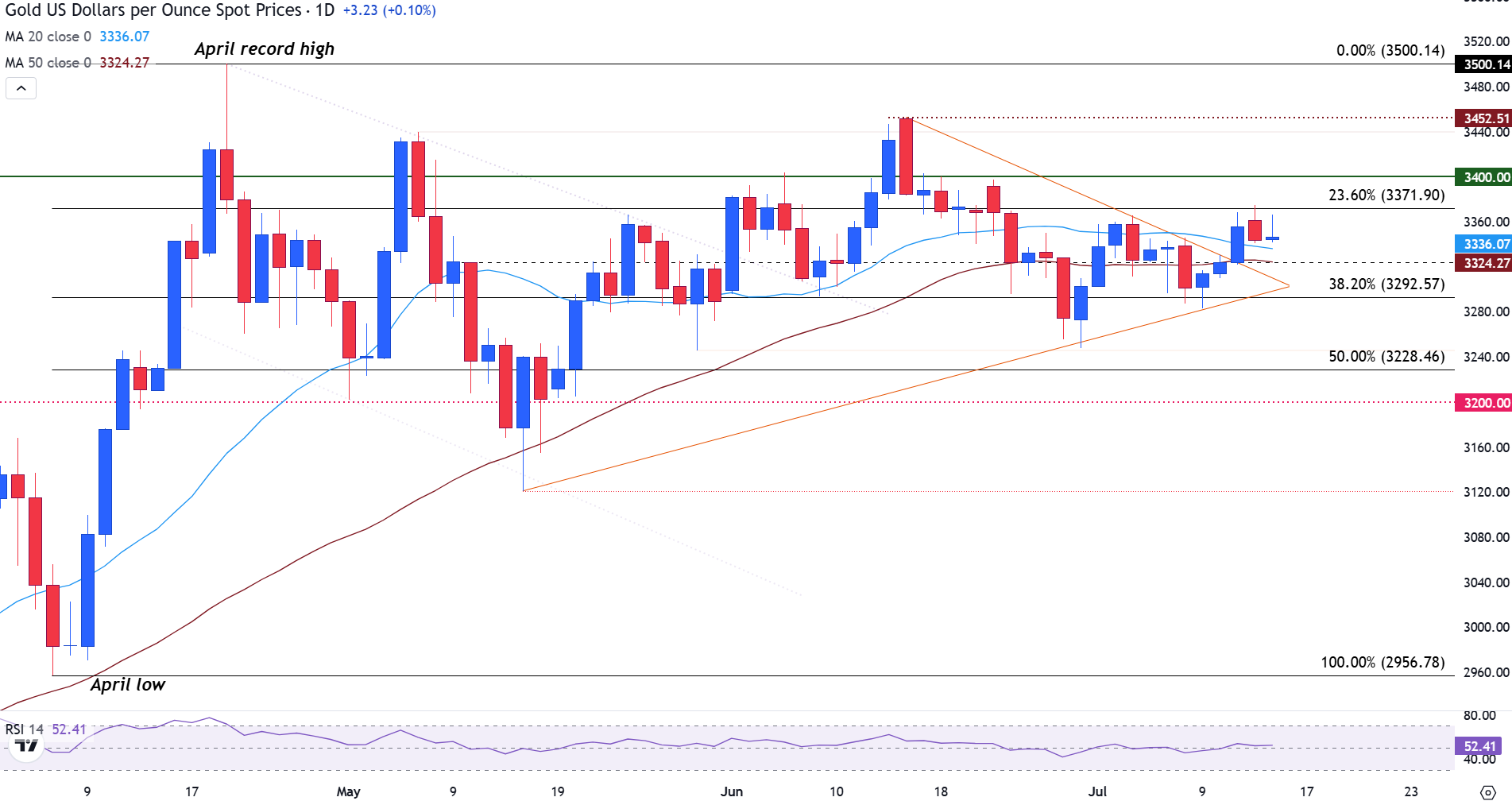
Gold (XAU/USD) daily chart
Risk sentiment FAQs
In the world of financial jargon the two widely used terms “risk-on” and “risk off'' refer to the level of risk that investors are willing to stomach during the period referenced. In a “risk-on” market, investors are optimistic about the future and more willing to buy risky assets. In a “risk-off” market investors start to ‘play it safe’ because they are worried about the future, and therefore buy less risky assets that are more certain of bringing a return, even if it is relatively modest.
Typically, during periods of “risk-on”, stock markets will rise, most commodities – except Gold – will also gain in value, since they benefit from a positive growth outlook. The currencies of nations that are heavy commodity exporters strengthen because of increased demand, and Cryptocurrencies rise. In a “risk-off” market, Bonds go up – especially major government Bonds – Gold shines, and safe-haven currencies such as the Japanese Yen, Swiss Franc and US Dollar all benefit.
The Australian Dollar (AUD), the Canadian Dollar (CAD), the New Zealand Dollar (NZD) and minor FX like the Ruble (RUB) and the South African Rand (ZAR), all tend to rise in markets that are “risk-on”. This is because the economies of these currencies are heavily reliant on commodity exports for growth, and commodities tend to rise in price during risk-on periods. This is because investors foresee greater demand for raw materials in the future due to heightened economic activity.
The major currencies that tend to rise during periods of “risk-off” are the US Dollar (USD), the Japanese Yen (JPY) and the Swiss Franc (CHF). The US Dollar, because it is the world’s reserve currency, and because in times of crisis investors buy US government debt, which is seen as safe because the largest economy in the world is unlikely to default. The Yen, from increased demand for Japanese government bonds, because a high proportion are held by domestic investors who are unlikely to dump them – even in a crisis. The Swiss Franc, because strict Swiss banking laws offer investors enhanced capital protection.
Author

Tammy Da Costa, CFTe®
FXStreet
Tammy is an economist and market analyst with a deep passion for financial markets, particularly commodities and geopolitics.