Gold softer after Secretary Lutnick reiterates Trump could cancel tariffs
- Gold softer after earlier losses in the Asian trading session.
- US Commerce Secretary Howard Lutnick alludes again on some relief on the recent tariffs this Wednesday
- US yields push back a touch, though they still have a long road to recovery.


Gold’s price (XAU/USD) eases again, though less severe after earlier losses in the Asian trading session and trades around $2,920 at the time of writing on Wednesday. With tariffs still in place and several more tariffs to come for Europe and other countries, Gold will remain the place to be in terms of safe haven.
However, some surprising comments from United States (US) Commerce Secretary Howard Lutnick overnight hinted that tariffs could already be eased or fully unwinded for Mexico and Canada. This pressures the upside for Gold for now.
Daily digest market movers: Trump to confirm easing
- US President Donald Trump doubled tariffs on China and imposed 25% levies against Canada and Mexico earlier this week. However, US Commerce Secretary Howard Lutnick hinted at some relief for the US’s two neighbors, telling Fox Business there could be a path to reduce some of the duties, Bloomberg reports.
- Zimbabwe’s Gold output jumped to 2,568 kg last month from 1,854 kg in the year-earlier period, Fidelity Gold Refinery says in an emailed statement, Reuters reports.
- Gold's extreme price dislocations are fading as tightness in the physical market eases, indicating a rush to ship bullion to America may have run its course, Bloomberg reports.
Technical Analysis: Lutnick comments are mixed picture
Bullion might face some pressure on Wednesday after its two-day strong recovery this week. The comments from Secretary Lutnick are putting longer-term safe haven flow for Gold a bit on loose screws. Traders will want to trim their positions in the idea that the US could, at any moment, unwind those tariffs, which would spark profit-taking in the precious metal.
While Gold trades near $2,920 at the time of writing, the daily Pivot Point at $2,909 and the daily R1 resistance at $2,936 are the levels to watch for this Wednesday, with the daily Pivot Point already back in the hands of the bulls. In case Gold sees more inflows, the daily R2 resistance at $2,955 will possibly be the final cap ahead of the all-time high of $2,956 reached on February 24.
On the downside, the S1 support at $2,890 converges with Monday’s high. That will be the vital support for this Wednesday. If Bullion bulls want to avoid another leg lower, that level must hold. Further down, the daily S2 support at $2,863 should be able to catch any additional downside pressure.
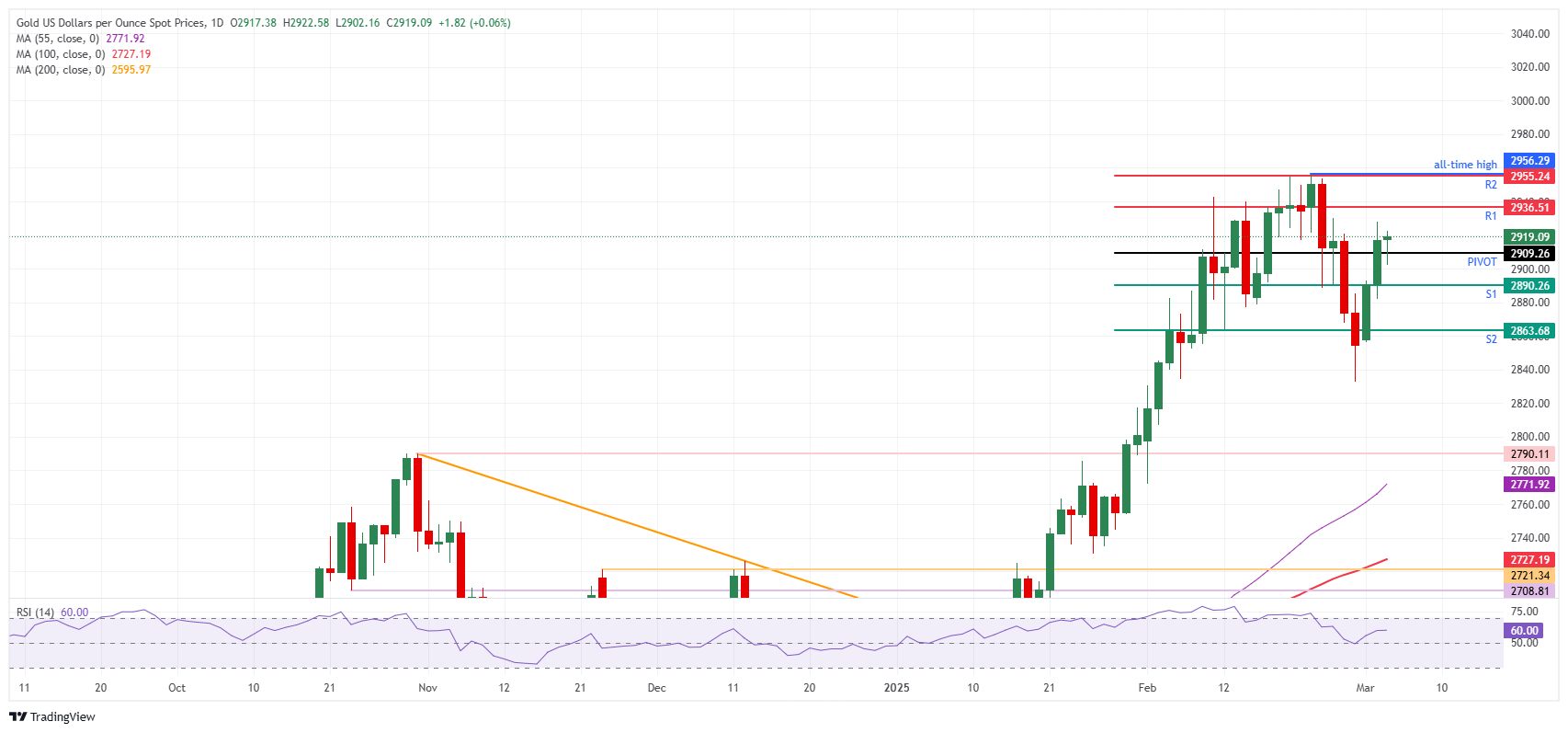
XAU/USD: Daily Chart
Gold FAQs
Gold has played a key role in human’s history as it has been widely used as a store of value and medium of exchange. Currently, apart from its shine and usage for jewelry, the precious metal is widely seen as a safe-haven asset, meaning that it is considered a good investment during turbulent times. Gold is also widely seen as a hedge against inflation and against depreciating currencies as it doesn’t rely on any specific issuer or government.
Central banks are the biggest Gold holders. In their aim to support their currencies in turbulent times, central banks tend to diversify their reserves and buy Gold to improve the perceived strength of the economy and the currency. High Gold reserves can be a source of trust for a country’s solvency. Central banks added 1,136 tonnes of Gold worth around $70 billion to their reserves in 2022, according to data from the World Gold Council. This is the highest yearly purchase since records began. Central banks from emerging economies such as China, India and Turkey are quickly increasing their Gold reserves.
Gold has an inverse correlation with the US Dollar and US Treasuries, which are both major reserve and safe-haven assets. When the Dollar depreciates, Gold tends to rise, enabling investors and central banks to diversify their assets in turbulent times. Gold is also inversely correlated with risk assets. A rally in the stock market tends to weaken Gold price, while sell-offs in riskier markets tend to favor the precious metal.
The price can move due to a wide range of factors. Geopolitical instability or fears of a deep recession can quickly make Gold price escalate due to its safe-haven status. As a yield-less asset, Gold tends to rise with lower interest rates, while higher cost of money usually weighs down on the yellow metal. Still, most moves depend on how the US Dollar (USD) behaves as the asset is priced in dollars (XAU/USD). A strong Dollar tends to keep the price of Gold controlled, whereas a weaker Dollar is likely to push Gold prices up.
Author
Filip Lagaart
FXStreet
Filip Lagaart is a former sales/trader with over 15 years of financial markets expertise under its belt.

















