Gold stabilizes after declining on hope of ceasefire deal in Lebanon
- Gold stabilizes after an over-3% sell-off following news Israel and Hezbollah had reached a ceasefire deal.
- The Israeli war cabinet meets on Tuesday to discuss the 60-day deal, while Trump issues tariff threats to neighbors and China.
- Technically, XAU/USD forms a Bearish Engulfing candlestick pattern as it falls to support at a major trendline.

Gold (XAU/USD) stabilizes in the $2,620s on Tuesday after sliding almost three percent – a whopping $90 plus – on Monday due to rumors Israel and Hezbollah were on the verge of agreeing on a ceasefire.
Whilst good news for Lebanon, this was not good news for Gold as it improved the outlook for geopolitical risk, thereby reducing safe-haven flows to the precious metal.
Gold’s sell-off stalls on Tuesday, Trump issues tariff threat
Gold weakens slightly but then recovers on Tuesday after President-elect Donald Trump threatens to impose 25% trade tariffs on Mexico and Canada, and an extra 10% to the already 60% announced in his election campaign on China.
Trump said that he would implement the tariffs unless Mexico and Canada tightened their borders with the United States, cracked down on illegal immigration and the smuggling of illicit drugs, such as Fentanyl, into the US.
Mexican drug cartels manufacture the drug in large quantities before smuggling it into the US.
Meanwhile, Trump said China had to try harder to prevent the illegal supply of “precursor chemicals” to the cartels used in the narcotic’s manufacturing process.
Gold weakened initially as Trump’s comments led to a stronger US Dollar (USD), and USD tends to be negatively correlated with Gold since the precious metal is mainly priced and traded in Dollars. At the time of publication, however, Gold has already recovered the lost ground from earlier in the session.
Gold falls as ceasefire deal imminent
Gold fell almost three percentage points on Monday during the US session after rumors began emerging that Israel and Hezbollah were inches away from closing a ceasefire deal in Lebanon.
So far, such a deal has not materialized, although the BBC reports that the Israeli security cabinet is meeting on Tuesday to discuss the 60-day ceasefire deal.
If implemented, it would see the Israeli army steadily withdraw its ground forces from Lebanon in return for Hezbollah withdrawing its militia from a zone near the border with northern Israel. The ceasefire would not cover the conflict in Gaza.
Despite the talk of a ceasefire, the Israeli Defence Force (IDF) issued an evacuation order for a district with close Hezbollah links in southern Beirut on Tuesday morning.
In addition, in the last 24 hours, Israeli forces have killed at least 31 people in Lebanon, 11 people in Gaza, and two on the Syrian border in strikes, according to Aljazeera News.
Technical Analysis: XAU/USD pulls back to major trendline
Gold sliced cleanly through its (red) 50-day Simple Moving Average (SMA) at around $2,666 and fell all the way down to the major trendline, mapping the precious metal’s long-term uptrend at circa $2,630.
The steep drop that happened on Monday formed a Bearish Engulfing candlestick. If the pattern is confirmed and followed by a bearish candle today (Tuesday), this would signal a short-term reversal and probably more downside ahead.
XAU/USD Daily Chart
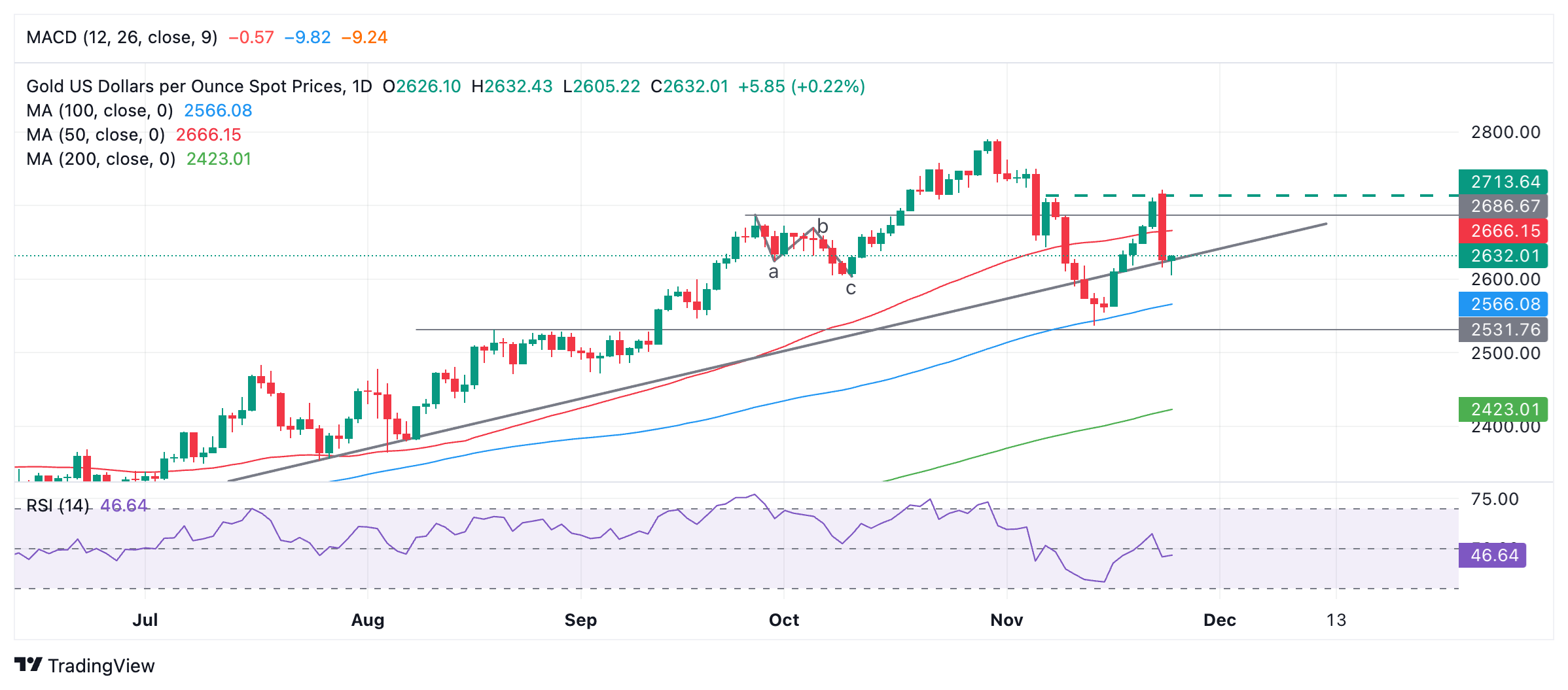
However, the precious metal trend is still bullish on a medium and long-term basis, and given the maxim that “the trend is your friend,” the odds still favor a continuation higher. In the short term, the trend is unclear.
A break above $2,721 (Monday’s high) would be a bullish sign and give the green light to a continuation higher. The next target would be at $2,790, matching the previous record high.
Alternatively, a decisive break below the major trendline would likely lead to further losses and flip the short-term trend bearish. A decisive break would be one accompanied by a long red candlestick that broke cleanly through the trendline and closed near its low – or three red candlesticks in a row that broke below the line.
US Dollar FAQs
The US Dollar (USD) is the official currency of the United States of America, and the ‘de facto’ currency of a significant number of other countries where it is found in circulation alongside local notes. It is the most heavily traded currency in the world, accounting for over 88% of all global foreign exchange turnover, or an average of $6.6 trillion in transactions per day, according to data from 2022. Following the second world war, the USD took over from the British Pound as the world’s reserve currency. For most of its history, the US Dollar was backed by Gold, until the Bretton Woods Agreement in 1971 when the Gold Standard went away.
The most important single factor impacting on the value of the US Dollar is monetary policy, which is shaped by the Federal Reserve (Fed). The Fed has two mandates: to achieve price stability (control inflation) and foster full employment. Its primary tool to achieve these two goals is by adjusting interest rates. When prices are rising too quickly and inflation is above the Fed’s 2% target, the Fed will raise rates, which helps the USD value. When inflation falls below 2% or the Unemployment Rate is too high, the Fed may lower interest rates, which weighs on the Greenback.
In extreme situations, the Federal Reserve can also print more Dollars and enact quantitative easing (QE). QE is the process by which the Fed substantially increases the flow of credit in a stuck financial system. It is a non-standard policy measure used when credit has dried up because banks will not lend to each other (out of the fear of counterparty default). It is a last resort when simply lowering interest rates is unlikely to achieve the necessary result. It was the Fed’s weapon of choice to combat the credit crunch that occurred during the Great Financial Crisis in 2008. It involves the Fed printing more Dollars and using them to buy US government bonds predominantly from financial institutions. QE usually leads to a weaker US Dollar.
Quantitative tightening (QT) is the reverse process whereby the Federal Reserve stops buying bonds from financial institutions and does not reinvest the principal from the bonds it holds maturing in new purchases. It is usually positive for the US Dollar.
Author

Joaquin Monfort
FXStreet
Joaquin Monfort is a financial writer and analyst with over 10 years experience writing about financial markets and alt data. He holds a degree in Anthropology from London University and a Diploma in Technical analysis.