Gold shrugs off US Retail Sales data, trades little changed
- Gold bounces off technical support aided by the US Dollar, which peaks and rolls over.
- The precious metal faces headwinds from the outlook for US interest rates and Trumponomics.
- The US economy is in “remarkably good” shape, according to Fed Chair Powell, lifting the USD and weighing on Gold.

Gold (XAU/USD) trades little changed on Friday, holding steady in the $2,570s after making a slight recovery from the two-month lows reached on the previous day.
The precious metal remains relatively unaffected by the release of US Retail Sales which rose by 0.4% MoM, beating estimates of 0.3% but below the previous month's revised-up 0.8%, according to data from the Bureau of Labor Statistics (BLS).
Retail Sales ex Autos, however, registered a 0.1% rise, falling below estimates of 0.3% and the previous month's revised-up 1.0% rise.
The data indicates that US consumers continue to spend quite freely and given the importance of consumption to the US economy this is likely to be positive for growth. It backs up the Chariman of the Federal Reserve Jerome Powell's remark on Thursday that the US economy is doing "remarkably well" and suggests he and his Fed colleagues will not cut interest rates as aggresively as previous feared. Higher interest rates are positive for the USD – but negative for Gold.
The stronger US Dollar (USD) continues to put background pressure on Gold since it is mainly priced and traded in the US currency. Sticky US inflation and positive labor market data, as well as upbeat comments from the Federal Reserve (Fed) Chairman Jerome Powell, led the US Dollar Index (DXY) to a new year-to-date high on Thursday, continue to maintain bearish pressure on the yellow metal.
Gold slumps on strong USD, Republican “clean-sweep”
Gold extended its decline, breaking below a major trendline and reaching new lows in the $2,530s on Thursday, after a combination of higher US factory-gate inflation data, lower US unemployment claims data and upbeat commentary from Fed Chairman Powell.
Powell said the Fed would not need to not take such an aggressive approach to cutting interest rates given the US economy was doing “remarkably well”. The comments were negative for Gold, which, as a non-interest-paying asset, tends to outperform when interest rates are lower.
The news that the Republicans had crossed the threshold for gaining a majority in the US House of Representatives, and the fact they already control the US Senate and the White House, further weighed on Gold.
Control of the legislature will mean President-elect Donald Trump and his party will be able to push through their economic policies with less friction. These, whilst expected to be inflationary and therefore potentially positive for Gold – a traditional “goto” inflation hedge – could also be bearish for the precious metal because it could force the Fed to keep interest rates elevated.
Another reason for Gold's relatively rapid decline in November are outflows from large hedge funds, who rode the bull wave higher in October as Gold peaked at a record high of $2,790. Many of these funds use trend-following techniques and Gold’s recent declines could be flashing warning lights about the sustainability of the hitherto rock-solid uptrend.
Gold Exchange Traded Funds (ETFs), which allow investors to purchase “stocks” in Gold – enabling them to hold the commodity without actually purchasing the physical commodity – have also seen outflows, according to the World Gold Council (WGC). Gold ETFs shed around $809 million (12 tonnes) net in early November, driven by North American outflows and partially offset by Asian inflows.
Meanwhile, geopolitical risks remain elevated, providing some underpinning support for Gold as a popular safe-haven asset. That said, US efforts at negotiating a ceasefire in Lebanon were said to be showing “tentative signs of progress,” according to a Reuters report on Friday.
Technical Analysis: XAU/USD finds support at 100-day SMA
Gold bounces off its (blue) 100-day Simple Moving Average (SMA) and attempts a recovery. Still, the precious metal is in a short and probably medium-term downtrend. This, given the principle of technical analysis that “the trend is your friend,” favors a continuation lower.
XAU/USD Daily Chart
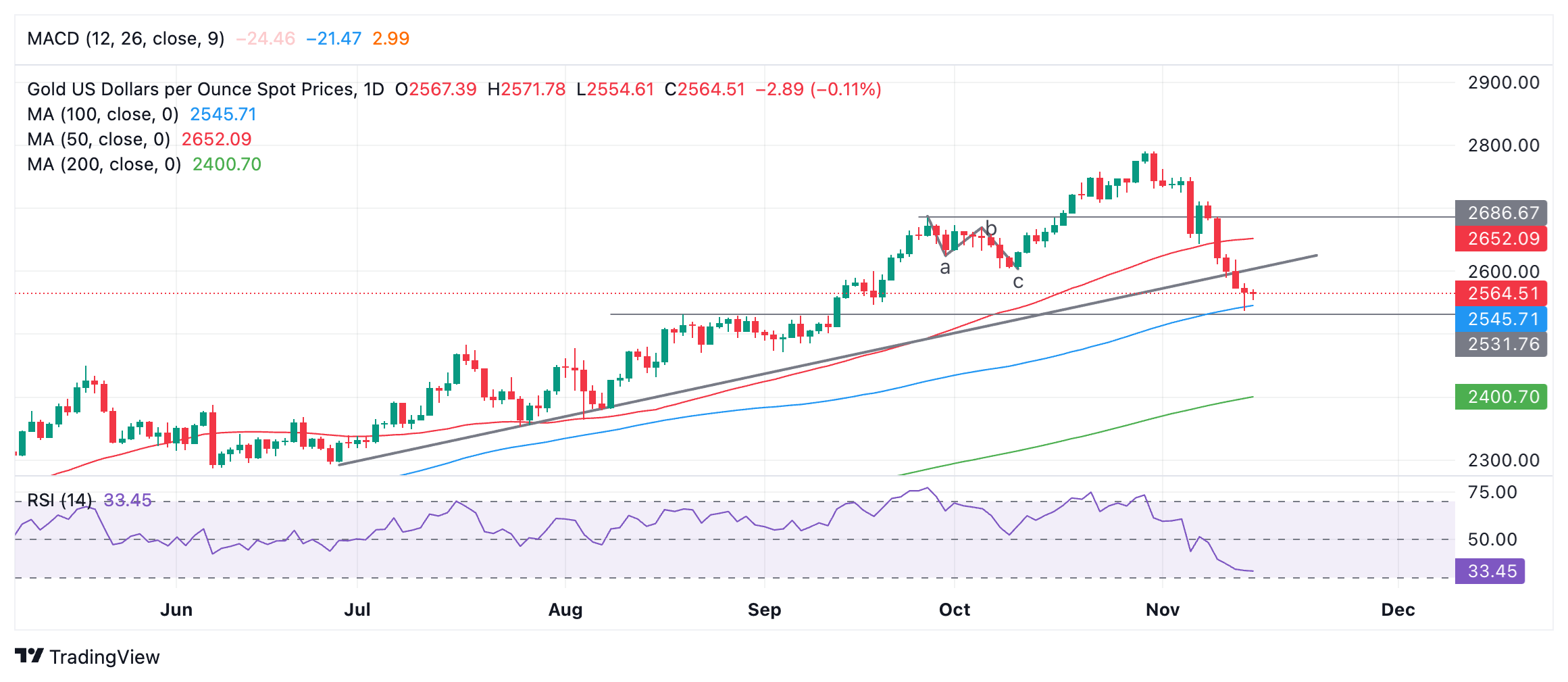
Gold formed a bullish Hammer Japanese candlestick pattern on Thursday after touching support at the 100 SMA. However, it will require confirmation from a green bullish candle on Friday to indicate a near-term reversal. Currently, the price is trading flat.
Given the overarching downtrend, a break below the $2,530 August highs would probably indicate an extension of the trend lower. The next downside target lies in around the $2,470s, followed by $2,400, where the (green) 200-day SMA is located.
The precious metal remains in an uptrend on a long-term basis, raising the risk of a reversal higher in line with its broader upcycle.
Gold FAQs
Gold has played a key role in human’s history as it has been widely used as a store of value and medium of exchange. Currently, apart from its shine and usage for jewelry, the precious metal is widely seen as a safe-haven asset, meaning that it is considered a good investment during turbulent times. Gold is also widely seen as a hedge against inflation and against depreciating currencies as it doesn’t rely on any specific issuer or government.
Central banks are the biggest Gold holders. In their aim to support their currencies in turbulent times, central banks tend to diversify their reserves and buy Gold to improve the perceived strength of the economy and the currency. High Gold reserves can be a source of trust for a country’s solvency. Central banks added 1,136 tonnes of Gold worth around $70 billion to their reserves in 2022, according to data from the World Gold Council. This is the highest yearly purchase since records began. Central banks from emerging economies such as China, India and Turkey are quickly increasing their Gold reserves.
Gold has an inverse correlation with the US Dollar and US Treasuries, which are both major reserve and safe-haven assets. When the Dollar depreciates, Gold tends to rise, enabling investors and central banks to diversify their assets in turbulent times. Gold is also inversely correlated with risk assets. A rally in the stock market tends to weaken Gold price, while sell-offs in riskier markets tend to favor the precious metal.
The price can move due to a wide range of factors. Geopolitical instability or fears of a deep recession can quickly make Gold price escalate due to its safe-haven status. As a yield-less asset, Gold tends to rise with lower interest rates, while higher cost of money usually weighs down on the yellow metal. Still, most moves depend on how the US Dollar (USD) behaves as the asset is priced in dollars (XAU/USD). A strong Dollar tends to keep the price of Gold controlled, whereas a weaker Dollar is likely to push Gold prices up.
Author

Joaquin Monfort
FXStreet
Joaquin Monfort is a financial writer and analyst with over 10 years experience writing about financial markets and alt data. He holds a degree in Anthropology from London University and a Diploma in Technical analysis.

















