Gold eases from three-week highs as USD steadies on cautious Fed outlook
- Gold eases from three-week highs as momentum fades amid mixed market sentiment.
- US Dollar stabilizes after Fed officials signal caution on further monetary easing.
- Technically, sustained weakness below $4,100 would raise the risk of a slide toward $4,000.

Gold (XAUUSD) trades on the back foot on Friday as bulls struggle to hold early gains amid mixed market sentiment. At the time of writing, XAU/USD is trading around $4,100, down nearly 1.5%, after sliding to $4,032 earlier in the day
Relief over the end of the US government shutdown has eased some of Gold’s safe-haven appeal. At the same time, a run of cautious remarks from Federal Reserve (Fed) officials has prompted traders to dial back expectations of a December rate cut. The fading prospect of near-term easing is helping the US Dollar (USD) recover after recent weakness, adding pressure on the non-yielding metal.
Traders now await the release of the delayed US economic data to gain a clearer picture of the Fed’s monetary policy outlook. Meanwhile, renewed concerns over stretched AI valuations are weighing on global equity markets, tempering risk appetite and could help limit Gold’s downside as the metal heads for a weekly gain.
Market movers: Greenback recovers as Fed officials push back on December rate cut
- The US Dollar Index (DXY), which measures the Greenback's value against a basket of six major currencies, is staging a modest rebound from two-week lows, trading around 99.37, up nearly 0.20% on the day.
- Markets welcomed the reopening of the US government, but the short-lived funding arrangement has not eased deeper concerns, as the temporary bill only restores federal operations through January 30, 2026, while extending funding for select departments until September 30, 2026. With another shutdown risk looming just weeks away, overall sentiment remains fragile.
- On the release of delayed economic data, White House Senior Adviser Kevin Hassett told Fox News on Thursday that the September nonfarm payrolls report could be published next week. For the October jobs report, he said, “We’re going to get half the employment report. We’ll get the jobs part, but we won’t get the unemployment rate.”
- Fed officials struck a cautious tone on Thursday, signaling no urgency to cut rates. San Francisco Fed President Mary Daly said it is “premature to say definitely a cut or no cut in December,” noting that the labor market “has slowed quite a bit” and inflation is easing but “still stubborn.” Boston Fed President Susan Collins echoed a similar stance, saying there is a “relatively high bar for additional easing in the near term,” warning that further policy support “runs the risk of slowing or stalling inflation’s return to 2%.”
- St. Louis Fed President Alberto Musalem said, “We need to proceed and tread with caution, because I think there’s limited room for further easing.” Minneapolis Fed President Neel Kashkari added that he opposed the October cut and has not made up his mind about December.
- According to the CME FedWatch Tool, markets now price a 49% probability of a December rate cut, sharply lower from 94% a month ago. Traders will parse upcoming Fed speeches later today, which could shape rate expectations further.
Technical analysis: XAU/USD drifts lower after rejection at $4,250
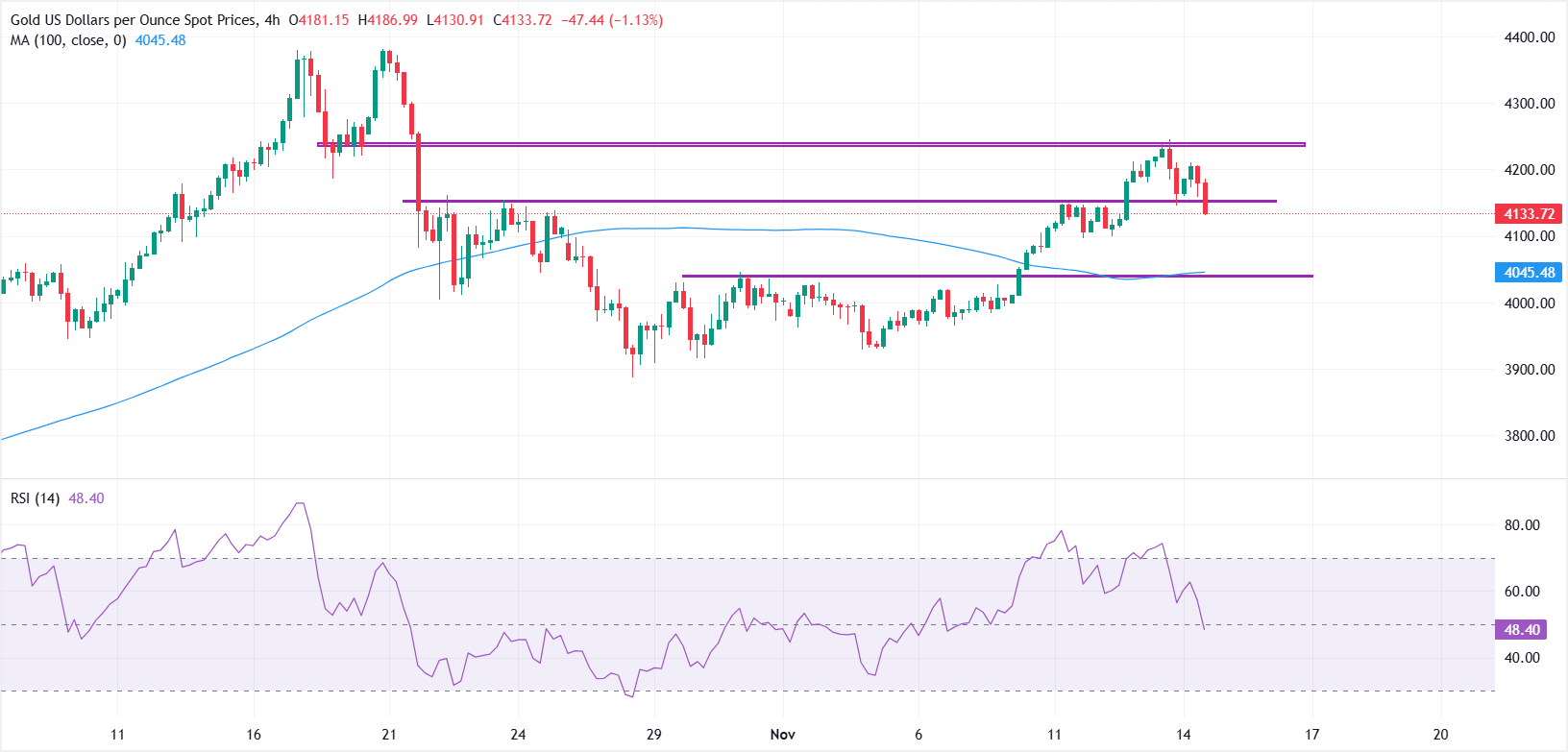
XAU/USD loses momentum after rising sharply earlier in the week following a breakout from its previous consolidation zone. The rally stalled in the $4,200-$4,250 resistance band, where sellers have re-emerged and taken near-term control.
On the downside, the $4,050 region forms an immediate support zone, and a sustained move below this area opens the risk of a slide toward $4,000. On the upside, a decisive break above $4,250 is needed to revive bullish momentum and expose the all-time high zone around $4,318 as the next upside target.
Momentum signals are cooling, with the Relative Strength Index (RSI) easing below 50, suggesting buyers are losing some strength after the recent surge.
Gold FAQs
Gold has played a key role in human’s history as it has been widely used as a store of value and medium of exchange. Currently, apart from its shine and usage for jewelry, the precious metal is widely seen as a safe-haven asset, meaning that it is considered a good investment during turbulent times. Gold is also widely seen as a hedge against inflation and against depreciating currencies as it doesn’t rely on any specific issuer or government.
Central banks are the biggest Gold holders. In their aim to support their currencies in turbulent times, central banks tend to diversify their reserves and buy Gold to improve the perceived strength of the economy and the currency. High Gold reserves can be a source of trust for a country’s solvency. Central banks added 1,136 tonnes of Gold worth around $70 billion to their reserves in 2022, according to data from the World Gold Council. This is the highest yearly purchase since records began. Central banks from emerging economies such as China, India and Turkey are quickly increasing their Gold reserves.
Gold has an inverse correlation with the US Dollar and US Treasuries, which are both major reserve and safe-haven assets. When the Dollar depreciates, Gold tends to rise, enabling investors and central banks to diversify their assets in turbulent times. Gold is also inversely correlated with risk assets. A rally in the stock market tends to weaken Gold price, while sell-offs in riskier markets tend to favor the precious metal.
The price can move due to a wide range of factors. Geopolitical instability or fears of a deep recession can quickly make Gold price escalate due to its safe-haven status. As a yield-less asset, Gold tends to rise with lower interest rates, while higher cost of money usually weighs down on the yellow metal. Still, most moves depend on how the US Dollar (USD) behaves as the asset is priced in dollars (XAU/USD). A strong Dollar tends to keep the price of Gold controlled, whereas a weaker Dollar is likely to push Gold prices up.
Author

Vishal Chaturvedi
FXStreet
I am a macro-focused research analyst with over four years of experience covering forex and commodities market. I enjoy breaking down complex economic trends and turning them into clear, actionable insights that help traders stay ahead of the curve.