Gold rises despite easing Fed cut bets, US Dollar recovery
- Gold trades near $4,092 as markets reduce bets on a December Fed amid a US Dollar rebound.
- US Senate advances a bipartisan bill to end the shutdown, with optimism from President Trump.
- Weaker US data stokes recession fears; traders price 67% chance of Fed easing next month.

Gold price rallies over 2% on Monday as investors increases bets on a Federal Reserve (Fed) rate cut at the December meeting. Meanwhile, news of a possible reopening of the US government pushed the Greenback higher, yet the yellow-metal buyers remain reluctant to give way to earlier gains. At the time of writing, XAU/USD trades at $4,092.
Bullion rallies over 2% to start the week, buoyed by easing expectations, optimism over US government reopening
On the weekend, the US Senate approved a measure paving the way for the reopening of the federal government, with support from several Democratic lawmakers. President Donald Trump welcomed the move, saying it looks “like we’re getting very close to the shutdown ending.”
Recent news revealed that the leader of the Republicans in the Senate John Thune commented that he hopes the stopgap funding vote will be held within hours. At the same time, House Speaker Mike Johnson is seeking a vote on the stopgap bill for Wednesday, according to The Wall Street Journal.
Last week’s data showed that the US economy has begun to show some cracks, following the Challenger’s report and the University of Michigan (UoM) Consumer Sentiment data. This has kept the chances for a Fed rate cut at the December meeting at around 61%, compared to 66.8% a week ago, according to the CME Fedwatch Tool, amid Fed Chair Jerome Powell's hawkish press conference following October 29 decision.
Daily market movers: Gold unfazed by strong US Dollar
- The US Dollar Index (DXY), which tracks the performance of the American currency against other six, recovers and gains over 0.12% to 99.67.
- US Treasury yields with the 10-year Treasury note yield stabilized, edges up two basis points, remains steady at 4.115%. US real yields — which correlate inversely to Gold prices — climb nearly two basis points to 1.832%.
- St. Louis Fed President Alberto Musalem said the US economy has shown resilience, noting that inflation remains “closer to 3% than 2%.” Earlier, San Francisco Fed President Mary Daly remarked that inflation in goods prices has been “pretty contained,” adding that recent rate cuts have supported the labor market but also placed some upward pressure on inflation.
- The University of Michigan’s Consumer Sentiment Index fell sharply to 50.3 in November from 53.6 in October, signaling weaker household confidence. The survey showed one-year inflation expectations edged higher to 4.7% from 4.6%, while the five-year outlook eased to 3.6% from 3.9%.
- The World Gold Council revealed that Gold ETFs recorded inflows of 54.9 tonnes in October.
- US employers announced more than 150,000 job cuts in October, marking the largest reduction for that month in over two decades, according to data from Challenger, Gray & Christmas. The report highlighted that industries implementing AI-driven transformations accounted for much of the increase in layoffs.
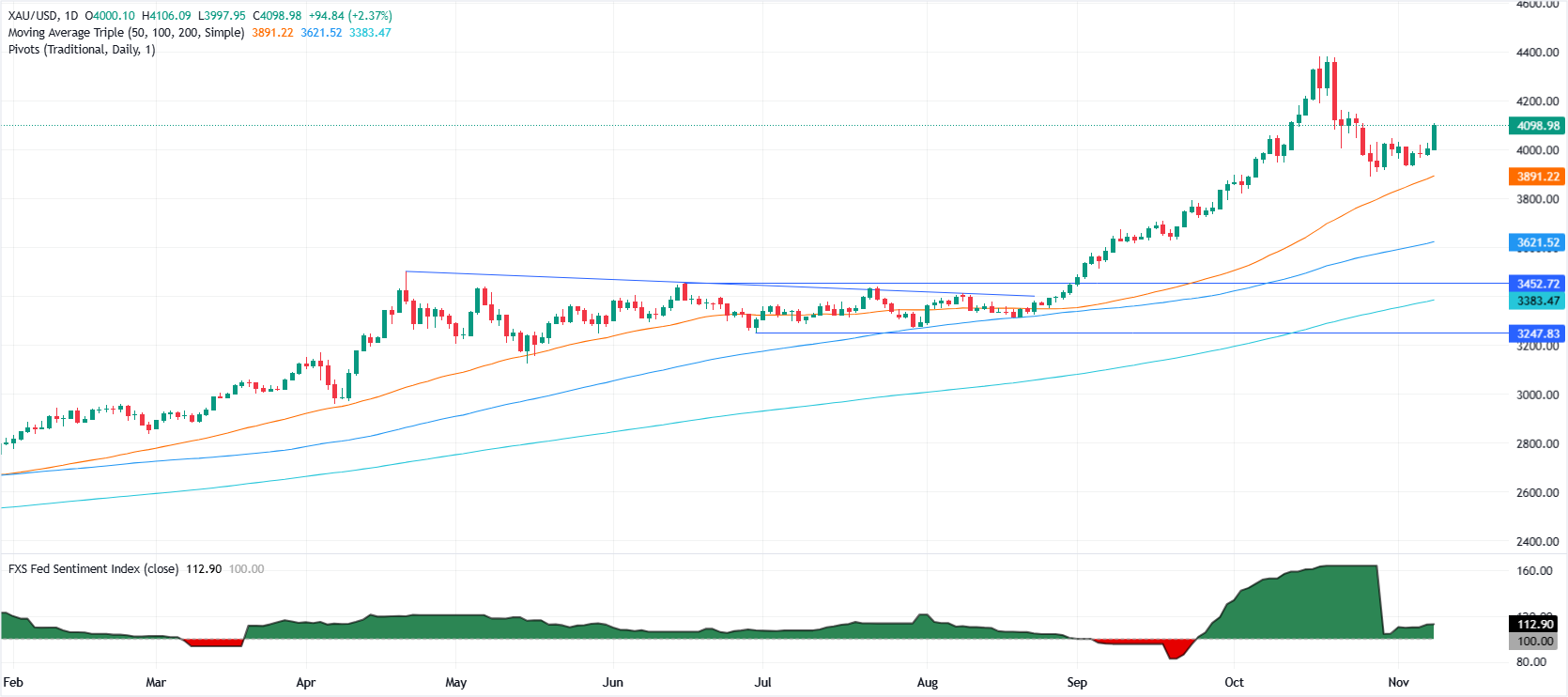
Technical outlook: Gold price surges, traders target $4,100
Gold’s technical picture remains bullish, yet it failed to decisively clear the $4,100 mark, opening the door for some consolidation within the $4,000-$4,100 range. The Relative Strength Index (RSI) shows that bullish momentum is building,
Key resistance lies at $4,100. A breach of the latter will expose October 22 high at $4,161, ahead of $4,200. Conversely, a drop below $4,000 would expose the $3,950, followed by the October 28 low of $3,886.
Gold FAQs
Gold has played a key role in human’s history as it has been widely used as a store of value and medium of exchange. Currently, apart from its shine and usage for jewelry, the precious metal is widely seen as a safe-haven asset, meaning that it is considered a good investment during turbulent times. Gold is also widely seen as a hedge against inflation and against depreciating currencies as it doesn’t rely on any specific issuer or government.
Central banks are the biggest Gold holders. In their aim to support their currencies in turbulent times, central banks tend to diversify their reserves and buy Gold to improve the perceived strength of the economy and the currency. High Gold reserves can be a source of trust for a country’s solvency. Central banks added 1,136 tonnes of Gold worth around $70 billion to their reserves in 2022, according to data from the World Gold Council. This is the highest yearly purchase since records began. Central banks from emerging economies such as China, India and Turkey are quickly increasing their Gold reserves.
Gold has an inverse correlation with the US Dollar and US Treasuries, which are both major reserve and safe-haven assets. When the Dollar depreciates, Gold tends to rise, enabling investors and central banks to diversify their assets in turbulent times. Gold is also inversely correlated with risk assets. A rally in the stock market tends to weaken Gold price, while sell-offs in riskier markets tend to favor the precious metal.
The price can move due to a wide range of factors. Geopolitical instability or fears of a deep recession can quickly make Gold price escalate due to its safe-haven status. As a yield-less asset, Gold tends to rise with lower interest rates, while higher cost of money usually weighs down on the yellow metal. Still, most moves depend on how the US Dollar (USD) behaves as the asset is priced in dollars (XAU/USD). A strong Dollar tends to keep the price of Gold controlled, whereas a weaker Dollar is likely to push Gold prices up.
Author

Christian Borjon Valencia
FXStreet
Markets analyst, news editor, and trading instructor with over 14 years of experience across FX, commodities, US equity indices, and global macro markets.














