Gold continues rallying after dip in US consumer sentiment index
- Gold continues to recover after the Michigan Consumer Sentiment Index reveals a dip in sentiment on Friday.
- Gold shurgged off higher inflation data earlier in the day as weak US jobs data on Thursday kept bets alive of furter Fed easing.
- Technically, XAU/USD returns to its range-bound mode as it unfolds a leg back higher.

Gold (XAU/USD) extends its rally, trading in the $2,650s on Friday, after the release the the preliminary Michigan Consumer Sentiment Index showed a slide in sentiment in October.
The Michigan Consumer Sentiment Index fell to 68.9 in October from 70.1 in the previous month and was below estimates of 70.8, according to data from the University of Michigan.
The release came after data showed US "factory-gate" prices rose in September compared to a year ago but flat-lined compared to the previous month. The mixed data seemed to have little impact on Gold prices which continued trading in the $2,640s after the release.
The US headline PPI increased by 1.8% YoY in September, which was higher than the 1.7% registered in August, and beat estimates of 1.6%, data from the US Bureau of Labor Statistics (BLS) showed on Friday.
These gains, however, were not reflected in the monthly data which showed headline PPI rising 0.0% compared to 0.2% in August and below the 0.1% forecast.
The PPI ex Food and Energy rose by 2.8% YoY in September, which was higher than the 2.4% in August and beat expectations of 2.7%.
For core PPI the monthly data showed a slower 0.2% in September compared to 0.3% in August which was in line with expectations.
PPI figures are sometimes taken as a precursor of consumer prices since higher production prices are usually passed to consumers in the form of dearer shop prices.
Gold rallies after US jobs data
Gold rebounded from just above the key $2,600 psychological level on Thursday after the release of official US Jobless Claims data showed a surprising spike in the number of people claiming unemployment benefits. US Treasury yields dipped after the release, the US Dollar (USD) marginally weakened and Gold got a lift.
US Initial Jobless Claims in the week ending October 4 rose by 258K, above the 225K of the previous week and expectations of 230K, data from the US Bureau of Labor Statistics (BLS) showed. The rise in initial claims was well above the average, although this might have been caused by the exodus from Florida ahead of the impact of Hurricane Milton, according to Bloomberg News.
Continuing Claims for the week ending September 27 rose to 1.861 million, higher than the revised-down 1.819M of the previous week and roundly above the 1.830M estimate.
Overall, the data showed weakness creeping into the jobs market, which is likely to keep the Fed on track to cut interest rates (in order to stimulate borrowing and job creation) at its November policy meeting. In August, Fed Chairman Jerome Powell signaled he was shifting his focus from inflation to the Fed’s other mandate: “full employment”.
Although the market-based probability of the Fed lowering its fed funds rate by 50 basis points (bps) (0.50%) remained at zero after the release, the chances of a smaller 25 bps (0.25%) cut rose to 89% from 85% before the jobs’ data, according to the CME Fedwatch tool. The probability of the Fed leaving its key interest rate unchanged in November fell to 11% from 15%. These probabilities have since reverted to 85% for 25 bps and 15% for no-change.
Higher-than-expected inflation data, as measured by the Consumer Price Index (CPI) for September, released at the same time as the Jobless Claims’ data, failed to act as a counter-weight. Headline CPI climbed 2.4% year-over-year (YoY) from 2.3% previously, and core CPI rose 3.3% YoY from 3.2% previously. The higher inflation would normally be expected to increase bets of the Fed keeping interest rates unchanged to continue the fight against stubbornly high inflation, however, this was not the case on Thursday. This was probably due to the Fed’s new prioritization of employment.
Gold has recently gained a further backdraught from the speeches of Fed policymakers. A long list of officials commented on the outlook for monetary policy on Wednesday, and all were assessed as either neutral or dovish according to the FXStreet FedTracker, a new AI-powered tool that gauges the tone of Fed officials’ speeches on a dovish-to-hawkish scale from 0 to 10.
Gold could also be gaining due to attracting safe-haven flows amid elevated geopolitical tensions. Israel has stepped up its bombing of Hezbollah targets in Lebanon, causing substantial collateral damage, and investors remain on tenterhooks about the scale of Israel’s almost certain retaliation against Iran.
Technical Analysis: Gold returns to familiar range
Gold flips its short-term downtrend and rises back up into its familiar range above $2,625 after bottoming out at the $2,600 psychological level.
XAU/USD 4-hour Chart
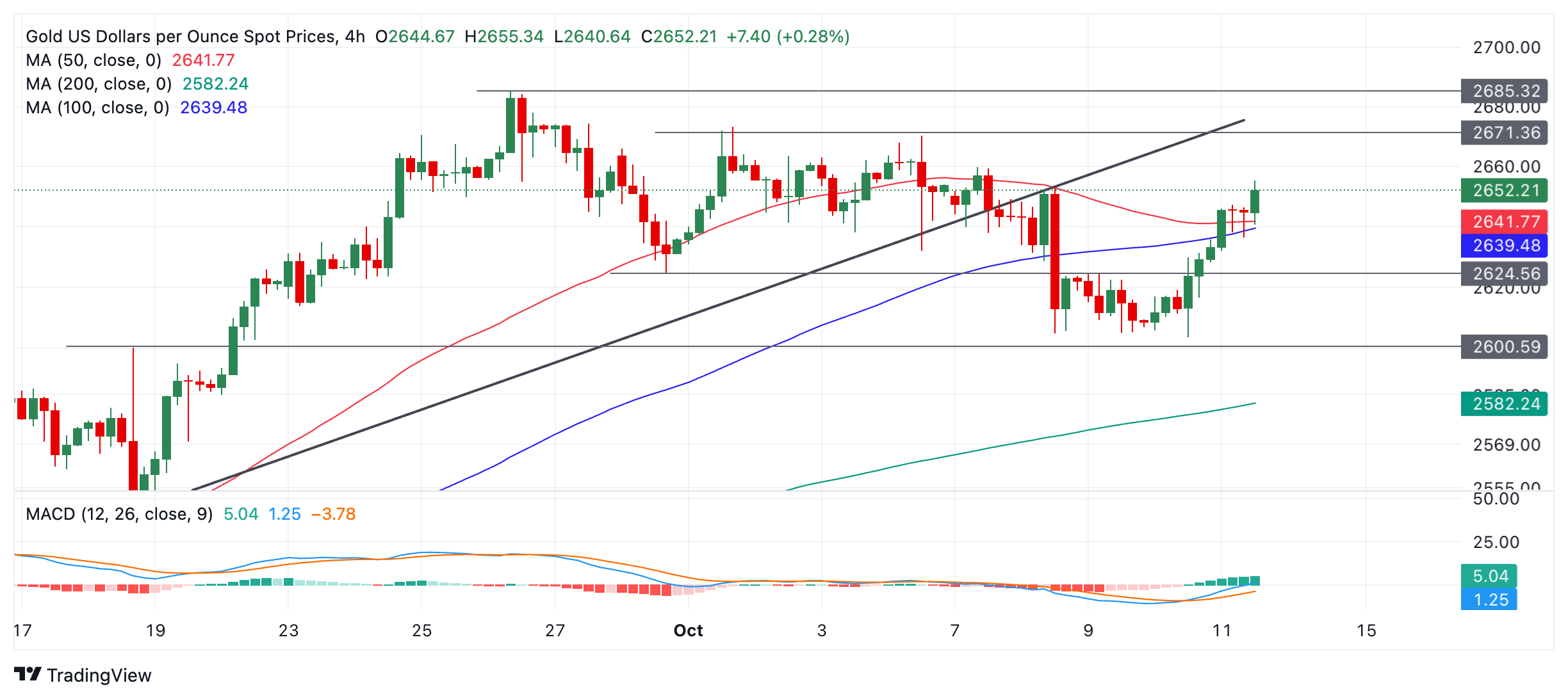
The short-term trend has probably switched back to sideways, and given the technical analysis principle that “the trend is your friend,” the odds favor a continuation in the near term. This will likely see Gold continue its up-leg towards the old range ceiling at $2,670. A break above $2,653 (October 8 high) would provide more confirmation such a leg was evolving. Following that, Gold might unfold a leg back down to the range floor as it continues oscillating.
Gold’s medium and long-term trends remain bullish, however, and if one of these longer-term cycles resumes, it could, in theory, push the asset to even higher highs.
Economic Indicator
Michigan Consumer Sentiment Index
The Michigan Consumer Sentiment Index, released on a monthly basis by the University of Michigan, is a survey gauging sentiment among consumers in the United States. The questions cover three broad areas: personal finances, business conditions and buying conditions. The data shows a picture of whether or not consumers are willing to spend money, a key factor as consumer spending is a major driver of the US economy. The University of Michigan survey has proven to be an accurate indicator of the future course of the US economy. The survey publishes a preliminary, mid-month reading and a final print at the end of the month. Generally, a high reading is bullish for the US Dollar (USD), while a low reading is bearish.
Read more.Last release: Fri Oct 11, 2024 14:00 (Prel)
Frequency: Monthly
Actual: 68.9
Consensus: 70.8
Previous: 70.1
Source: University of Michigan
Consumer exuberance can translate into greater spending and faster economic growth, implying a stronger labor market and a potential pick-up in inflation, helping turn the Fed hawkish. This survey’s popularity among analysts (mentioned more frequently than CB Consumer Confidence) is justified because the data here includes interviews conducted up to a day or two before the official release, making it a timely measure of consumer mood, but foremost because it gauges consumer attitudes on financial and income situations. Actual figures beating consensus tend to be USD bullish.
Author

Joaquin Monfort
FXStreet
Joaquin Monfort is a financial writer and analyst with over 10 years experience writing about financial markets and alt data. He holds a degree in Anthropology from London University and a Diploma in Technical analysis.