Gold remains below $4,200 as bulls seem non-committed amid reduced Fed rate cut bets
- Gold struggles to capitalize on its modest intraday gains, though the downside seems limited.
- Reduced bets for a December Fed rate cut act as a headwind for the non-yielding yellow metal.
- Economic concerns weigh on the USD and could support XAU/USD amid the risk-off impulse.

Gold (XAU/USD) rebounds slightly from the daily low and trades with a mild positive bias during the first half of the European session on Friday, though it remains below the $4,200 mark. A growing number of Federal Reserve (Fed) policymakers signaled caution on further easing amid the lack of economic data, prompting traders to trim their bets for another rate cut in December. This, in turn, is seen as a key factor acting as a headwind for the non-yielding yellow metal.
Investors, however, seem convinced that weakening economic momentum on the back of a prolonged US government shutdown could allow the Fed to ease monetary policy further. This, in turn, fails to assist the US Dollar (USD) in registering any meaningful recovery from a two-week low, touched on Thursday, and supports the Gold price. Moreover, a weaker risk tone turns out to be another factor that contributes to limiting the downside for the safe-haven precious metal.
Daily Digest Market Movers: Gold bulls seem reluctant amid receding bets for a December Fed rate cut
- The reopening of the US government shifts market focus back to the deteriorating fiscal outlook. Moreover, market participants now seem convinced that the delayed US macro data will show some weakness in the economy and back the case for further policy easing by the US Federal Reserve.
- Economists estimate that the prolonged government closure might have already shaved approximately 1.5 to 2.0% off quarterly GDP growth. This comes amid signs of deteriorating labor market conditions and fails to assist the US Dollar to register any recovery from a two-week trough.
- Meanwhile, a senior White House official said that key economic reports for October – employment details and inflation data – may not be released at all. This prompted several Fed officials to signal caution on further easing, forcing investors to trim their bets for a rate cut in December.
- Minneapolis Fed President Neel Kashkari said the economic outlook is mixed as inflation continues to run higher. Separately, Boston Fed President Susan Collins said that given the limited information on inflation due to the government shutdown, she would be hesitant to ease policy further.
- According to the CME Group's FedWatch Tool, traders are still pricing in a 50% possibility that the US central bank will lower borrowing costs by 25 basis points in December. Moreover, the probability of a rate reduction in January currently stands at over 75%, favoring the XAU/USD bulls.
- Traders might continue to scrutinize comments from influential FOMC members for more cues about the Fed's rate-cut path. This, in turn, will drive the USD demand and provide some impetus to the non-yielding yellow metal, which seems poised to register strong weekly gains.
Gold struggles to find acceptance above $4,200, warranting some caution before positioning for further gains
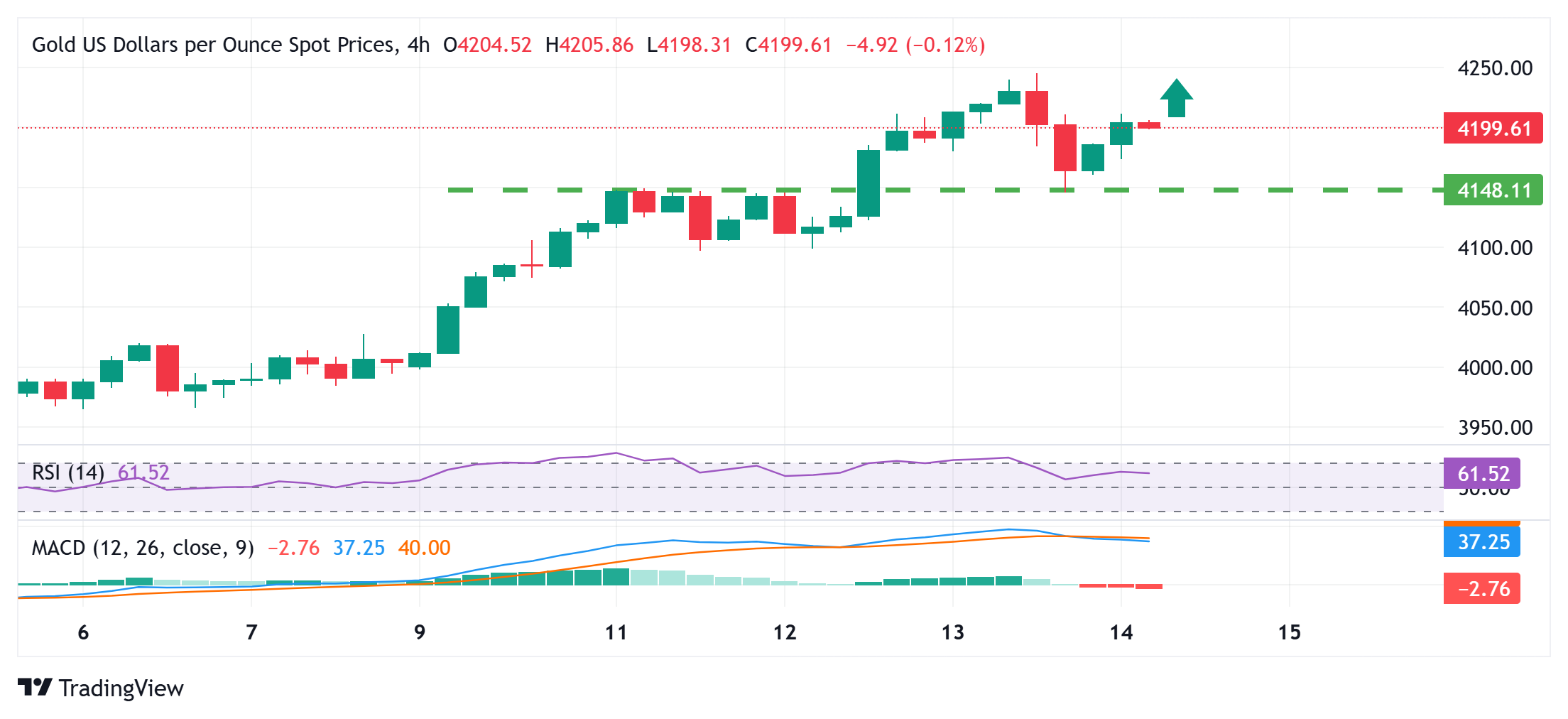
This week's breakout through the $4,150 horizontal barrier and a subsequent move beyond the $4,200 mark was seen as key trigger for the XAU/USD bulls. Moreover, oscillators on daily/4-hour chart have been gaining positive traction, suggesting that the path of least resistance for the Gold price is to the upside. Any further move higher, however, might face some hurdle near the overnight swing high, around the $4,245 region, above which the commodity could aim to reclaim the $4,300 round figure.
On the flip side, the overnight swing low, around the $4,145 region, now seems to protect the immediate downside, below which the Gold price could accelerate the fall to the $4,100 mark en route to the $4,075 zone. Some follow-through selling could expose the $4,025 intermediate support before the commodity eventually drops to the $4,000 psychological mark. The latter is likely to act as a key pivotal point, which, if broken decisively, might shift the near-term bias in favor of bearish traders.
Risk sentiment FAQs
In the world of financial jargon the two widely used terms “risk-on” and “risk off'' refer to the level of risk that investors are willing to stomach during the period referenced. In a “risk-on” market, investors are optimistic about the future and more willing to buy risky assets. In a “risk-off” market investors start to ‘play it safe’ because they are worried about the future, and therefore buy less risky assets that are more certain of bringing a return, even if it is relatively modest.
Typically, during periods of “risk-on”, stock markets will rise, most commodities – except Gold – will also gain in value, since they benefit from a positive growth outlook. The currencies of nations that are heavy commodity exporters strengthen because of increased demand, and Cryptocurrencies rise. In a “risk-off” market, Bonds go up – especially major government Bonds – Gold shines, and safe-haven currencies such as the Japanese Yen, Swiss Franc and US Dollar all benefit.
The Australian Dollar (AUD), the Canadian Dollar (CAD), the New Zealand Dollar (NZD) and minor FX like the Ruble (RUB) and the South African Rand (ZAR), all tend to rise in markets that are “risk-on”. This is because the economies of these currencies are heavily reliant on commodity exports for growth, and commodities tend to rise in price during risk-on periods. This is because investors foresee greater demand for raw materials in the future due to heightened economic activity.
The major currencies that tend to rise during periods of “risk-off” are the US Dollar (USD), the Japanese Yen (JPY) and the Swiss Franc (CHF). The US Dollar, because it is the world’s reserve currency, and because in times of crisis investors buy US government debt, which is seen as safe because the largest economy in the world is unlikely to default. The Yen, from increased demand for Japanese government bonds, because a high proportion are held by domestic investors who are unlikely to dump them – even in a crisis. The Swiss Franc, because strict Swiss banking laws offer investors enhanced capital protection.
Author

Haresh Menghani
FXStreet
Haresh Menghani is a detail-oriented professional with 10+ years of extensive experience in analysing the global financial markets.
















