Gold languishes near daily low; downside seems limited as Fed rate cut bets undermine USD
- Gold attracts some sellers following an intraday uptick amid receding safe-haven demand.
- Rising Fed rate cut bets keep the USD depressed and offer support to the XAU/USD pair.
- Geopolitical risk should contribute to limiting losses for the safe-haven precious metal.

Gold (XAU/USD) hangs near the lower end of the daily range during the first half of the European session on Wednesday, though it manages to hold above the $4,200 mark amid mixed cues. A generally positive tone around the equity markets is seen as a key factor acting as a headwind for the safe-haven precious metal. Furthermore, bulls opt to wait for important US macro releases for more cues about the Federal Reserve's (Fed) rate-cut path and placing fresh bets around the non-yielding yellow metal.
In the meantime, firming expectations that the US central bank will lower borrowing costs at its upcoming policy meeting next week keep the US Dollar (USD) depressed near a two-week low and offer some support to the Gold price. Moreover, persistent geopolitical uncertainties stemming from the protracted Russia-Ukraine war and the risk of a further escalation of conflict turn out to be another factor that helps limit the downside for the safe-haven precious metal. This warrants some caution for the XAU/USD bears.
Daily Digest Market Movers: Gold traders seem non-committed as receding safe-haven demand counter Fed rate cut bets
- Recent US macro data pointed to a gradual cooling of the US economy. Moreover, dovish signals from Federal Reserve officials bolstered expectations for a 25-basis-point rate cut at the upcoming FOMC meeting next week.
- According to the CME Group's FedWatch Tool, traders are pricing in a nearly 90% probability of the move, which keeps the US Dollar depressed through the Asian session on Wednesday and supports the non-yielding Gold.
- Reports suggest that White House National Economic Council Director Kevin Hassett is seen as the frontrunner to become the next Fed Chair. Hassett is expected to enact US President Donald Trump's calls for lower rates.
- Russian President Vladimir Putin and Trump’s envoys Steve Witkoff failed to reach a compromise on a possible peace deal in Ukraine. Adding to this, Putin issued threats that Russia was ready for a war with Europe.
- This keeps geopolitical risks in play and turns out to be another factor acting as a tailwind for the safe-haven precious metal. The XAU/USD bulls, however, might opt to wait for US macro data before placing fresh bets.
- The US ADP report on private-sector employment and the US ISM Services PMI will be published later today. The focus, however, will remain glued to the Personal Consumption Expenditure (PCE) Price Index on Friday.
- The latter would provide more cues about the Fed's rate-cut path, which, in turn, will play a key role in influencing the near-term USD price dynamics and determining the next leg of a directional move for the commodity.
Gold might continue to attract dip-buyers around $4,164-4,163, overnight swing low
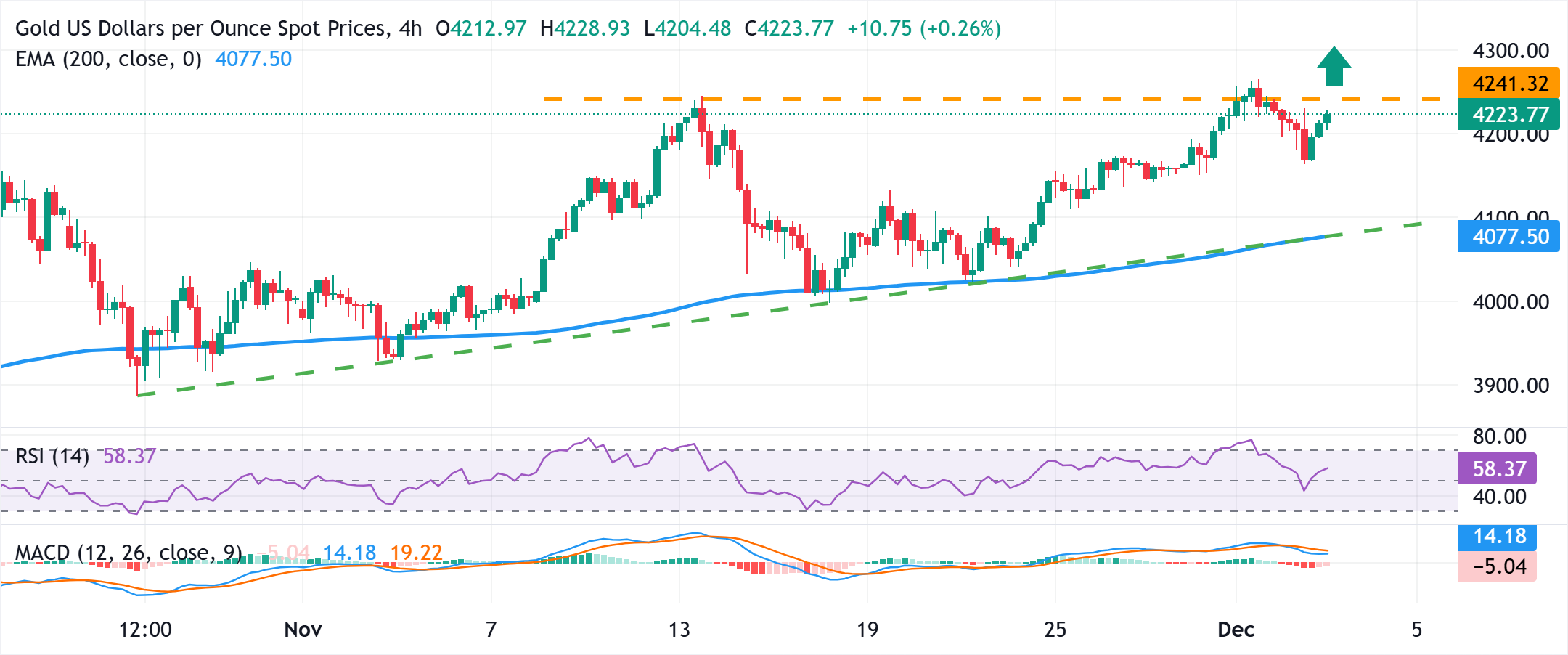
The overnight goodish rebound from the vicinity of the $4,155-4,150 support and the subsequent move up favor the XAU/USD bulls. However, it will still be prudent to wait for acceptance above the $4,245-4,250 strong barrier before positioning for any further appreciating move. The commodity might then surpass the weekly swing high, around the $4,264-4,265 region and the $4,277-4,278 resistance, toward reclaiming the $4,300 round figure.
On the flip side, weakness below the $4,200 mark might continue to attract buyers and find decent support ahead of the $4,150 level. The latter should act as a key pivotal point, which, if broken, could drag the Gold price to the $4,100 mark en route to the $4,075-4,073 confluence support – comprising the 200-period Exponential Moving Average (EMA) on the 4-hour chart and an ascending trend-line extending from late October.
Fed FAQs
Monetary policy in the US is shaped by the Federal Reserve (Fed). The Fed has two mandates: to achieve price stability and foster full employment. Its primary tool to achieve these goals is by adjusting interest rates. When prices are rising too quickly and inflation is above the Fed’s 2% target, it raises interest rates, increasing borrowing costs throughout the economy. This results in a stronger US Dollar (USD) as it makes the US a more attractive place for international investors to park their money. When inflation falls below 2% or the Unemployment Rate is too high, the Fed may lower interest rates to encourage borrowing, which weighs on the Greenback.
The Federal Reserve (Fed) holds eight policy meetings a year, where the Federal Open Market Committee (FOMC) assesses economic conditions and makes monetary policy decisions. The FOMC is attended by twelve Fed officials – the seven members of the Board of Governors, the president of the Federal Reserve Bank of New York, and four of the remaining eleven regional Reserve Bank presidents, who serve one-year terms on a rotating basis.
In extreme situations, the Federal Reserve may resort to a policy named Quantitative Easing (QE). QE is the process by which the Fed substantially increases the flow of credit in a stuck financial system. It is a non-standard policy measure used during crises or when inflation is extremely low. It was the Fed’s weapon of choice during the Great Financial Crisis in 2008. It involves the Fed printing more Dollars and using them to buy high grade bonds from financial institutions. QE usually weakens the US Dollar.
Quantitative tightening (QT) is the reverse process of QE, whereby the Federal Reserve stops buying bonds from financial institutions and does not reinvest the principal from the bonds it holds maturing, to purchase new bonds. It is usually positive for the value of the US Dollar.
Author

Haresh Menghani
FXStreet
Haresh Menghani is a detail-oriented professional with 10+ years of extensive experience in analysing the global financial markets.