Gold ticks up on Russia-Ukraine tensions, EU-US trade optimism restricts upside
- Gold price recovers to near $3,305 despite increasing hopes for a US-EU trade deal.
- Russia’s Putin demands that NATO restrict its eastern expansion in writing.
- Investors await FOMC minutes and the US PCE inflation data for April.

Gold price (XAU/USD) trades higher 0.15% to near $3,305 during North American trading hours on Wednesday, following an over 1% sell-off the previous day. The yellow metal ticks up as hopes of a ceasefire between Russia and Ukraine have diminished. Gold price tends to perform better in heightened geopolitical tensions.
Russian leader Vladimir Putin has demanded assurance from Western leaders to restrict the NATO enlargement on the east side in writing and the removal of sanctions on his nation to end the war in Ukraine. In contrast, German Chancellor Friedrich Merz stated that "we [the European Commission (EC)] are conducting talks with the US on additional sanctions against Russia."
However, the upside is expected to remain limited as investors become increasingly confident that the United States (US) and the European Union (EU) will secure a trade deal soon.
During North American trading hours, EU officials stated that US trade negotiators Howard Lutnick and Jameison Greer have agreed to trade discussions every other day.
Additionally, German carmakers BMW, Mercedes, and Volkswagen are in talks with the US trade ministry on tariffs and aim to reach an agreement by early July, according to a report by German newspaper Handelsblatt. This reflects the EU's intention to fast-track trade talks and reach a bilateral deal swiftly.
On Tuesday, US President Donald Trump expressed confidence in a post on Truth.Social that the EU is making swift efforts to come to the table for trade negotiations with Washington.
"I was extremely satisfied with the 50% Tariff allotment on the European Union, especially since they were “slow walking". I have just been informed that the EU has called to quickly establish meeting dates. This is a positive event, and I hope that they will," Trump wrote.
This comes as an improvement in the global economic outlook as both economies trade a significant portion of the global business. Theoretically, signs of easing global economic uncertainty diminish demand for safe-haven assets, such as Gold.
The optimism over the trade deal between the EU and the US has also supported the US Dollar (USD). During European trading hours, the US Dollar Index (DXY) rises to near 99.85, following Tuesday's recovery. Technically, a higher US Dollar makes the Gold price an expensive bet for investors.
Daily digest market movers: Gold price edges higher on geopolitical tensions
- The next major trigger for the Gold price will be the release of the Federal Open Market Committee (FOMC) minutes from the May policy meeting, due at 18:00 GMT. The FOMC minutes are expected to provide a detailed explanation behind the Federal Reserve’s (Fed) decision to hold interest rates steady in the range of 4.25%-4.50%.
- After the interest rate announcement, the Fed guided to hold interest rates steady for a long enough period until officials gain clarity on the economic performance due to the imposition of new economic policies under the US President Donald Trump’s leadership. The Fed also warned that the risks of higher unemployment and inflation have risen.
- This week, investors will also focus on the US Personal Consumption Expenditures Price Index (PCE) data for April, which will be released on Friday. However, the impact of the inflation data is expected to be limited as Fed officials have warned that tariffs imposed by the White House could de-anchor consumer inflation expectations.
- On Tuesday, Minneapolis Fed Bank President Neel Kashkari supported holding interest rates for longer amid elevated uncertainty over Trump’s tariff policy. “Until there is more clarity on the path for tariffs and their impact on prices and economic activity, it is better to keep a patient stance on the monetary policy, which is likely only modestly restrictive now,” Kashkari said.
Technical Analysis: Gold price struggles above $3,300
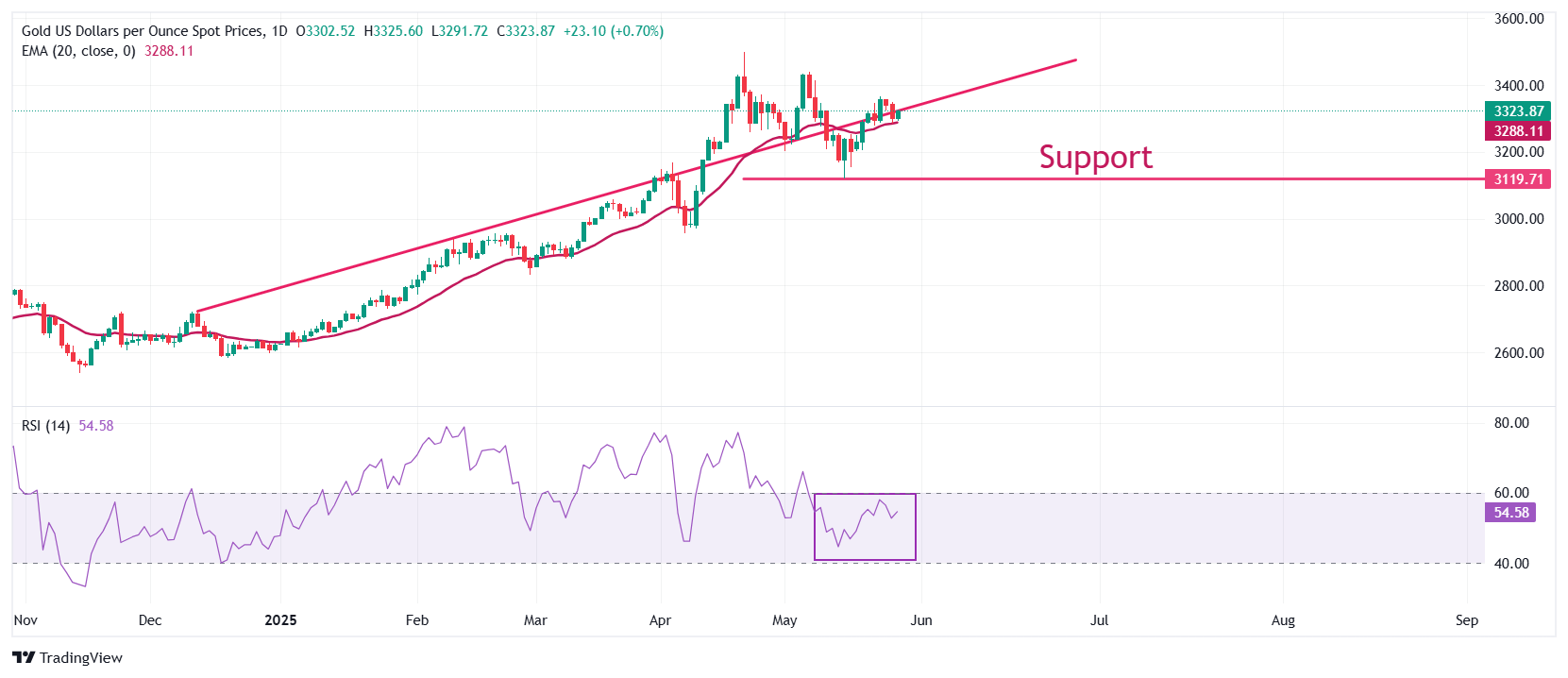
Gold price struggles around an upward-sloping trendline on a daily timeframe around $3,335, which is plotted from the December 12 high of $2,726. However, the near-term trend of the precious metal is bullish as it holds above the 20-day Exponential Moving Average (EMA), which trades around $3,288.
The 14-day Relative Strength Index (RSI) oscillates inside the 40.00-60.00 range, suggesting indecisiveness among market participants.
Looking up, the May 7 high around $3,440 will act as key resistance for the metal. On the downside, the May 15 low at $3,120 will be the key support zone.
Economic Indicator
FOMC Minutes
FOMC stands for The Federal Open Market Committee that organizes 8 meetings in a year and reviews economic and financial conditions, determines the appropriate stance of monetary policy and assesses the risks to its long-run goals of price stability and sustainable economic growth. FOMC Minutes are released by the Board of Governors of the Federal Reserve and are a clear guide to the future US interest rate policy.
Next release: Wed May 28, 2025 18:00
Frequency: Irregular
Consensus: -
Previous: -
Source: Federal Reserve
Minutes of the Federal Open Market Committee (FOMC) is usually published three weeks after the day of the policy decision. Investors look for clues regarding the policy outlook in this publication alongside the vote split. A bullish tone is likely to provide a boost to the greenback while a dovish stance is seen as USD-negative. It needs to be noted that the market reaction to FOMC Minutes could be delayed as news outlets don’t have access to the publication before the release, unlike the FOMC’s Policy Statement.
Author

Sagar Dua
FXStreet
Sagar Dua is associated with the financial markets from his college days. Along with pursuing post-graduation in Commerce in 2014, he started his markets training with chart analysis.