Gold struggles near two-week low; looks to US data for fresh impetus
- Gold price edges higher as the strong US PPI-inspired USD rally lacks follow-through buying.
- Bets for an imminent Fed rate cut in September cap the USD and support the commodity.
- The upbeat market mood keeps the XAU/USD bulls on the defensive ahead of the US data.

Gold (XAU/USD) retreats to the lower boundary of its daily range during the first half of the European session on Friday and remains close to a two-week trough touched the previous day. The strong US Producer Price Index (PPI) report released on Thursday tempered market bets for an aggressive policy easing by the Federal Reserve (Fed). This, in turn, is seen as a key factor acting as a headwind for the non-yielding yellow metal.
Apart from this, the upbeat market mood further contributes to capping the upside for the safe-haven Gold. However, the emergence of some US Dollar (USD) selling could offer support to the commodity. Traders now look to the US macro data and the headlines coming out of the US-Russia summit on Ukraine for a fresh impetus heading into the weekend. Nevertheless, the XAU/USD pair remains on track to register losses for the first time in three weeks.
Daily Digest Market Movers: Gold lacks bullish conviction amid mixed fundamental cues
- Traders trimmed their bets for a more aggressive policy easing by the Federal Reserve following the hotter-than-expected release of the US Producer Price Index on Thursday. The US Bureau of Labor Statistics reported that the headline PPI accelerated from the 2.4% YoY rate to 3.3% in July, surpassing expectations of a 2.5% by a wide margin.
- The US Dollar rebounded sharply from the vicinity of its lowest level since July 28, touched on Wednesday, and triggered an intraday turnaround of around $45 in the Gold price. The USD recovery, however, runs out of steam during the Asian session on Friday as traders are still pricing in a 90% chance that the Fed will cut interest rates in September.
- Moreover, the CME Group's FedWatch Tool indicates the possibility of two 25-basis-point Fed rate cuts by the end of this year. This, in turn, keeps a lid on any further USD appreciation and acts as a tailwind for the non-yielding yellow metal during the Asian session. However, the prevalent risk-on environment caps gains for the safe-haven commodity.
- An extension of the US-China tariff truce for another three months eased concerns about a full-blown trade war between the world's two largest economies. Furthermore, hopes that Friday's US-Russian summit will increase the chances of ending the prolonged war in Ukraine remain supportive of the bullish sentiment across the global financial markets.
- Traders now look forward to the US economic docket – featuring the release of monthly Retail Sales figures, the Empire State Manufacturing Index, followed by the University of Michigan Consumer Sentiment and Inflation Expectations Index. The data might influence the USD and provide some impetus to the XAU/USD pair heading into the weekend.
- Nevertheless, the precious metal remains on track to register losses for the first time in three weeks, and the lack of strong follow-through buying suggests that the path of least resistance remains to the downside. Hence, any subsequent move up could be seen as a selling opportunity and runs the risk of fizzling out rather quickly.
Gold seems vulnerable; two-week low around $3,330 area holds the key for bullish traders
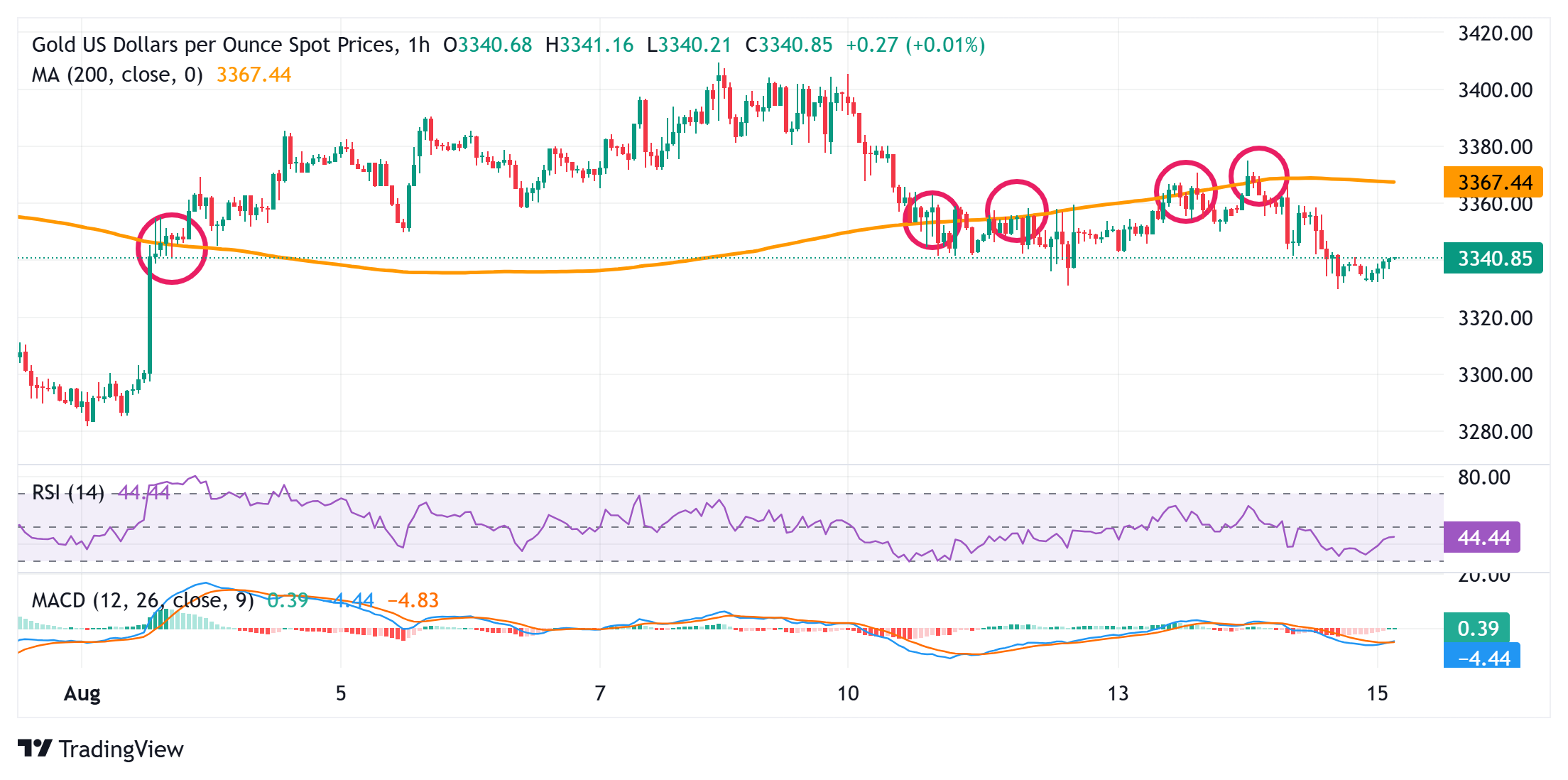
The recent repeated failures to build on momentum beyond the 100-hour Simple Moving Average (SMA) and the overnight slide favor the XAU/USD bears. Moreover, oscillators on hourly charts are holding in bearish territory and have just started gaining negative traction on the daily chart. This, in turn, validates the near-term negative outlook for the Gold price.
Hence, any attempted recovery might confront a stiff barrier and remain capped near the 100-hour SMA, currently pegged near the $3,355 region. The latter should now act as a pivotal point, which, if cleared, could lift the Gold price back to the overnight swing high, around the $3,375 zone. The momentum could extend further towards reclaiming the $3,400 mark.
On the flip side, the $3,330 area, or a two-week low touched on Thursday, seems to have emerged as an immediate support. Some follow-through selling could make the Gold price vulnerable to accelerate the slide to the $3,300 mark. Acceptance below the latter would reaffirm the near-term bearish bias and set the stage for a further depreciating move.
Economic Indicator
Retail Sales (MoM)
The Retail Sales data, released by the US Census Bureau on a monthly basis, measures the value in total receipts of retail and food stores in the United States. Monthly percent changes reflect the rate of changes in such sales. A stratified random sampling method is used to select approximately 4,800 retail and food services firms whose sales are then weighted and benchmarked to represent the complete universe of over three million retail and food services firms across the country. The data is adjusted for seasonal variations as well as holiday and trading-day differences, but not for price changes. Retail Sales data is widely followed as an indicator of consumer spending, which is a major driver of the US economy. Generally, a high reading is seen as bullish for the US Dollar (USD), while a low reading is seen as bearish.
Read more.Next release: Fri Aug 15, 2025 12:30
Frequency: Monthly
Consensus: 0.5%
Previous: 0.6%
Source: US Census Bureau
Retail Sales data published by the US Census Bureau is a leading indicator that gives important information about consumer spending, which has a significant impact on the GDP. Although strong sales figures are likely to boost the USD, external factors, such as weather conditions, could distort the data and paint a misleading picture. In addition to the headline data, changes in the Retail Sales Control Group could trigger a market reaction as it is used to prepare the estimates of Personal Consumption Expenditures for most goods.
Author

Haresh Menghani
FXStreet
Haresh Menghani is a detail-oriented professional with 10+ years of extensive experience in analysing the global financial markets.

















