Gold surges to fresh record highs amid geopolitical turmoil
- Gold hits fresh record highs as geopolitical risks fuel safe-haven demand.
- XAU/USD briefly topped $5,598 before easing amid rising volatility.
- Technicals remain stretched, but trend conditions continue to favor buyers.

Gold (XAU/USD) adds another leg to its relentless rally on Thursday, building on the previous day’s solid gains of 3.87% as increased volatility and ongoing safe-haven demand continue to drive strong inflows into Bullion. At the time of writing, XAU/USD trades around $5,522, consolidating after setting a fresh record peak near $5,598 earlier in the day.
Heightened geopolitical tensions remain a key driver behind the latest surge in Gold, with US-Iran risks back in the spotlight after Washington issued fresh warnings of potential military action.
At the same time, investor confidence in the US Dollar (USD) continues to erode, pushing flows into traditional havens. The so-called “debasement trade” remains firmly in play, fueled by US President Donald Trump’s aggressive trade agenda and repeated attacks on the Federal Reserve’s (Fed) independence.
Meanwhile, the Fed’s latest monetary policy decision failed to materially shift expectations, with markets still pricing in two rate cuts this year, adding another layer of support for the non-yielding metal.
Market movers: Geopolitics, Fed signals and Dollar volatility steer markets
- Geopolitical tensions escalated sharply after CNN reported that President Donald Trump is considering a major military strike on Iran, although no final decision has yet been made. The report follows Trump’s warning in a Truth Social post on Wednesday that a “massive armada” is heading toward Iran, urging Tehran to return to the negotiating table over its nuclear programme. Trump cautioned that “time is running out” to secure a deal and warned that “the next attack will be far worse.”
- The World Gold Council (WGC) said in its Gold Demand Trends Q4 and Full Year 2025 report published on Thursday that total Gold demand in 2025 surpassed 5,000 tonnes for the first time on record, driven by exceptionally strong investment flows. Central banks bought 863 tonnes of Gold during the year, while global Gold ETF holdings rose by 801 tonnes, the second-strongest annual increase on record. Bar and coin demand also climbed to a 12-year high.
- On the monetary policy front, the Fed kept interest rates unchanged in the 3.50%-3.75% range in a 10-2 split decision. In its statement, the central bank said economic activity continues to expand at a solid pace, while noting that job gains have remained low and the unemployment rate is showing signs of stabilization. Policymakers added that inflation remains somewhat elevated and stressed that uncertainty around the economic outlook remains high.
- Markets are also keeping a close watch on Fed leadership after US Treasury Secretary Scott Bessent said on Wednesday that President Trump’s pick for the next Fed Chair could be announced “in a week or so.” Potential candidates reportedly include Rick Rieder, Christopher Waller and Kevin Warsh. Investors remain wary that Trump’s choice could tilt the central bank toward a more dovish policy path.
- US Treasury Secretary Scott Bessent also helped steady markets after the recent bout of heavy selling that pushed the Greenback to four-year lows. Bessent said the US “always has a strong dollar policy.” The remarks followed comments from US President Donald Trump on Tuesday, who downplayed the recent slide.
- The US Dollar Index (DXY), which tracks the Greenback against a basket of six major currencies, is holding firm near 96.20. On the US economic calendar, Initial Jobless Claims fell slightly to 209K from 210K in the previous week, but came in above expectations of 205K. Initial Jobless Claims fell slightly to 209K from 210K in the previous week, but came in above expectations of 205K. Meanwhile, Nonfarm Productivity held steady at 4.3%, while Unit Labor Costs fell by 1.9% in Q3.
Technical analysis: Rally stretches, volatility rises, bulls still dominant
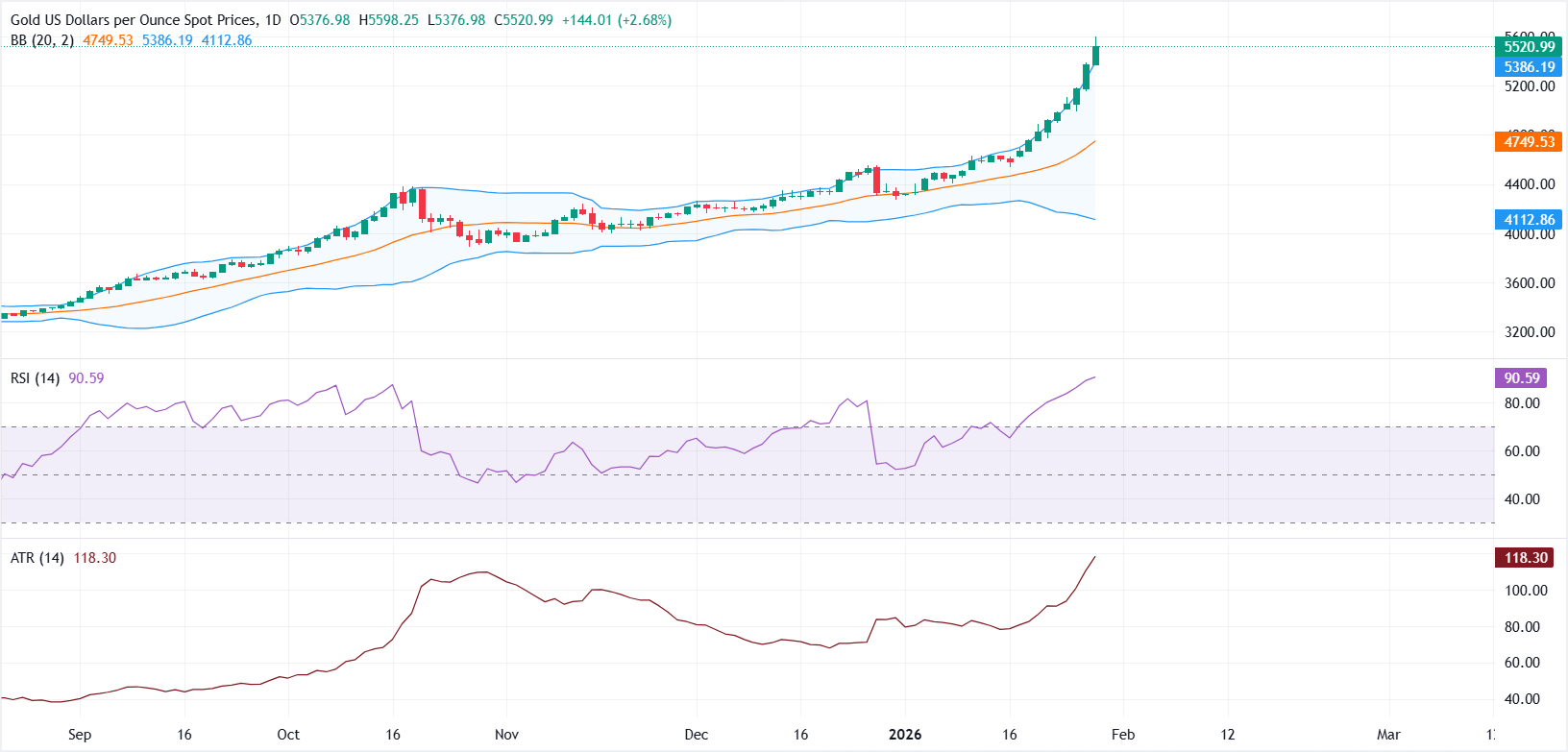
Gold’s rally is becoming increasingly overstretched, but bulls remain unfazed as upside momentum stays strong. On the daily chart, Bollinger Bands are widening, and price is trading well above the upper band near $5,384, highlighting both strong bullish momentum and stretched conditions.
The Relative Strength Index (RSI) stands at 90.53, deep in overbought territory, underscoring the strength of the move but also warning that the market is increasingly vulnerable to mean-reversion pullbacks or consolidation if momentum starts to roll over.
Volatility is also rising sharply. ATR (14) has expanded to 118.30, confirming that daily trading ranges are broadening and that price swings are becoming more aggressive.
Immediate support sits near $5,500, followed by the previous day’s low around $5,157. On the upside, if bullish momentum remains intact, XAU/USD could extend higher toward the $5,700-$5,800 zone.
(The technical analysis of this story was written with the help of an AI tool.)
Gold FAQs
Gold has played a key role in human’s history as it has been widely used as a store of value and medium of exchange. Currently, apart from its shine and usage for jewelry, the precious metal is widely seen as a safe-haven asset, meaning that it is considered a good investment during turbulent times. Gold is also widely seen as a hedge against inflation and against depreciating currencies as it doesn’t rely on any specific issuer or government.
Central banks are the biggest Gold holders. In their aim to support their currencies in turbulent times, central banks tend to diversify their reserves and buy Gold to improve the perceived strength of the economy and the currency. High Gold reserves can be a source of trust for a country’s solvency. Central banks added 1,136 tonnes of Gold worth around $70 billion to their reserves in 2022, according to data from the World Gold Council. This is the highest yearly purchase since records began. Central banks from emerging economies such as China, India and Turkey are quickly increasing their Gold reserves.
Gold has an inverse correlation with the US Dollar and US Treasuries, which are both major reserve and safe-haven assets. When the Dollar depreciates, Gold tends to rise, enabling investors and central banks to diversify their assets in turbulent times. Gold is also inversely correlated with risk assets. A rally in the stock market tends to weaken Gold price, while sell-offs in riskier markets tend to favor the precious metal.
The price can move due to a wide range of factors. Geopolitical instability or fears of a deep recession can quickly make Gold price escalate due to its safe-haven status. As a yield-less asset, Gold tends to rise with lower interest rates, while higher cost of money usually weighs down on the yellow metal. Still, most moves depend on how the US Dollar (USD) behaves as the asset is priced in dollars (XAU/USD). A strong Dollar tends to keep the price of Gold controlled, whereas a weaker Dollar is likely to push Gold prices up.
Author

Vishal Chaturvedi
FXStreet
I am a macro-focused research analyst with over four years of experience covering forex and commodities market. I enjoy breaking down complex economic trends and turning them into clear, actionable insights that help traders stay ahead of the curve.

















