Gold retreats from earlier all-time high at $3,000
- Gold jumps on US President Donald Trump’s harsh talks on tariffs.
- Recession fears and growth concerns remain high amongst traders, while tariff war rages on.
- Traders are heading further into safe-haven assets as reciprocal tariffs approach.

Gold’s price (XAU/USD) has hit a new all-time high at 3,004 earlier, before falling back below $3,000, still registering a weekly gain of over 2.5% for now at the time of writing on Friday. The additional inflow and demand for Bullion came after United States (US) President Donald Trump fired back at European counter-tariffs, saying he would slap 200% tariffs on wine and champagne from the region.
This has spooked market participants into believing that all bets are off and that US President Trump will not step back or ease his stance on tariffs, raising even more concerns regarding growth and demand for risk assets. Meanwhile, US yields hit a fresh five-day high on Thursday before retreating.
Daily digest market movers: Positioning on tariffs
- President Donald Trump’s aggressive tariff agenda fanned concerns about the potential hit to growth, hurting demand for risk assets and aiding flows into bullion-backed funds, Bloomberg reports.
- Some Chinese jeweler stocks have risen substantially this week. On Friday, mainland-listed Zhejiang Ming Jewelry Co. surged by its 10% gain limit for a fourth day. Chow Tai Fook Jewellery Group was also up, showing that traders are looking for associated companies that can profit from a higher Gold price, Bloomberg reports.
- Macquarie Group’s Commodities Strategy team lead, Marcus Garvey, pointed out on Thursday that holdings are still about 20% below its previous peak in 2020. This means there is still ample scope for inflows to increase in the precious metal, Reuters reports.
- The CME Fedwatch Tool sees a 97.0% chance for no interest rate changes in the upcoming Fed meeting on March 19. The chances of a rate cut at the May 7 meeting currently stand at 30.3%.
Technical Analysis: Watch out for profit taking
The $3,000 mark has come into play quickly just a day after the French bank BNP Paribas said $3,200 would be the target price for Gold for the second quarter. With the European and US sessions still ahead, a quick sprint higher could materialize. However, traders should refrain from entering on the break of $3,000 because this level will likely trigger some short-term profit-taking.
The new all-time high at $2,993 can easily be taken out any time now. Look for the psychological $3,000 mark on the way up. Beyond that level, it is an uncharted territory where resistances and supports from the daily Pivot Point can help guide direction. The daily R1 resistance at $3,007 and the R2 resistance at $3,026 are certainly levels to look out for.
On the downside, the daily Pivot Point stands at $2,970. In case that level breaks, look at the S1 support around $2,951. Further down, the S2 support stands at $2,914, preceding the $2,900 big figure, which should be strong enough to catch any corrections.
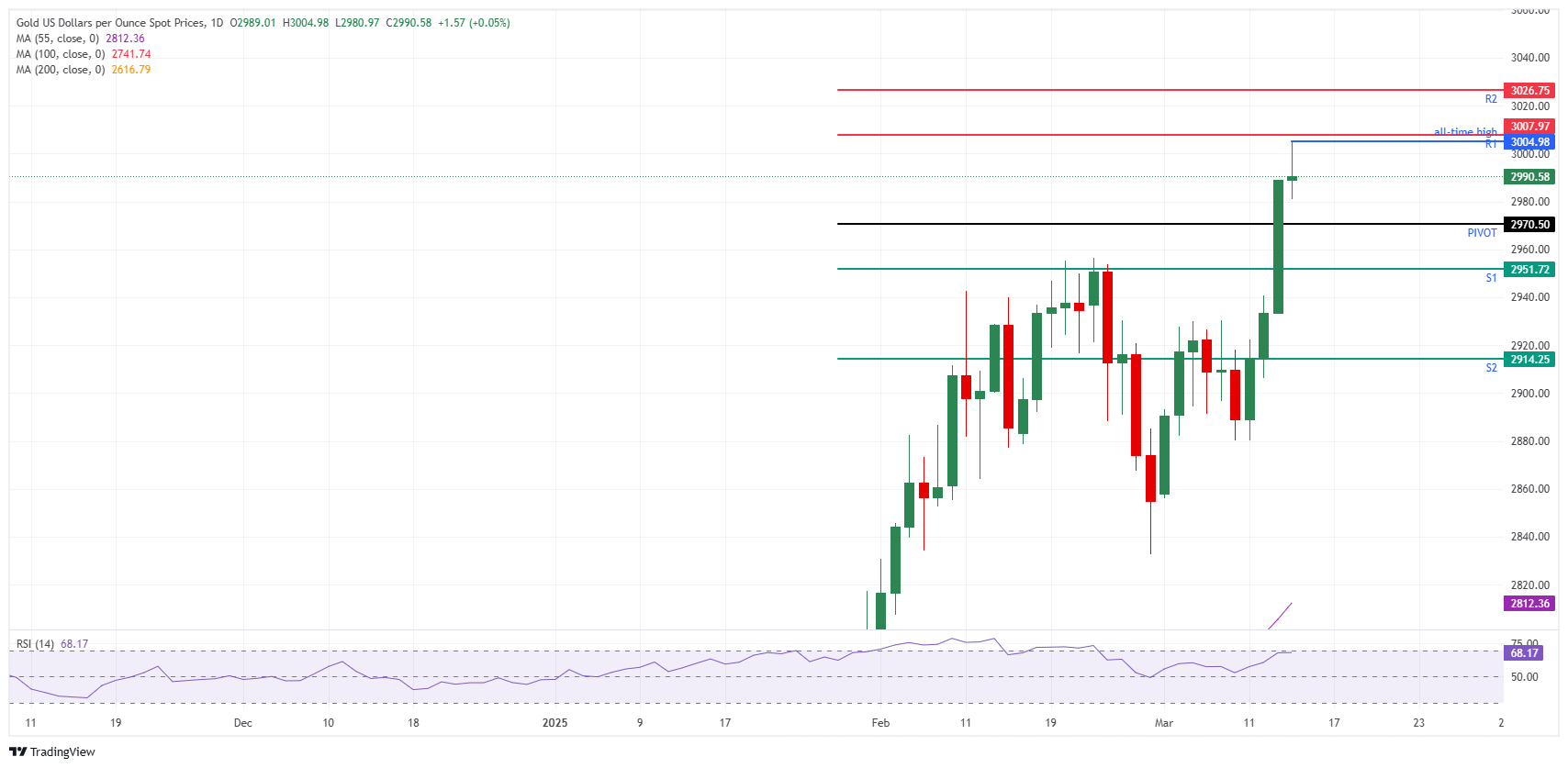
XAU/USD: Daily Chart
Interest rates FAQs
Interest rates are charged by financial institutions on loans to borrowers and are paid as interest to savers and depositors. They are influenced by base lending rates, which are set by central banks in response to changes in the economy. Central banks normally have a mandate to ensure price stability, which in most cases means targeting a core inflation rate of around 2%. If inflation falls below target the central bank may cut base lending rates, with a view to stimulating lending and boosting the economy. If inflation rises substantially above 2% it normally results in the central bank raising base lending rates in an attempt to lower inflation.
Higher interest rates generally help strengthen a country’s currency as they make it a more attractive place for global investors to park their money.
Higher interest rates overall weigh on the price of Gold because they increase the opportunity cost of holding Gold instead of investing in an interest-bearing asset or placing cash in the bank. If interest rates are high that usually pushes up the price of the US Dollar (USD), and since Gold is priced in Dollars, this has the effect of lowering the price of Gold.
The Fed funds rate is the overnight rate at which US banks lend to each other. It is the oft-quoted headline rate set by the Federal Reserve at its FOMC meetings. It is set as a range, for example 4.75%-5.00%, though the upper limit (in that case 5.00%) is the quoted figure. Market expectations for future Fed funds rate are tracked by the CME FedWatch tool, which shapes how many financial markets behave in anticipation of future Federal Reserve monetary policy decisions.
Author

Filip Lagaart
FXStreet
Filip Lagaart is a former sales/trader with over 15 years of financial markets expertise under its belt.

















