Gold price holds on to gains ahead of US session after reaching $3,500 first time ever
- Gold price has hit a fresh all-time high at $3,500, booking over 10% in return for April.
- US President Trump lashed out at Fed Chairman Powell on social media, calling Powell a 'loser'.
- Markets look unstable due to earnings season's uncertainty and the US political crackdown on the Fed.

Gold price (XAU/USD) is continuing its historic performance with another record high in early Asian trading on Tuesday, at $3,500. Price action meanwhile is cooling off a bit towards the US trading session, and Gold dips back to around $3,450 at the time of writing, due to some profit taking at the psychological level. Several markets across the globe are returning to normal trading regimes after the holiday-infused Easter price action, with Good Friday and Easter Monday seeing reduced trading volumes due to bank holidays.
This week’s rally is being fueled by mounting uncertainty and pressure on the independence of the Federal Reserve (Fed) and its Chairman Jerome Powell. United States (US) President Donald Trump has been blaming the Fed and its Chairman for the still-elevated interest rates. Trump accused Fed Chairman Powell of lowering rates during Joe Biden’s presidency and said to be looking at any means or possibilities to have the Chairman replaced by Trump’s pick to get US rates slashed quickly.
Daily digest market movers: More safe haven demand
- US President Trump’s call on the Fed to cut interest rates immediately is seen by several traders and market participants as a threat to the central bank’s independence that drove the US Dollar to its lowest since 2022 in the US Dollar Index (DXY), Bloomberg reports.
- Gold may be “the only true safe-haven asset left” as investors question US assets, including Treasuries, according to Jefferies. “With the recent selloff in US Treasuries, and a view that Treasuries are inextricably tied to tariffs, a trade war with China, and the US fiscal situation, we believe gold is the only true safe-haven asset left,” Jefferies analysts said in a note on Tuesday, Reuters reports.
- Ahead of quarterly earnings, and based on fundamentals, Jefferies highlighted as preferred picks Endeavour Mining Plc among seniors, and Dundee Precious Metals Inc. among non-seniors, Bloomberg reports.
Gold Price Technical Analysis: R1 to hold as support around $3,447
The precious metal is heated, maybe overheated, after hitting a fresh all-time high yet again in April. As if the trade war uncertainties and domestic political spats in the US were not enough to fuel the Bullion rally, the fact that the US President is willing to pick a fight with the Fed and is looking for ways to have its credible Chairman removed from office is probably the final straw for markets.
The intraday R2 resistance at $3,494 has already been tested, and Gold has hit a fresh all-time high at $3,500 on Tuesday before correcting slightly lower. This makes these levels a double resistance zone from now on. Should the Gold price close above the R1 resistance at $3,447 on a daily basis, more all-time highs and gains for April could still occur.
On the downside, the daily Pivot Point comes in at $3,395, though that looks bleak with no real technical support nearby. Instead, the S1 support at $3,360, which roughly coincides with the April 17 high, is a more logical support to look at. In case that level breaks, look for the S2 support at $3,296 and the April 11 high at $ 3,245 on the downside.
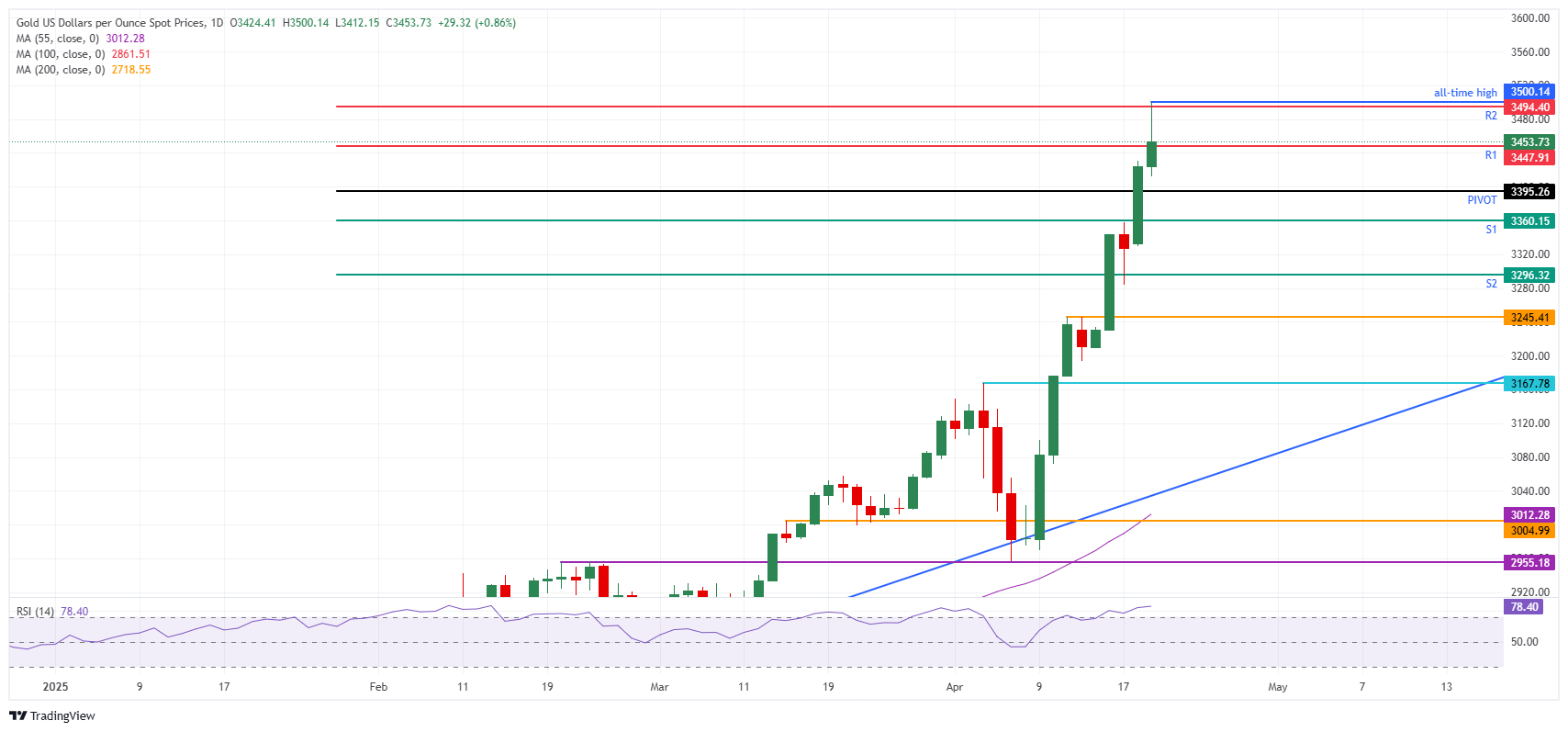
XAU/USD: Daily Chart
Fed FAQs
Monetary policy in the US is shaped by the Federal Reserve (Fed). The Fed has two mandates: to achieve price stability and foster full employment. Its primary tool to achieve these goals is by adjusting interest rates. When prices are rising too quickly and inflation is above the Fed’s 2% target, it raises interest rates, increasing borrowing costs throughout the economy. This results in a stronger US Dollar (USD) as it makes the US a more attractive place for international investors to park their money. When inflation falls below 2% or the Unemployment Rate is too high, the Fed may lower interest rates to encourage borrowing, which weighs on the Greenback.
The Federal Reserve (Fed) holds eight policy meetings a year, where the Federal Open Market Committee (FOMC) assesses economic conditions and makes monetary policy decisions. The FOMC is attended by twelve Fed officials – the seven members of the Board of Governors, the president of the Federal Reserve Bank of New York, and four of the remaining eleven regional Reserve Bank presidents, who serve one-year terms on a rotating basis.
In extreme situations, the Federal Reserve may resort to a policy named Quantitative Easing (QE). QE is the process by which the Fed substantially increases the flow of credit in a stuck financial system. It is a non-standard policy measure used during crises or when inflation is extremely low. It was the Fed’s weapon of choice during the Great Financial Crisis in 2008. It involves the Fed printing more Dollars and using them to buy high grade bonds from financial institutions. QE usually weakens the US Dollar.
Quantitative tightening (QT) is the reverse process of QE, whereby the Federal Reserve stops buying bonds from financial institutions and does not reinvest the principal from the bonds it holds maturing, to purchase new bonds. It is usually positive for the value of the US Dollar.
BRANDED CONTENT
Not all brokers provide the same benefits for Gold trading, making it essential to compare key features. Knowing each broker’s strengths will help you find the ideal fit for your trading strategy. Explore our detailed guide on the best Gold brokers.
Author

Filip Lagaart
FXStreet
Filip Lagaart is a former sales/trader with over 15 years of financial markets expertise under its belt.

















