Gold slumps amid strong US Dollar, high US Treasury yields
- Gold falls 0.87%, pressured by climbing US Treasury yields.
- Fed Governor Neel Kashkari's hawkish remarks underpin US yields, US Dollar.
- Upcoming PCE inflation data will play a critical role in shaping future price movements.

Gold prices slump on Wednesday amid rising US Treasury yields, boosting demand for the Greenback due to hawkish comments by a Federal Reserve (Fed) official. Consequently, sentiment shifted sour, the US Dollar climbed, and the XAU/USD is down some 0.87%, trading at $2,339 at the time of writing.
Wall Street trades in the red, while US yields from the belly to the long end of the curve rise between four and six basis points. Meanwhile, a scarce economic docket on Wednesday keeps traders digesting Minnesota Fed President Neel Kashkari's hawkish comments from Tuesday.
He said that Fed officials hadn’t disregarded rate hikes while adding that if they cut borrowing costs, it would be twice toward the end of 2024.
Data-wise, the US Conference Board (CB) revealed that May’s consumer confidence improved, yet Americans began to worry about a possible recession in the next 12 to 18 months, wrote Dana Paterson, The Conference Board’s Chief Economist.
Ahead in the week, traders are bracing for the expected release of April’s Personal Consumption Expenditures (PCE) Price Index - the Federal Reserve’s (Fed) preferred measure of inflation. The core figure is expected to be 2.8% YoY, while headline PCE is projected to increase by 0.3% MoM.
Daily digest market movers: Gold price falls as US Treasury yields advance to multi-week high
- Gold prices dropped sharply after hitting a three-day high as US Treasury yields rose.
- US 10-year Treasury note yields 4.616%, rising six basis points and underpinning the Greenback. The US Dollar Index (DXY), which tracks the buck’s performance against a basket of peers, trades at 105.05, up 0.42%.
- Fed Governor Michelle Bowman said she would have supported either waiting to slow the quantitative tightening pace or a more tapered slowing in balance sheet run-off.
- The US Conference Board’s Consumer Confidence survey improved in May after three months of declines, rising to 102.0 from 97.0, exceeding estimates of 95.9.
- On Thursday, the US economic docket will feature the second estimate of the Gross Domestic Product (GDP) for Q1 2024, which is expected to be 1.3%.
- Additionally, traders will eye Initial Jobless Claims for the week ending May 25 and the Goods Trade Balance.
- Fed funds rate futures estimate just 25 basis points of interest rate cuts in 2024, according to data provided by the Chicago Board of Trade (CBOT).
Technical analysis: Gold price drops below $2,350 as buyers lose momentum
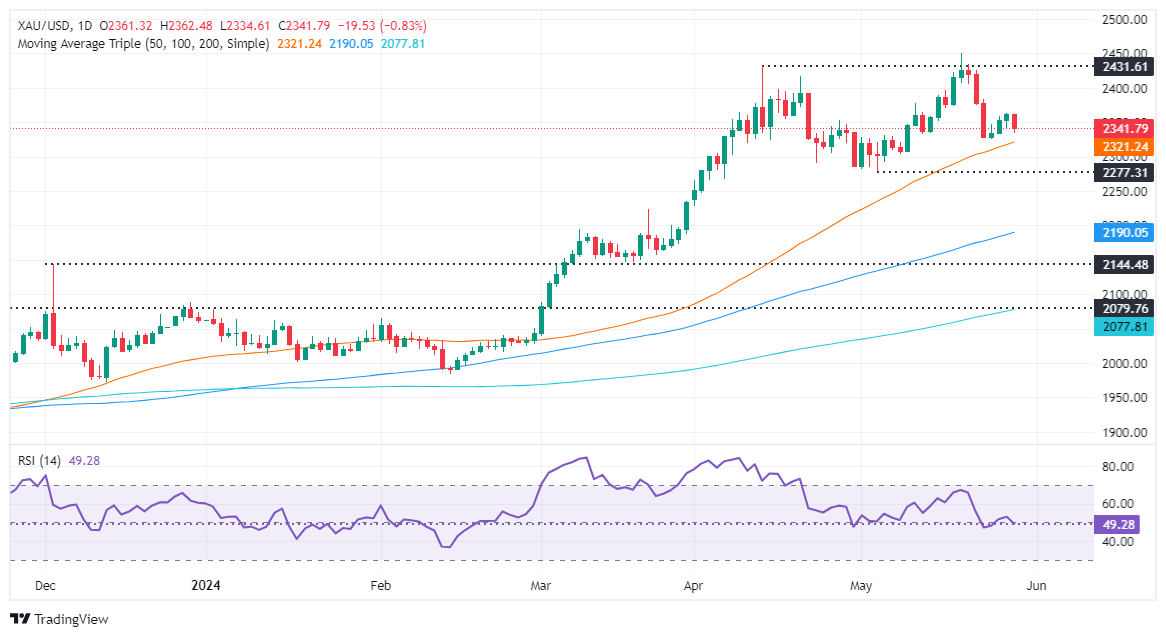
Gold price is upwardly biased despite retreating to $2,320. As mentioned on Tuesday, “the rally is showing signs of exhaustion, with momentum beginning to fade,” as the Relative Strength Index (RSI) turned bearish, punching below the 50 midline.
That said, the XAU/USD's first support would be the 50-day Simple Moving Average (SMA) at $2,321. A breach of the latter will expose the May 8 low of $2,303, followed by the May 3 cycle low of $2,277.
On the other hand, if XAU/USD reclaims the psychological mark of $2,350, further gains lie overhead. Up next would be the $2,400 mark, followed by the year-to-date high of $2,450 and then the $2,500 mark.
Gold FAQs
Gold has played a key role in human’s history as it has been widely used as a store of value and medium of exchange. Currently, apart from its shine and usage for jewelry, the precious metal is widely seen as a safe-haven asset, meaning that it is considered a good investment during turbulent times. Gold is also widely seen as a hedge against inflation and against depreciating currencies as it doesn’t rely on any specific issuer or government.
Central banks are the biggest Gold holders. In their aim to support their currencies in turbulent times, central banks tend to diversify their reserves and buy Gold to improve the perceived strength of the economy and the currency. High Gold reserves can be a source of trust for a country’s solvency. Central banks added 1,136 tonnes of Gold worth around $70 billion to their reserves in 2022, according to data from the World Gold Council. This is the highest yearly purchase since records began. Central banks from emerging economies such as China, India and Turkey are quickly increasing their Gold reserves.
Gold has an inverse correlation with the US Dollar and US Treasuries, which are both major reserve and safe-haven assets. When the Dollar depreciates, Gold tends to rise, enabling investors and central banks to diversify their assets in turbulent times. Gold is also inversely correlated with risk assets. A rally in the stock market tends to weaken Gold price, while sell-offs in riskier markets tend to favor the precious metal.
The price can move due to a wide range of factors. Geopolitical instability or fears of a deep recession can quickly make Gold price escalate due to its safe-haven status. As a yield-less asset, Gold tends to rise with lower interest rates, while higher cost of money usually weighs down on the yellow metal. Still, most moves depend on how the US Dollar (USD) behaves as the asset is priced in dollars (XAU/USD). A strong Dollar tends to keep the price of Gold controlled, whereas a weaker Dollar is likely to push Gold prices up.
Author
Christian Borjon Valencia
FXStreet
Markets analyst, news editor, and trading instructor with over 14 years of experience across FX, commodities, US equity indices, and global macro markets.