Gold holds as US-China thaw lifts mood, eyes on US CPI
- XAU/USD trades at $3,328, up 0.10%, after bouncing off $3,300 intraday low.
- Positive US-China trade talks in London lift risk appetite, boost equities.
- Choppy price action appears as traders await key US CPI data due Wednesday.

Gold price clings to modest gains on Tuesday after bouncing off a daily low near the $3,300 figure as talks between the United States (US) and China appear to be progressing well, improving risk appetite among investors who are driving US equities higher. The XAU/USD trades at $3,328, up 0.10%.
The market mood remains positive, fueled by the reunion between US and Chinese officials in London. Meanwhile, price action in the financial markets remains choppy as traders await the release of the latest US Consumer Price Index (CPI) figures for May. Estimates suggest that prices most likely rose, with US households feeling the impact of tariffs by the Trump administration.
Therefore, the Federal Reserve (Fed) could remain in its wait-and-see mode, keeping interest rates at the 4.25%-4.50% range.
The US Dollar Index (DXY), which tracks the value of the Dollar against a basket of peers, recovers after hitting a daily low of 98.86 and is up 0.06% at 99.07.
On Tuesday, the US economic schedule revealed that small businesses are growing more optimistic, according to the National Federation of Independent Business (NFIB) Optimism Index, which improved in May compared to figures revealed in April.
Daily digest market movers: Gold price holds firm amid steady US Treasury yields
- The US 10-year Treasury yield remains flat at 4.474%. US real yields have also remained unchanged at 2.16%, capping the Bullion price advance.
- The NFIB Optimism Index rose from 95.8 in April to 98.8 in May, taking the index above its long-term average. The print finished a four-month streak of worsening conditions and sentiment for US small businesses due to uncertainty about tariffs.
- Traders would be relieved if talks between Washington and Beijing yield a positive outcome, which could prompt investors to shift toward riskier assets, such as equities. However, the release of inflation figures for the US could cap outflows from Gold.
- The US CPI is expected to rise from 2.3% to 2.5% YoY, with core figures projected to increase from 2.8% to 2.9% YoY.
- Geopolitical tensions remain high as US President Trump told Fox News that Iran is becoming much more aggressive in nuclear talks. This, along with Russia’s claim to control territory in Ukraine’s east-central region, could push Gold prices higher, clearing the path to test $3,350 in the short term.
- Money markets suggest that traders are pricing in 43.5 basis points of easing toward the end of the year, according to Prime Market Terminal data.
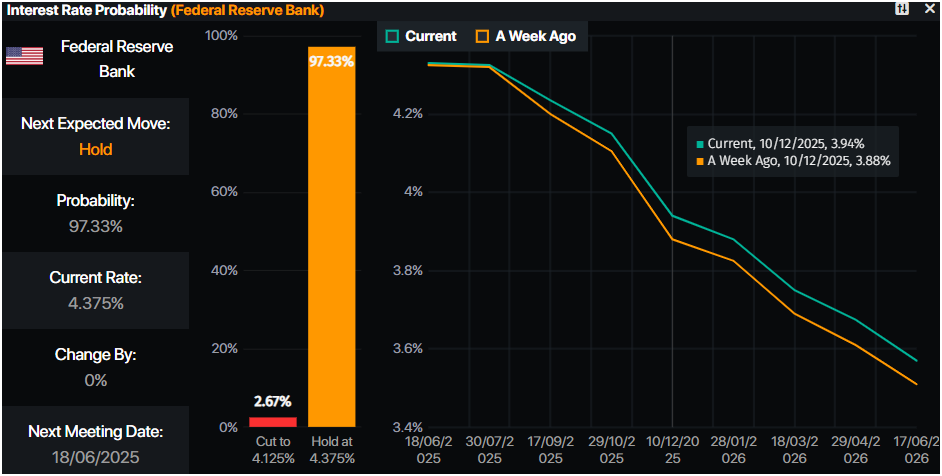
Source: Prime Market Terminal
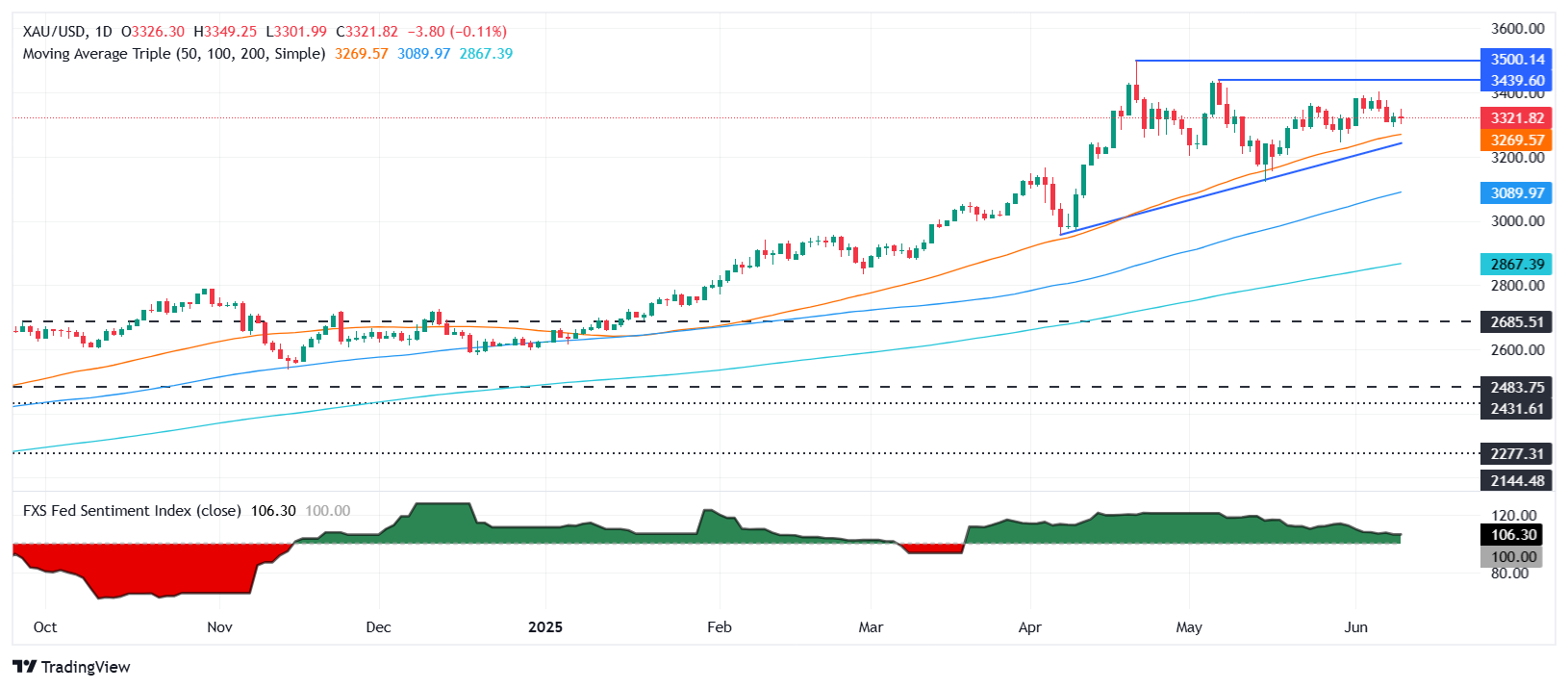
XAU/USD technical outlook: Gold price trades sideways within $3,300-$3,350 corridor
From a technical standpoint, XAU/USD found strong support around $3,290-$3,300 provided by a support trendline, along with the current week’s low. Momentum is also favoring further upside as the Relative Strength Index (RSI) remains bullish.
If XAU/USD clears $3,350, this opens the door for a move toward $3,400. Further strength lies in $3,450 and the all-time high (ATH) at $3,500.
On the flip side, Gold sliding below $3,300 opens the path to challenge key support levels, such as the 50-day Simple Moving Average (SMA) at $3,265, followed by the April 3 high, which has since become support at $3,167.
Inflation FAQs
Inflation measures the rise in the price of a representative basket of goods and services. Headline inflation is usually expressed as a percentage change on a month-on-month (MoM) and year-on-year (YoY) basis. Core inflation excludes more volatile elements such as food and fuel which can fluctuate because of geopolitical and seasonal factors. Core inflation is the figure economists focus on and is the level targeted by central banks, which are mandated to keep inflation at a manageable level, usually around 2%.
The Consumer Price Index (CPI) measures the change in prices of a basket of goods and services over a period of time. It is usually expressed as a percentage change on a month-on-month (MoM) and year-on-year (YoY) basis. Core CPI is the figure targeted by central banks as it excludes volatile food and fuel inputs. When Core CPI rises above 2% it usually results in higher interest rates and vice versa when it falls below 2%. Since higher interest rates are positive for a currency, higher inflation usually results in a stronger currency. The opposite is true when inflation falls.
Although it may seem counter-intuitive, high inflation in a country pushes up the value of its currency and vice versa for lower inflation. This is because the central bank will normally raise interest rates to combat the higher inflation, which attract more global capital inflows from investors looking for a lucrative place to park their money.
Formerly, Gold was the asset investors turned to in times of high inflation because it preserved its value, and whilst investors will often still buy Gold for its safe-haven properties in times of extreme market turmoil, this is not the case most of the time. This is because when inflation is high, central banks will put up interest rates to combat it. Higher interest rates are negative for Gold because they increase the opportunity-cost of holding Gold vis-a-vis an interest-bearing asset or placing the money in a cash deposit account. On the flipside, lower inflation tends to be positive for Gold as it brings interest rates down, making the bright metal a more viable investment alternative.
Author

Christian Borjon Valencia
FXStreet
Markets analyst, news editor, and trading instructor with over 14 years of experience across FX, commodities, US equity indices, and global macro markets.

















