Gold price dips on upbeat market mood, elevated US yields
- Gold drops 0.67% as US limits tariffs to specific trade partners, easing global trade fears.
- Rising US Treasury yields and Dollar strength continue to sap Gold’s bullish momentum.
- Fed’s Bostic signals only one rate cut in 2025, pushing inflation target out to 2027.

Gold price extended its drop for the third consecutive trading day as sentiment improved on news that reciprocal tariffs would be focused on some United States (US) trading partners. At the time of writing, XAU/USD trades at $3,002, down 0.67%.
Wall Street trades on a positive mood, edging higher. The rise of US Treasury bond yields and broad US Dollar (USD) strength kept Bullion prices from prolonging its rally, with the yellow metal gaining over 13% in the year.
An article by Bloomberg showed that the US President Donald Trump administration would target specific countries on April 2, contrary to applying reciprocal tariffs against most countries. Instead, the measures are targeting the so-called Dirty 15 trade partners.
According to last year’s data, The Wall Street Journal reported in an article that the US has the most significant goods trade deficits with China, the EU, Mexico, Vietnam, Taiwan, Japan, South Korea, Canada, India, Thailand, Switzerland, Malaysia, Indonesia, Cambodia and South Africa.
Data-wise, S&P Global revealed that Flash PMIs for the US were mixed, with manufacturing activity contracting, while the services sector strengthened, improving from February’s figures. The divergence highlights ongoing softness in the industrial sector, mainly spurred by tariffs, amid fears of higher prices.
Recently, Atlanta Fed President Raphael Bostic said he supports only one rate cut this year and doesn’t see inflation returning to target until around 2027. Bostic added that inflation is expected to be very bumpy and stated that he doesn’t expect the Fed to be behind the curve.
The money market has priced in 62.5 basis points of Fed easing in 2025, according to Prime Market Terminal interest rate probabilities data.
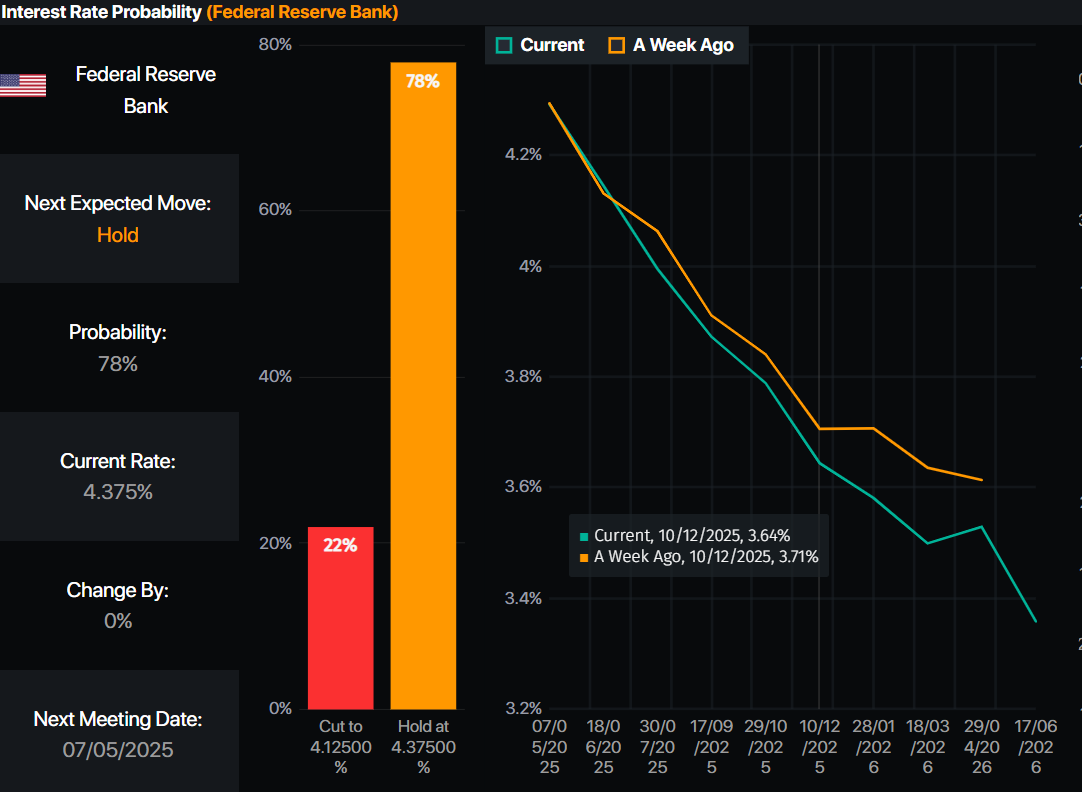
Source: Prime Market Terminal
Daily digest market movers: Gold bears moved in, pushing prices toward $3,000
- Gold prices remain pressured by rising US Treasury yields. The US 10-year T-note yield has surged eight basis points to 4.331%.
- US real yields, as measured by the US 10-year Treasury Inflation-Protected Securities yield, which correlates inversely to Bullion prices, rise almost 2 bps to 1.980%.
- The US Dollar Index (DXY), which tracks the performance of the buck’s value against a basket of six currencies, rose 0.20% up to 104.35.
- The March S&P Global Manufacturing PMI showed a sharp deterioration in US factory activity, falling from 52.7 to 49.8, signaling contraction and missing expectations for a 51.7 expansion.
- In contrast, the S&P Global Services PMI surged from 51.0 to 54.3, exceeding forecasts of 50.8 and highlighting strong service sector momentum.
XAU/USD technical outlook: Gold price retreats but stays firm near $3,000
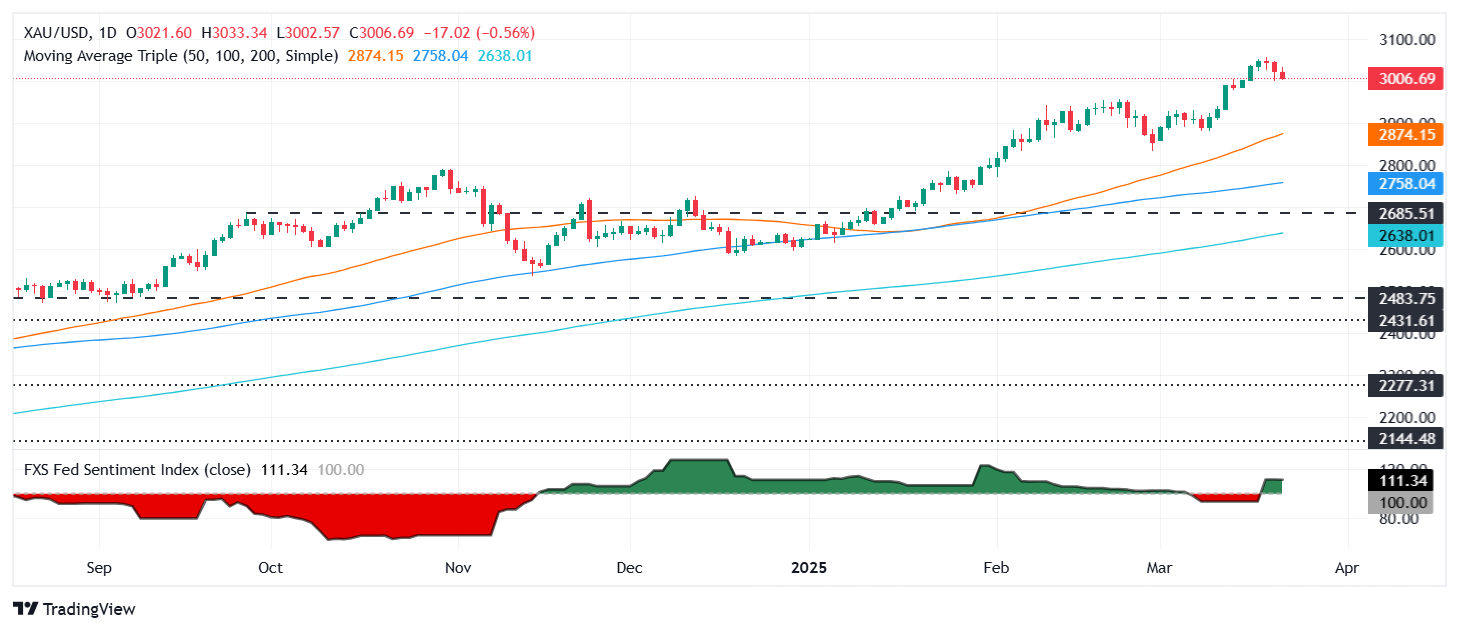
Gold price uptrend remains in place, though traders are booking profits as XAU/USD drops below $3,010, threatening to clear the $3,000 figure. A breach of the latter will expose the February 24 swing high at $2,956, followed by the $2,900 mark and the 50-day Simple Moving Average (SMA) at $2,874.
Conversely, if Bullion remains above $3,000, the first resistance would be March’s 21 peaks at $3,047, followed by the year-to-date (YTD) high at $3,057 and the $3,100 mark.
Gold FAQs
Gold has played a key role in human’s history as it has been widely used as a store of value and medium of exchange. Currently, apart from its shine and usage for jewelry, the precious metal is widely seen as a safe-haven asset, meaning that it is considered a good investment during turbulent times. Gold is also widely seen as a hedge against inflation and against depreciating currencies as it doesn’t rely on any specific issuer or government.
Central banks are the biggest Gold holders. In their aim to support their currencies in turbulent times, central banks tend to diversify their reserves and buy Gold to improve the perceived strength of the economy and the currency. High Gold reserves can be a source of trust for a country’s solvency. Central banks added 1,136 tonnes of Gold worth around $70 billion to their reserves in 2022, according to data from the World Gold Council. This is the highest yearly purchase since records began. Central banks from emerging economies such as China, India and Turkey are quickly increasing their Gold reserves.
Gold has an inverse correlation with the US Dollar and US Treasuries, which are both major reserve and safe-haven assets. When the Dollar depreciates, Gold tends to rise, enabling investors and central banks to diversify their assets in turbulent times. Gold is also inversely correlated with risk assets. A rally in the stock market tends to weaken Gold price, while sell-offs in riskier markets tend to favor the precious metal.
The price can move due to a wide range of factors. Geopolitical instability or fears of a deep recession can quickly make Gold price escalate due to its safe-haven status. As a yield-less asset, Gold tends to rise with lower interest rates, while higher cost of money usually weighs down on the yellow metal. Still, most moves depend on how the US Dollar (USD) behaves as the asset is priced in dollars (XAU/USD). A strong Dollar tends to keep the price of Gold controlled, whereas a weaker Dollar is likely to push Gold prices up.
Author

Christian Borjon Valencia
FXStreet
Markets analyst, news editor, and trading instructor with over 14 years of experience across FX, commodities, US equity indices, and global macro markets.