Gold trips down amid firm US Dollar, despite falling US yields
- Bullion retreats from two-week high as US House passes debt-heavy budget.
- A strong US Dollar and firmer US S&P PMIs dent safe-haven appeal.
- Geopolitical risks with Iran still support longer-term bullish bias for Gold.

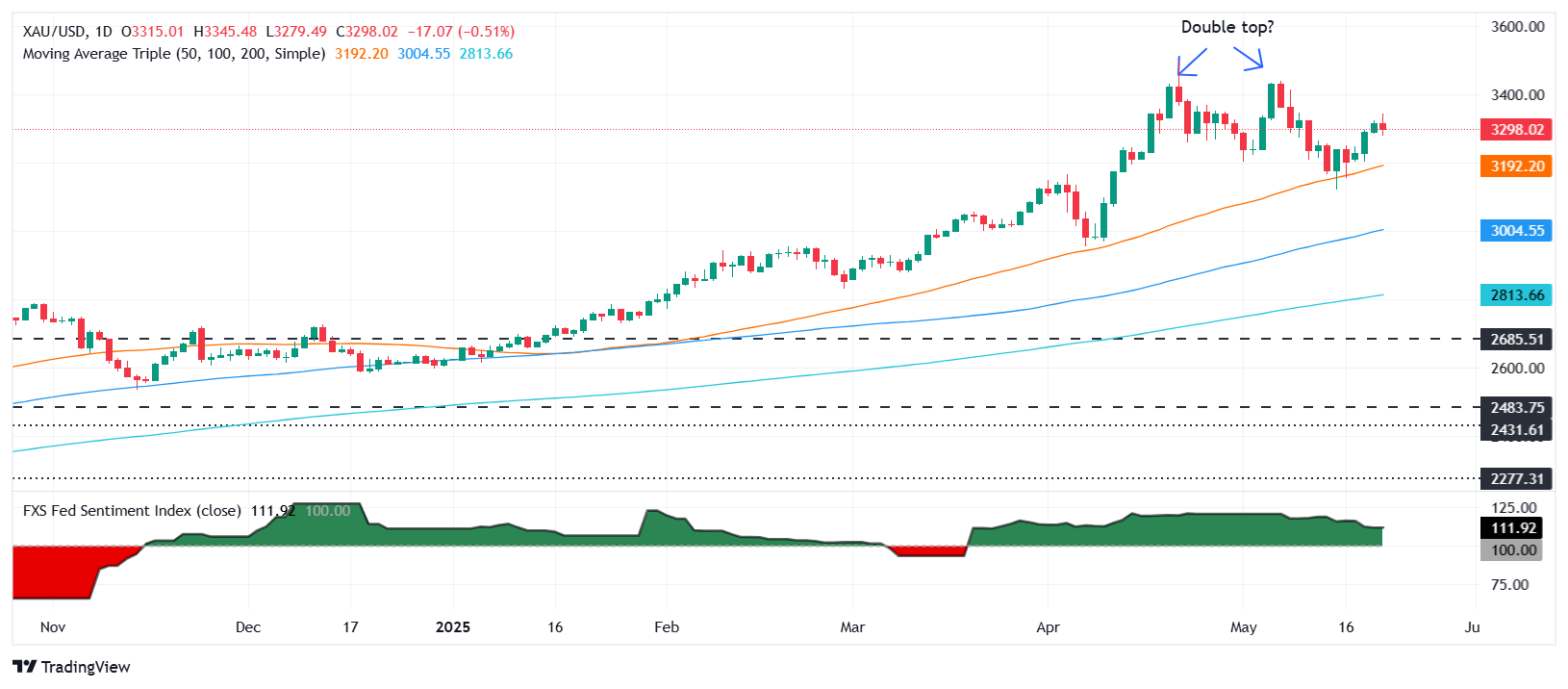
Gold price dropped some 0.48% on Thursday and failed to hold onto the $3,300 figure after reaching a two-week high of $3,345 earlier. A strong US Dollar pressures the golden metal as US Treasury yields retreated from daily highs as the US House of Representatives approved Trump’s budget, which now will be sent for approval to the Senate. XAU/USD trades at $3,289, down 0.83%.
The market mood has improved slightly but remains fragile as it was sponsored by Moody’s downgrade to US government debt. The fiscal package so far approved by the US lower house is projected to add $4 trillion to the debt ceiling.
The US Dollar Index (DXY), which tracks the buck’s value against a basket of six currencies, has paired some of its previous weekly losses and is up a modest 0.18% at 99.86, a headwind for the Dollar-denominated precious metal.
Nevertheless, the outlook for Bullion prices remains optimistic due to geopolitical conflicts. Newswires revealed that Israel is preparing to attack Iran’s nuclear facilities if talks between the latter and the US fall, according to Walla citing sources.
On the data front, S&P Global Purchasing Managers Indices (PMIs) in the US improved, an indication that the economy remains solid. Earlier, the US Department of Labor revealed that the number of Americans filing for unemployment benefits edged lower compared to the prior reading and beneath forecasts.
Bullion traders are eyeing the release of US housing data and Fed speakers on Friday.
Gold daily market movers: Tumbles despite falling US yields on upbeat US data
- US Treasury bond yields halted their advance with the US 10-year Treasury note yield falling three basis points (bps) to 4.55%. Meanwhile, US real yields are also down four bps at 2.207%.
- Gold prices will likely remain underpinned by a sour sentiment toward US assets, namely the Greenback, equities and bonds. This was spurred by controversial US trade policies, along with Moody’s downgrading the US government rating from AAA negative to AA1 stable and an approval of a US budget that will increase the deficit.
- The US S&P Global Manufacturing PMI Flash in May improved from 50.2 to 52.3, exceeding estimates of 50.1. The Services Flash PMI for the same period rose by 52.3, above forecasts and the previous reading of 50.8.
- US Initial Jobless Claims for the week ending May 17 rose by 227K, down from the prior’s week 229K and below forecasts of 230K, indicating the labor market remains solid.
- Fed Governor Christopher Waller said that markets are monitoring fiscal policy. He added that if tariffs are close to 10%, the economy would be in good shape for H2, and the Fed could be in position to cut later in the year.
- Data from the Chicago Board of Trade suggests that traders are pricing in 50.5 basis points of easing toward the end of the year.
XAU/USD technical outlook: Retreats below $3,300 as bulls take a breather
Gold price retraces from weekly highs below $3,300 as traders booked profits and demand for safe haven assets has diminished. Nevertheless, the overall trend remains bullish, as confirmed by the Relative Strength Index (RSI), which remains above its 50-neutral line despite leaning on the downside.
Hence, XAU/USD first resistance would be $3,300 followed by $3,345, the current weekly peak. Once breached, $3,400 is up next, and on further strength $3,438, the May 7 swing high, would be up next.
For a bearish reversal, Gold bears must achieve a daily close below $3,300. Once cleared, immediate support emerges at a May 20 daily low of $3,204, ahead of the 50-day Simple Moving Average (SMA) at $3,191.
Fed FAQs
Monetary policy in the US is shaped by the Federal Reserve (Fed). The Fed has two mandates: to achieve price stability and foster full employment. Its primary tool to achieve these goals is by adjusting interest rates. When prices are rising too quickly and inflation is above the Fed’s 2% target, it raises interest rates, increasing borrowing costs throughout the economy. This results in a stronger US Dollar (USD) as it makes the US a more attractive place for international investors to park their money. When inflation falls below 2% or the Unemployment Rate is too high, the Fed may lower interest rates to encourage borrowing, which weighs on the Greenback.
The Federal Reserve (Fed) holds eight policy meetings a year, where the Federal Open Market Committee (FOMC) assesses economic conditions and makes monetary policy decisions. The FOMC is attended by twelve Fed officials – the seven members of the Board of Governors, the president of the Federal Reserve Bank of New York, and four of the remaining eleven regional Reserve Bank presidents, who serve one-year terms on a rotating basis.
In extreme situations, the Federal Reserve may resort to a policy named Quantitative Easing (QE). QE is the process by which the Fed substantially increases the flow of credit in a stuck financial system. It is a non-standard policy measure used during crises or when inflation is extremely low. It was the Fed’s weapon of choice during the Great Financial Crisis in 2008. It involves the Fed printing more Dollars and using them to buy high grade bonds from financial institutions. QE usually weakens the US Dollar.
Quantitative tightening (QT) is the reverse process of QE, whereby the Federal Reserve stops buying bonds from financial institutions and does not reinvest the principal from the bonds it holds maturing, to purchase new bonds. It is usually positive for the value of the US Dollar.
Author

Christian Borjon Valencia
FXStreet
Markets analyst, news editor, and trading instructor with over 14 years of experience across FX, commodities, US equity indices, and global macro markets.