Gold struggles as US yields rise, big rate cut hopes wane
- Gold trades at $2,645, down 0.30%, as US 10-year Treasury yields rise to 4.026%, capping further upside.
- Middle East conflict escalation involving Israel, Hamas, and other groups like Houthis supports Gold amid risk-off sentiment.
- Market expectations of a 25 bps Fed rate cut remain high at 83.5%, while a 50 bps cut is off the table for now.

Gold price edges down during Monday’s North American session, yet it remains within the $2,630 - $2,659 range as US Treasury bond yields capped the yellow metal advance, while the escalation of the Middle East conflict keeps the precious metal from falling further. The XAU/USD trades at $2,645, losses 0.30%.
Market mood has deteriorated due to the war in the Middle East. The exchange of fire prolonged as Israel continued its ground operations in Lebanon, while Hamas launched rockets at Tel-Aviv. Ceasefire hopes faded as the conflict broadened, involving other groups like Houthis attacking ships in the Red Sea.
In the meantime, the latest US stellar Nonfarm Payrolls report in September sparked a jump in US Treasury bond yields.
Traders disregarded a 50 basis point (bps) cut by the Federal Reserve (Fed), according to CME FedWatch Tool data. The odds for a 25 bps Fed rate cut are 83.5%. Meanwhile, the chances of lowering rates by 50 bps are 0%, but they increased to 16.5% for a hold.
The US 10-year Treasury yield jumps over five and a half basis points to 4.026% as traders seem confident the Fed will lower borrowing costs by 25 bps in each of the last two policy meetings in 2024.
In the meantime, the Greenback clings to minimal gains as the US Dollar Index (DXY), which tracks the buck’s value against a basket of six currencies, is at 102.52, virtually unchanged but at levels last seen in August 2024.
Next week, the US docket will feature the release of inflation data, the Fed’s last Meeting Minutes, jobless claims, and the University of Michigan Consumer Sentiment.
Daily digest market movers: Gold price falls amid fading US recession fears
- Following the last US jobs report, recession fears faded. Therefore, most Wall Street banks like Citi, JP Morgan, and Bank of America revised its November Fed call from a 50 to 25 bps rate cut.
- Minneapolis Fed President Neel Kashkari said he doesn’t see signs of “resurgent inflation" and is confident that inflation is returning to 2%.
- Meanwhile, the People’s Bank of China (PBoC) halted its Bullion purchases for the fifth month. China’s reserves were unchanged, as their holdings stood at 72.8 million troy ounces at the end of last month.
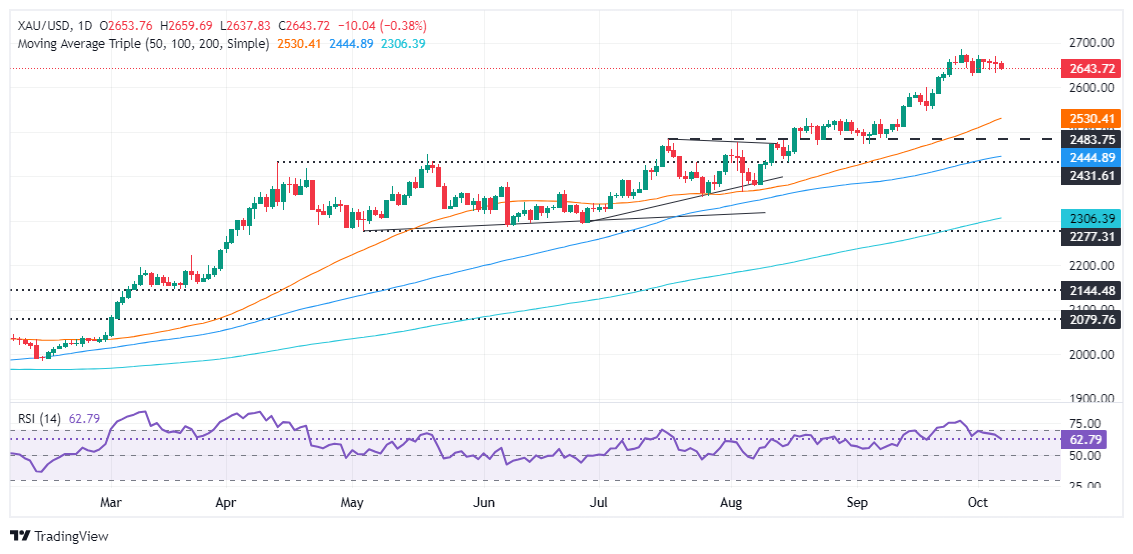
XAU/USD technical analysis: Gold price slips as sellers eye support underneath $2,650
Gold price remains capped within a trading range, while the Relative Strength Index (RSI) suggests that a leg down is underway despite printing bullish readings. Still, the slope is accelerating downwards, closing toward the neutral line.
If XAU/USD drops below the September 30 low of $2,624, that could sponsor a leg down toward the $2,600 mark. On further weakness, the following floor will be the 50-day Simple Moving Average (SMA) at $2,531.
On the other hand, if Gold prints a daily close above $2,650, the XAU/USD needs to clear $2,670 to challenge the year-to-date high of $2,685. Up next will be the $2,700 mark.
Gold FAQs
Gold has played a key role in human’s history as it has been widely used as a store of value and medium of exchange. Currently, apart from its shine and usage for jewelry, the precious metal is widely seen as a safe-haven asset, meaning that it is considered a good investment during turbulent times. Gold is also widely seen as a hedge against inflation and against depreciating currencies as it doesn’t rely on any specific issuer or government.
Central banks are the biggest Gold holders. In their aim to support their currencies in turbulent times, central banks tend to diversify their reserves and buy Gold to improve the perceived strength of the economy and the currency. High Gold reserves can be a source of trust for a country’s solvency. Central banks added 1,136 tonnes of Gold worth around $70 billion to their reserves in 2022, according to data from the World Gold Council. This is the highest yearly purchase since records began. Central banks from emerging economies such as China, India and Turkey are quickly increasing their Gold reserves.
Gold has an inverse correlation with the US Dollar and US Treasuries, which are both major reserve and safe-haven assets. When the Dollar depreciates, Gold tends to rise, enabling investors and central banks to diversify their assets in turbulent times. Gold is also inversely correlated with risk assets. A rally in the stock market tends to weaken Gold price, while sell-offs in riskier markets tend to favor the precious metal.
The price can move due to a wide range of factors. Geopolitical instability or fears of a deep recession can quickly make Gold price escalate due to its safe-haven status. As a yield-less asset, Gold tends to rise with lower interest rates, while higher cost of money usually weighs down on the yellow metal. Still, most moves depend on how the US Dollar (USD) behaves as the asset is priced in dollars (XAU/USD). A strong Dollar tends to keep the price of Gold controlled, whereas a weaker Dollar is likely to push Gold prices up.
Author

Christian Borjon Valencia
FXStreet
Markets analyst, news editor, and trading instructor with over 14 years of experience across FX, commodities, US equity indices, and global macro markets.

















