Gold price surge as investors seek safety on trade policies uncertainty
- XAU/USD climbs to $2,918 as weak US data weighs on the US Dollar.
- US imposes 25% tariffs on Mexico and Canada, 10% on China, boosting Gold’s appeal.
- Atlanta Fed GDP Now model slashes Q1 2025 forecast to -2.8%, stoking recession fears.
- Traders eye ISM Services PMI, Initial Jobless Claims and Nonfarm Payrolls for further cues.

Gold price climbs amid a soft US Dollar (USD) as the trade war between the United States (US), Canada, Mexico and China escalates with new tariffs taking effect on Tuesday. Therefore, the plunge of the USD underpins the precious metal. The XAU/USD is trading at $2,918, gaining 0.62%.
Market sentiment remains downbeat after 25% tariffs on Canada and Mexico and an additional 10% duties in China took effect around midnight. Consequently, traders seeking safety pushed Bullion prices higher on increased demand, while the Greenback dropped across the board.
Meanwhile, recently revealed US data sparked recessionary fears. The Atlanta Fed GDP Now Model projects the Gross Domestic Product (GDP) for Q1 2025 at -2.8%, down from 1.6% estimated on Monday.
On Monday, the February ISM and S&P Global Manufacturing PMI readings were mixed. The former slowed towards the expansion/contraction 50 thresholds, while the latter expanded solidly. US Treasury bond yields slumped on the data as traders began to price in the Federal Reserve's (Fed) interest rate cuts.
Therefore, traders seeking safety bought Bullion pushing prices on the way towards $2,900.
Gold traders' focus shifts toward the release of the ISM Services PMI, Initial Jobless Claims data and February’s Nonfarm Payrolls.
Daily digest market movers: Gold price surges amid pessimistic US economic outlook
- The US 10-year Treasury note climbs six basis points (bps) to 4.221%.
- US real yields, as measured by the US 10-year Treasury Inflation-Protected Securities (TIPS) yield, are rising six bps up to 1.858%.
- St. Louis Fed President Alberto Musalem said the economic outlook is for continued solid economic growth, but recent data pose some downside risks.
- Data from Prime Market Terminal revealed that money markets had priced in the Federal Reserve (Fed) easing policy by 74 basis points (bps), up from 70 bps last week.
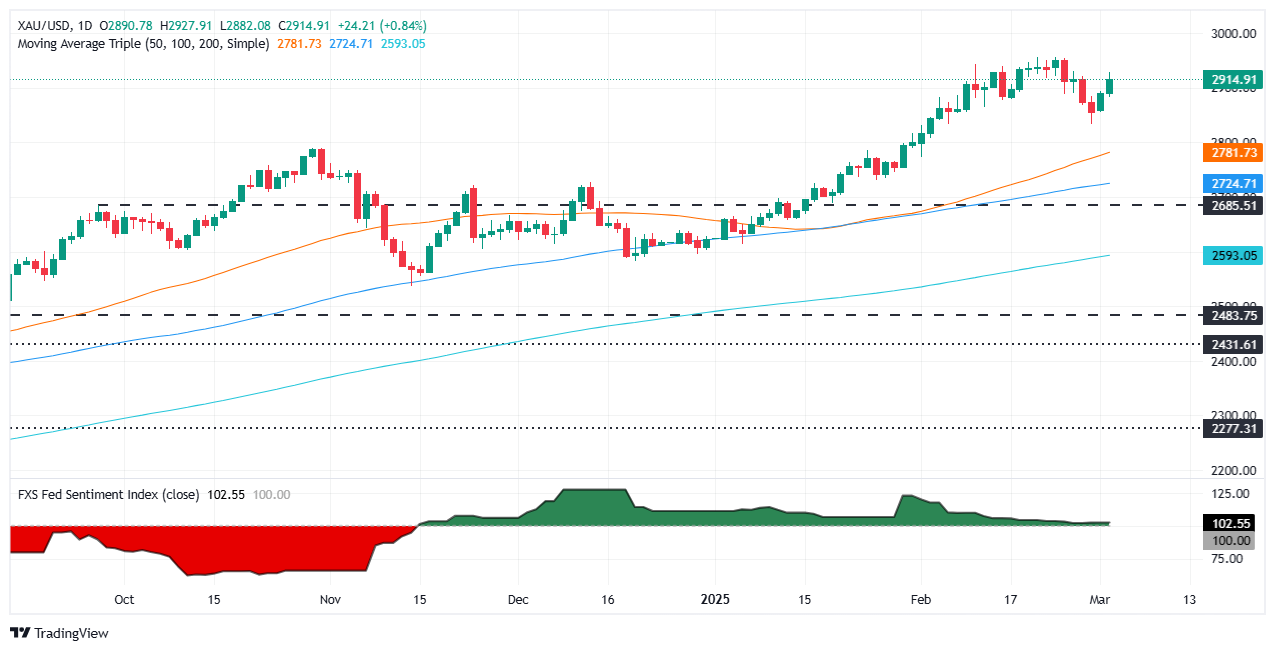
XAU/USD technical outlook: Gold price surges above $2,900
After bottoming out at around $2,830, Gold buyers seem to have regained control and are poised to drive XAU/USD to retest the all-time high of $2,954. Although momentum is bullish, as depicted by the Relative Strength Index (RSI), buyers must reclaim $2,950 first. If the latter and the record high are hurdled, the next resistance would be the $3,000 mark.
On the other hand, Bullion sliding beneath $2,900 could pave the way for further downside. The first support would be the February 14 low of $2,877, followed by the February 12 swing low of $2,864.
Tariffs FAQs
Tariffs are customs duties levied on certain merchandise imports or a category of products. Tariffs are designed to help local producers and manufacturers be more competitive in the market by providing a price advantage over similar goods that can be imported. Tariffs are widely used as tools of protectionism, along with trade barriers and import quotas.
Although tariffs and taxes both generate government revenue to fund public goods and services, they have several distinctions. Tariffs are prepaid at the port of entry, while taxes are paid at the time of purchase. Taxes are imposed on individual taxpayers and businesses, while tariffs are paid by importers.
There are two schools of thought among economists regarding the usage of tariffs. While some argue that tariffs are necessary to protect domestic industries and address trade imbalances, others see them as a harmful tool that could potentially drive prices higher over the long term and lead to a damaging trade war by encouraging tit-for-tat tariffs.
During the run-up to the presidential election in November 2024, Donald Trump made it clear that he intends to use tariffs to support the US economy and American producers. In 2024, Mexico, China and Canada accounted for 42% of total US imports. In this period, Mexico stood out as the top exporter with $466.6 billion, according to the US Census Bureau. Hence, Trump wants to focus on these three nations when imposing tariffs. He also plans to use the revenue generated through tariffs to lower personal income taxes.
Author

Christian Borjon Valencia
FXStreet
Markets analyst, news editor, and trading instructor with over 14 years of experience across FX, commodities, US equity indices, and global macro markets.