Gold price consolidates rising US bond yields and stronger USD-inspired losses
- Gold price meets with heavy supply on Monday and snaps a four-day winning streak.
- Rebounding US bond yields help revive the USD demand and weigh on the commodity.
- Trade war concerns and geopolitical risks help limit losses for the safe-haven XAU/USD.

Gold price (XAU/USD) maintains its offered tone through the first half of the European session on Monday and currently trades around the $2,630 region, or the lower end of the daily range. The US Dollar (USD) makes a solid comeback following the recent pullback to a nearly three-week low amid a goodish pickup in the US Treasury bond yields and turns out to be a key factor weighing on the precious metal.
Furthermore, expectations that US President-elect Donald Trump's tariff plans and expansionary policies will boost inflation, and set the stage for the Federal Reserve (Fed) to stop cutting interest rates further undermine the non-yielding Gold price. That said, trade war concerns, geopolitical tension and a softer risk tone should help limit losses for the safe-haven XAU/USD ahead of this week's important US macro releases.
Gold price bears retain intraday control on rising US bond yields and strogner USD
- The US Dollar staged a goodish recovery from its lowest level since November 12 touched last Friday amid a fresh leg up in the US Treasury bond yields and weighs on the Gold price at the start of a new week/month.
- Investors seem convinced that US President-elect Donald Trump's tariff plans could trigger the second wave of trade wars and push consumer prices higher, forcing the Federal Reserve to stop cutting rates.
- In a critical post over the weekend, Trump threatened a 100% tariff on BRICS nations – Brazil, Russia, India, China, and South Africa – if they replace the USD with another currency for international transactions.
- Ukrainian President Volodymyr Zelenskyy has stated that he is willing to give up occupied Ukrainian territory to Russia, albeit with some conditions, in order to reach a ceasefire agreement and achieve peace.
- Russian and Syrian jets have carried out a series of air strikes on Syrian rebels led by the jihadi group Hayat Tahrir al-Sham, who took over most of Aleppo in a shock offensive on Saturday and entered the city of Hama.
- China’s official Manufacturing Purchasing Managers' Index (PMI) edged up to 50.3 in November from 50.2, while the NBS Non-Manufacturing PMI eased to 50.0 during the reported month from October’s 50.2.
- China's Caixin Manufacturing Purchasing Managers' Index (PMI) jumped to 51.5 in November after recording 50.3 in October amid hopes that the government will introduce more stimulus to bolster domestic demand.
- This week's important US macroeconomic releases, starting with the ISM Manufacturing PMI later this Monday, will be looked for interest rate cuts, which, in turn, will drive the USD and the non-yielding XAU/USD.
Gold price seems vulnerable to retest last week's swing low, around the $2,600 neighborhood
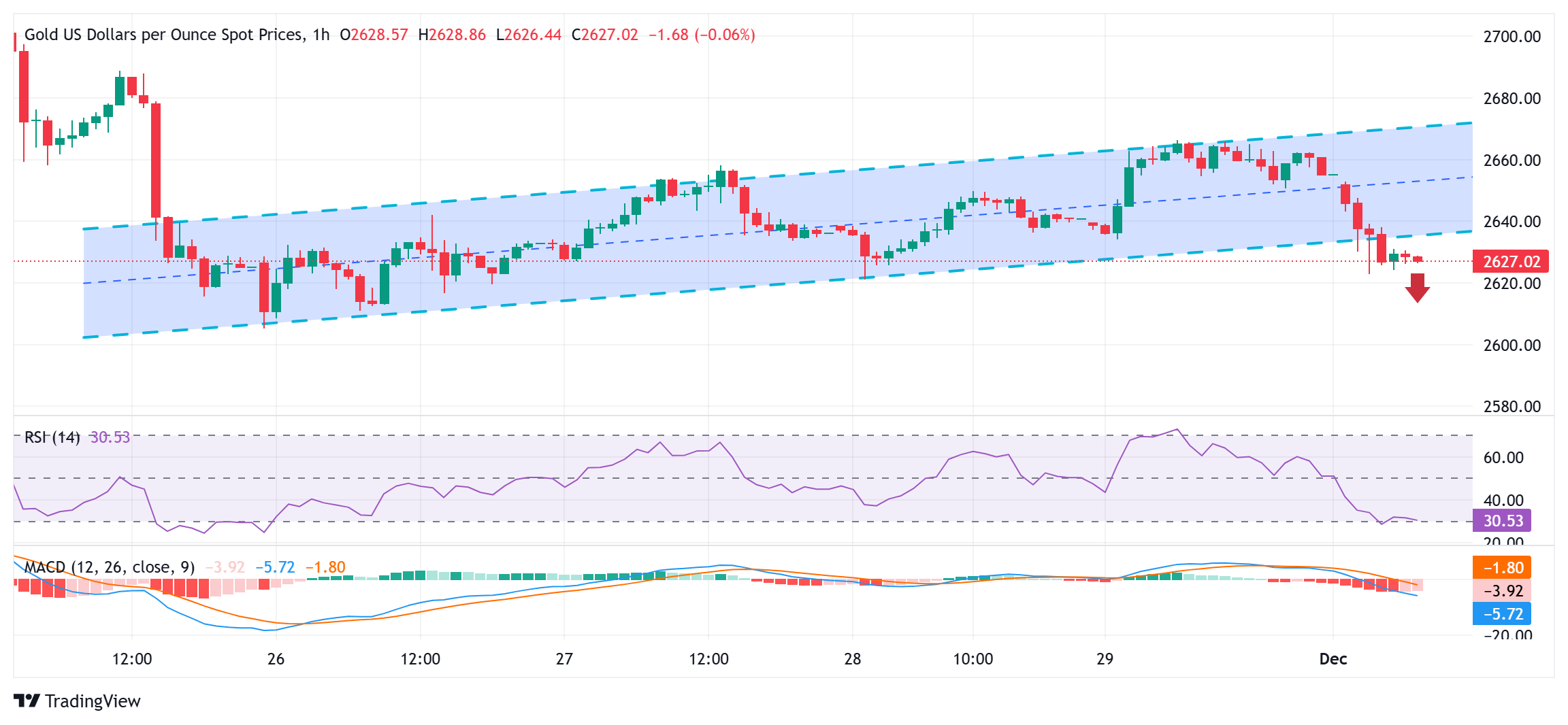
From a technical perspective, an intraday slide below the lower boundary of a nearly one-week-old descending channel could be seen as a key trigger for bearish traders. Moreover, oscillators on daily/4-hour charts have again started gaining negative traction and suggest that the path of least resistance for the Gold price is to the downside. Hence, a subsequent fall back towards last week's swing low, around the $2,605 region, looks like a distinct possibility. Some follow-through selling below the $2,600 mark would expose the 100-day Simple Moving Average (SMA), currently pegged near the $2,575 region.
On the flip side, the ascending trend-channel support breakpoint, around the $2,642-2,643 area, might now act as an immediate hurdle ahead of the $2,652 static resistance and last Friday's swing high, around the $2,665 region. Some follow-through buying should allow the Gold price to reclaim the $2,700 round-figure mark and extend the positive move further towards the $2,721-2,722 supply zone. The latter should act as a pivotal point, which if cleared decisively will suggest that the recent corrective decline from the all-time peak touched in October has run its course and pave the way for a further appreciating move.
Economic Indicator
Nonfarm Payrolls
The Nonfarm Payrolls release presents the number of new jobs created in the US during the previous month in all non-agricultural businesses; it is released by the US Bureau of Labor Statistics (BLS). The monthly changes in payrolls can be extremely volatile. The number is also subject to strong reviews, which can also trigger volatility in the Forex board. Generally speaking, a high reading is seen as bullish for the US Dollar (USD), while a low reading is seen as bearish, although previous months' reviews and the Unemployment Rate are as relevant as the headline figure. The market's reaction, therefore, depends on how the market assesses all the data contained in the BLS report as a whole.
Read more.Next release: Fri Dec 06, 2024 13:30
Frequency: Monthly
Consensus: 183K
Previous: 12K
Source: US Bureau of Labor Statistics
America’s monthly jobs report is considered the most important economic indicator for forex traders. Released on the first Friday following the reported month, the change in the number of positions is closely correlated with the overall performance of the economy and is monitored by policymakers. Full employment is one of the Federal Reserve’s mandates and it considers developments in the labor market when setting its policies, thus impacting currencies. Despite several leading indicators shaping estimates, Nonfarm Payrolls tend to surprise markets and trigger substantial volatility. Actual figures beating the consensus tend to be USD bullish.
Author

Haresh Menghani
FXStreet
Haresh Menghani is a detail-oriented professional with 10+ years of extensive experience in analysing the global financial markets.