Gold price extends its decline despite risk-off mood, US PMI data looms
- The Gold price attracts some sellers in Monday’s early European session.
- Disappointing US employment reports and risk-off sentiment continue to support the yellow metal.
- Investors await the release of US ISM Services PMI for July, which is due on Monday.

Gold price (XAU/USD) loses traction on Monday despite the softer Greenback. Markets are still digesting the FOMC’s dovish hold and softer US employment report. Meanwhile, the US Treasury bond yields and the US Dollar (USD) are likely to remain under pressure, which acts as a tailwind for the yellow metal. Additionally, the rising geopolitical tensions in the Middle East might continue to underpin traditional safe-haven assets like Gold.
Looking ahead, Gold traders will keep an eye on the US ISM Services Purchasing Managers Index (PMI) on Monday for fresh catalysts. The Services PMI is estimated to improve to 51.0 in July from 48.8 in June. In case of stronger-than-expected data, USD price might be lifted and cap the precious metal’s upside.
Daily Digest Market Movers: Gold price edges lower despite softer US jobs data and rising geopolitical risks
- US Secretary of State Tony Blinken told his counterparts from the G7 countries on Sunday that an attack by Iran and Hezbollah against Israel could start as early as Monday, three sources briefed on the call tell Axios.
- US President Joe Biden will convene National Security Council on Monday to discuss developments in the Middle East at 2:15 pm US Eastern time.
- The US Nonfarm Payrolls (NFP) rose by 114K in July from the previous month of 179K (revised down from 206K), weaker than the expectation of 175K.
- The US Unemployment Rate rose to the highest level since November 2021, coming in at 4.3% in July from 4.1% in June. The Average Hourly Earnings rose 0.2% month-over-month in the same reported period, below the market consensus of 0.3%.
- The marketplace is currently factoring in a nearly 74% chance for a 50 basis-point (bps) cut by the Fed at the September FOMC meeting.
- Chicago Federal Reserve Bank President Austan Goolsbee said on Friday that the Fed should not overreact to any one month's numbers after the US NFP came in widely under forecasts, but noted that inflation and jobs data have both made significant progress in recent months.
Technical Analysis: Gold price keeps the bullish vibe in the longer term
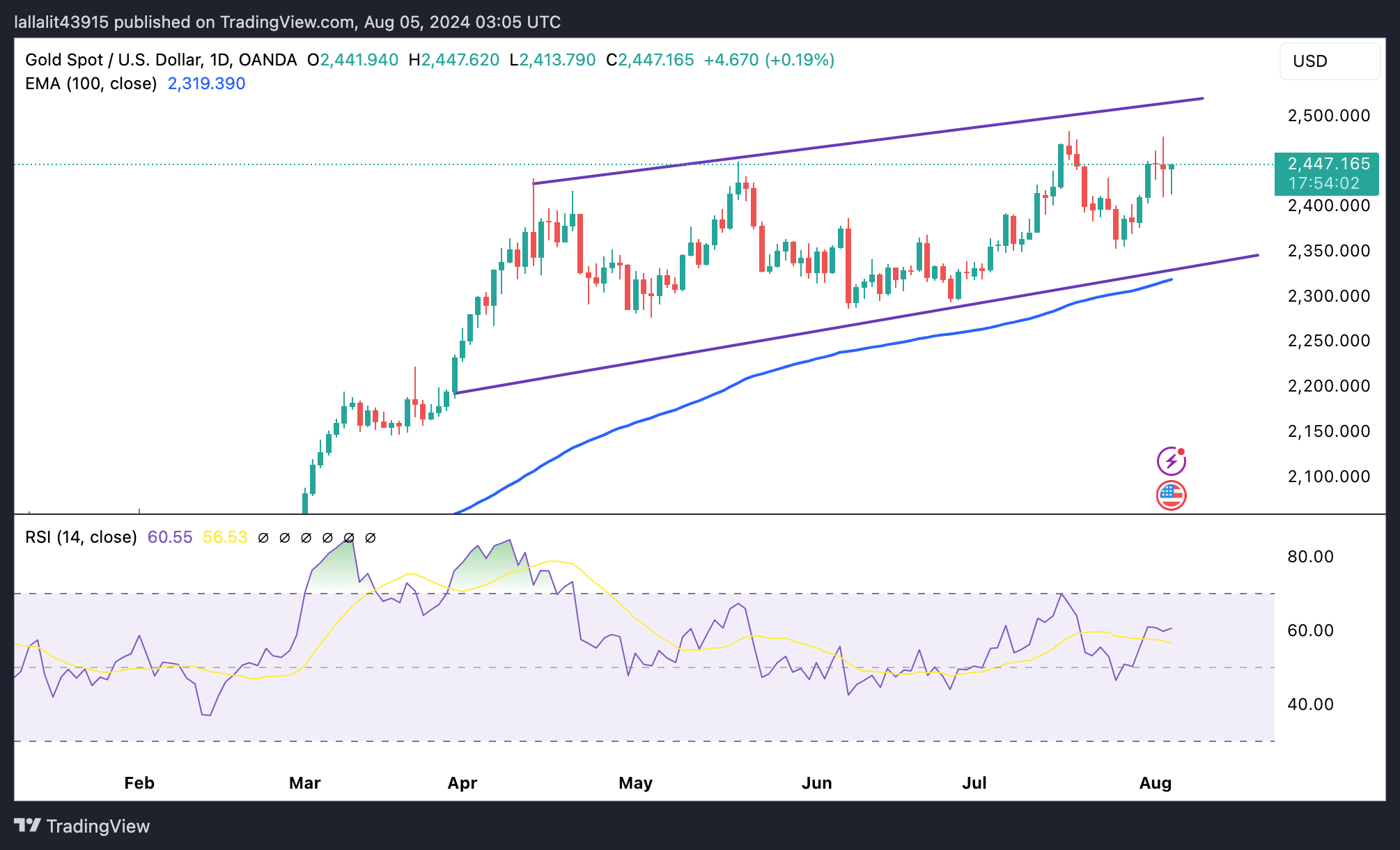
Gold price trades weaker on the day. Nonetheless, the yellow metal maintains a constructive outlook on the daily timeframe as it holds above the key 100-day Exponential Moving Average (EMA), with the bullish 14-day Relative Strength Index (RSI) around 58.0.
The precious metal has traded within the ascending trend channel since mid-April. The first upside target emerges near $2,450 (high of May 20) en route to $2,483 (all-time high on July 17). Bullish candlesticks above this level could expose XAU/USD to potential bullish momentum all the way to the upper boundary of the trend channel of $2,515.
On the downside, the initial support level for Gold price is located at $2,355 (low of July 26). Further south could take the price down to $2,335, the lower limit of the trend channel. Sustained trading below this level would pave the way to $2,319 (100-day EMA).
Interest rates FAQs
Interest rates are charged by financial institutions on loans to borrowers and are paid as interest to savers and depositors. They are influenced by base lending rates, which are set by central banks in response to changes in the economy. Central banks normally have a mandate to ensure price stability, which in most cases means targeting a core inflation rate of around 2%. If inflation falls below target the central bank may cut base lending rates, with a view to stimulating lending and boosting the economy. If inflation rises substantially above 2% it normally results in the central bank raising base lending rates in an attempt to lower inflation.
Higher interest rates generally help strengthen a country’s currency as they make it a more attractive place for global investors to park their money.
Higher interest rates overall weigh on the price of Gold because they increase the opportunity cost of holding Gold instead of investing in an interest-bearing asset or placing cash in the bank. If interest rates are high that usually pushes up the price of the US Dollar (USD), and since Gold is priced in Dollars, this has the effect of lowering the price of Gold.
The Fed funds rate is the overnight rate at which US banks lend to each other. It is the oft-quoted headline rate set by the Federal Reserve at its FOMC meetings. It is set as a range, for example 4.75%-5.00%, though the upper limit (in that case 5.00%) is the quoted figure. Market expectations for future Fed funds rate are tracked by the CME FedWatch tool, which shapes how many financial markets behave in anticipation of future Federal Reserve monetary policy decisions.
Author

Lallalit Srijandorn
FXStreet
Lallalit Srijandorn is a Parisian at heart. She has lived in France since 2019 and now becomes a digital entrepreneur based in Paris and Bangkok.