Gold price recovers further from one-month low, climbs to $2,620 amid risk-off mood
- Gold price attracts some haven flows in the wake of the post-FOMC sell-off in the equity markets.
- The Fed’s hawkish outlook lifts the US bond yields to a multi-month high and might the XAU/USD.
- Traders now look to the US Q3 GDP print for some impetus ahead of the US PCE data on Friday.

Gold price (XAU/USD) builds on its goodish intraday recovery from a one-month low and climbs to a fresh daily high, around the $2,622 area during the early part of the European session on Thursday. The global risk sentiment took a turn for the worse in reaction to the Federal Reserve's (Fed) hawkish cut on Wednesday. This, along with geopolitical risks and trade war fears, turn out to be key factors driving haven flows towards the precious metal.
Meanwhile, the US Dollar (USD) is seen consolidating the previous day's post-FOMC gains to a two-year top and does little to provide any impetus to the Gold price. That said, the Fed's signal that it would slow the pace of interest rate cuts continues to lift the US Treasury bond yields and acts as a tailwind for the buck. This, in turn, might keep a lid on any further gains for the non-yielding yellow metal and warrants some caution for bullish traders.
Gold price builds on intraday move up amid the global flight to safety
- The Federal Reserve, as was anticipated, lowered its benchmark policy rate for the third time since September and signaled that it would slow down the pace of rate cuts, triggering a sell-off in the US equity markets.
- The spillover effect drags Asian stocks sharply lower on Thursday and benefits traditional safe-haven assets, prompting some short-covering around the Gold price and assisting it to rebound from a one-month low.
- The so-called dot plot indicated that officials see the fed funds rate falling to 3.9% in 2025, suggesting two more 25 basis points interest rate reductions as compared to the previous forecast of four cuts in September.
- In his post-meeting press conference, Fed Chair Jerome Powell said that inflation has eased significantly in the past two years, though it remains somewhat elevated relative to the central bank’s 2% longer-run target.
- The yield on the benchmark 10-year US government bond climbs to the highest level since May and assists the US Dollar in preserving the overnight gains to a two-year top, capping the non-yielding yellow metal.
- Traders now look forward to Thursday's US economic docket – featuring the release of the final Q3 GDP print and Weekly Initial Jobless Claims – for short-term impetus later during the North American session.
- The market attention, meanwhile, shifts to the US Personal Consumption Expenditures (PCE) Price Index, or the Fed's preferred inflation gauge on Friday, which will drive the USD and the XAU/USD in the near term.
Gold price strenghtens beyond 23.6% Fibo. level; could climb further
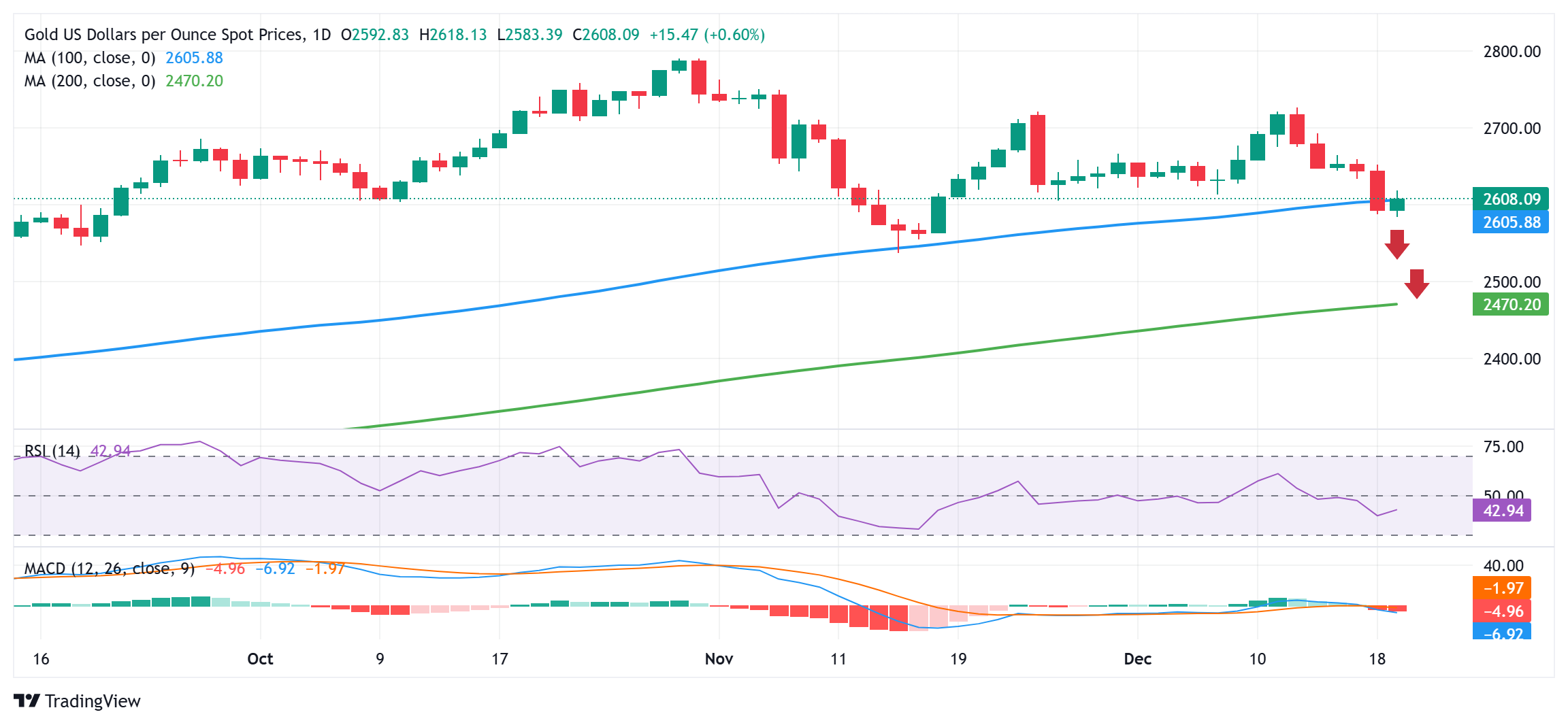
From a technical perspective, the overnight close below the 100-day Simple Moving Average (SMA), for the first time since October 2023, and the $2,600 mark was seen as a fresh trigger for bearish traders. Moreover, oscillators on the daily chart have just started gaining negative traction and suggest that the path of least resistance for the Gold price remains to the downside. Meanwhile, Thursday's attempted recovery stalls near the $2,618 region, or the 23.6% Fibonacci retracement level of the latest leg down from over a one-month high touched last week. The said area should now act as a pivotal point, above which a fresh bout of a short-covering could lift the XAU/USD towards the $2,635 area, or the 38.2% Fibo., en route to 50% retracement level, around the $2,655-2,656 supply zone.
On the flip side, the Asian session low, around the $2,584-$2,583 region, now seems to protect the immediate downside. The next relevant support is pegged near the $2,560 area, below which the Gold price could aim to challenge the November swing low, around the $2,537-$2,535 zone. Some follow-through selling, leading to a subsequent fall below the $2,500 psychological mark, might expose the very important 200-day SMA support near the $2,470 region.
Risk sentiment FAQs
In the world of financial jargon the two widely used terms “risk-on” and “risk off'' refer to the level of risk that investors are willing to stomach during the period referenced. In a “risk-on” market, investors are optimistic about the future and more willing to buy risky assets. In a “risk-off” market investors start to ‘play it safe’ because they are worried about the future, and therefore buy less risky assets that are more certain of bringing a return, even if it is relatively modest.
Typically, during periods of “risk-on”, stock markets will rise, most commodities – except Gold – will also gain in value, since they benefit from a positive growth outlook. The currencies of nations that are heavy commodity exporters strengthen because of increased demand, and Cryptocurrencies rise. In a “risk-off” market, Bonds go up – especially major government Bonds – Gold shines, and safe-haven currencies such as the Japanese Yen, Swiss Franc and US Dollar all benefit.
The Australian Dollar (AUD), the Canadian Dollar (CAD), the New Zealand Dollar (NZD) and minor FX like the Ruble (RUB) and the South African Rand (ZAR), all tend to rise in markets that are “risk-on”. This is because the economies of these currencies are heavily reliant on commodity exports for growth, and commodities tend to rise in price during risk-on periods. This is because investors foresee greater demand for raw materials in the future due to heightened economic activity.
The major currencies that tend to rise during periods of “risk-off” are the US Dollar (USD), the Japanese Yen (JPY) and the Swiss Franc (CHF). The US Dollar, because it is the world’s reserve currency, and because in times of crisis investors buy US government debt, which is seen as safe because the largest economy in the world is unlikely to default. The Yen, from increased demand for Japanese government bonds, because a high proportion are held by domestic investors who are unlikely to dump them – even in a crisis. The Swiss Franc, because strict Swiss banking laws offer investors enhanced capital protection.
Author

Haresh Menghani
FXStreet
Haresh Menghani is a detail-oriented professional with 10+ years of extensive experience in analysing the global financial markets.

















