Gold price remains close to multi-week high; looks to US CPI for fresh impetus
- Gold price attracts some dip-buyers amid a modest USD pullback from a multi-week high.
- Persistent trade-related uncertainties also lend support to the safe-haven precious metal.
- Reduced Fed rate cut bets might cap the commodity ahead of the critical US CPI report.

Gold price (XAU/USD) retains its positive bias through the first half of the European session on Tuesday and currently trades just below a three-week high touched the previous day. Some repositioning trade ahead of the latest US consumer inflation figures drags the US Dollar (USD) away from its highest level since June 24, which, in turn, is seen benefiting the commodity.
Traders, however, seem reluctant to place aggressive directional bets and opt to wait for more cues about the Federal Reserve's (Fed) rate-cut path. Hence, the crucial US Consumer Price Index (CPI) report will influence the USD and drive the non-yielding yellow metal. In the meantime, diminishing odds for an early Fed rate cut limit USD losses and cap the XAU/USD pair.
Daily Digest Market Movers: Gold price sticks to gains amid modest USD downtick
- The US Dollar retreats slightly from a multi-week top set the previous day amid some repositioning trade ahead of the latest US consumer inflation figures, due later this Tuesday, and lends support to the Gold price during the Asian session.
- The headline Consumer Price Index (CPI) is anticipated to rise 2.7% YoY in June, while the core gauge is seen coming in at 3.0% YoY. Even a slight disappointment would fuel speculations about an early interest rate cut by the Federal Reserve.
- Traders are currently assigning a 60% probability of a rate cut by September and at least 50 basis points worth of easing by the year-end. Hence, a softer print could weigh on the USD and provide a goodish lift to the non-yielding yellow metal.
- Meanwhile, the market reaction to stronger readings is more likely to be limited as persistent uncertainties surrounding US President Donald Trump's trade policies might continue to offer some support to the safe-haven XAU/USD pair.
- In fact, Trump issued tariff notices to more than 20 countries and announced a 50% tariff on copper imports last week. Trump, however, softened his stance on Monday and signaled that his administration was open to further trade negotiations.
- This, in turn, boosts investors' appetite for riskier assets, which is evident from a generally positive tone around the equity markets. Hence, some follow-through buying is needed to set the stage for a further XAU/USD appreciating move.
Gold price remains on track to reclaim $3,400 amid a bullish technical setup
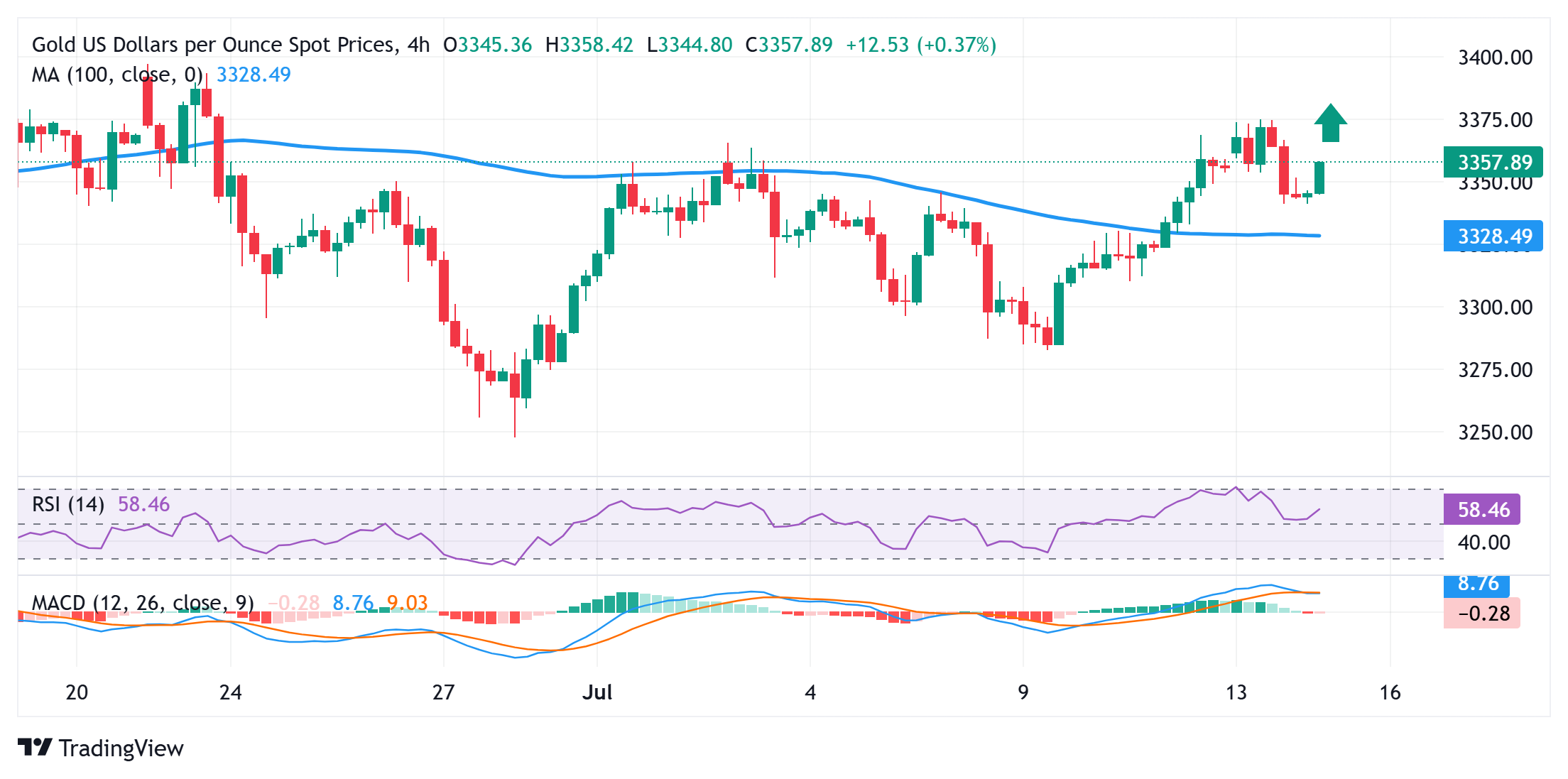
From a technical perspective, a sustained strength beyond the $3,365-3,366 region might be seen as a fresh trigger for the XAU/USD bulls amid positive oscillators on hourly/daily charts. This, in turn, would set the stage for additional gains and allow the Gold price to reclaim the $3,400 round figure. Some follow-through buying has the potential to lift the commodity further towards the next relevant hurdle near the $3,434-3,435 area.
On the flip side, the $3,341-3,340 could offer immediate support, and any further slide could be seen as a buying opportunity near the $3,326 region. This should help limit the downside for the Gold price near the $3,300 round figure. This is followed by the $3,283-3,282 region, or over a one-week low touched last Tuesday, which, if broken, would make the XAU/USD pair vulnerable to accelerate the corrective fall towards the July swing low, around the $3,248-3,247 area.
Fed FAQs
Monetary policy in the US is shaped by the Federal Reserve (Fed). The Fed has two mandates: to achieve price stability and foster full employment. Its primary tool to achieve these goals is by adjusting interest rates. When prices are rising too quickly and inflation is above the Fed’s 2% target, it raises interest rates, increasing borrowing costs throughout the economy. This results in a stronger US Dollar (USD) as it makes the US a more attractive place for international investors to park their money. When inflation falls below 2% or the Unemployment Rate is too high, the Fed may lower interest rates to encourage borrowing, which weighs on the Greenback.
The Federal Reserve (Fed) holds eight policy meetings a year, where the Federal Open Market Committee (FOMC) assesses economic conditions and makes monetary policy decisions. The FOMC is attended by twelve Fed officials – the seven members of the Board of Governors, the president of the Federal Reserve Bank of New York, and four of the remaining eleven regional Reserve Bank presidents, who serve one-year terms on a rotating basis.
In extreme situations, the Federal Reserve may resort to a policy named Quantitative Easing (QE). QE is the process by which the Fed substantially increases the flow of credit in a stuck financial system. It is a non-standard policy measure used during crises or when inflation is extremely low. It was the Fed’s weapon of choice during the Great Financial Crisis in 2008. It involves the Fed printing more Dollars and using them to buy high grade bonds from financial institutions. QE usually weakens the US Dollar.
Quantitative tightening (QT) is the reverse process of QE, whereby the Federal Reserve stops buying bonds from financial institutions and does not reinvest the principal from the bonds it holds maturing, to purchase new bonds. It is usually positive for the value of the US Dollar.
Author

Haresh Menghani
FXStreet
Haresh Menghani is a detail-oriented professional with 10+ years of extensive experience in analysing the global financial markets.