Breaking: US headline CPI comes in as expected in June

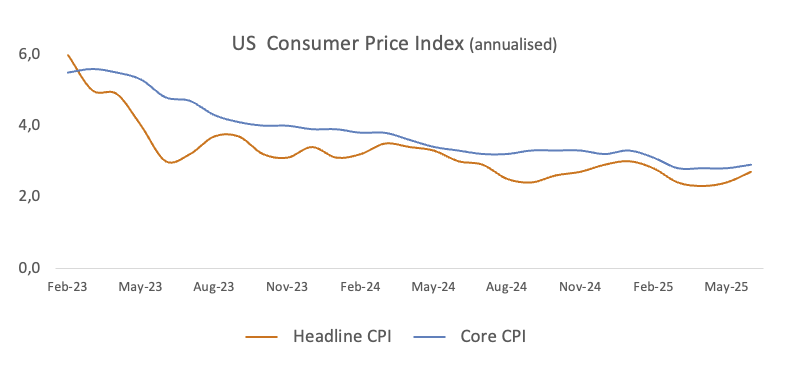
The United States (US) had an annual inflation rate of 2.7% in June, as measured by the Consumer Price Index (CPI), up from 2.4% in May, according to the US Bureau of Labor Statistics (BLS) on Tuesday. This figure matched the market forecast.
Follow our US CPI Live Coverage here
The core Consumer Price Index, excluding fluctuating food and energy costs, increased by 2.9% in the same month, up from May’s 2.8% rise.
Monthly, the headline CPI and core CPI rose by 0.3% and 0.2%, respectively.
Market reaction to US CPI inflation data
The selling momentum in the US Dollar (USD) now gathers traction, prompting the US Dollar Index (DXY) to challenge daily lows in the sub-98.00 region amid declining US yields across the curve.
US Dollar PRICE Today
The table below shows the percentage change of US Dollar (USD) against listed major currencies today. US Dollar was the strongest against the Japanese Yen.
| USD | EUR | GBP | JPY | CAD | AUD | NZD | CHF | |
|---|---|---|---|---|---|---|---|---|
| USD | -0.12% | -0.16% | 0.07% | -0.15% | -0.34% | -0.37% | -0.30% | |
| EUR | 0.12% | -0.11% | 0.22% | -0.01% | -0.24% | -0.30% | -0.17% | |
| GBP | 0.16% | 0.11% | 0.32% | 0.07% | -0.16% | -0.22% | 0.09% | |
| JPY | -0.07% | -0.22% | -0.32% | -0.28% | -0.43% | -0.52% | -0.32% | |
| CAD | 0.15% | 0.01% | -0.07% | 0.28% | -0.18% | -0.28% | 0.03% | |
| AUD | 0.34% | 0.24% | 0.16% | 0.43% | 0.18% | -0.07% | 0.21% | |
| NZD | 0.37% | 0.30% | 0.22% | 0.52% | 0.28% | 0.07% | 0.30% | |
| CHF | 0.30% | 0.17% | -0.09% | 0.32% | -0.03% | -0.21% | -0.30% |
The heat map shows percentage changes of major currencies against each other. The base currency is picked from the left column, while the quote currency is picked from the top row. For example, if you pick the US Dollar from the left column and move along the horizontal line to the Japanese Yen, the percentage change displayed in the box will represent USD (base)/JPY (quote).
This section below was published as a preview of the US Consumer Price Index (CPI) data at 03:00 GMT.
- The US Consumer Price Index is set to rise 2.7% YoY in June, accelerating from May’s 2.4% growth.
- US President Donald Trump continues to threaten tariffs and undermine the Fed’s independence.
- June’s inflation data will significantly impact the direction of the US Dollar as it is a key indicator for the Fed’s interest-rate path ahead.
The United States (US) Bureau of Labor Statistics (BLS) will publish the all-important Consumer Price Index (CPI) data for June on Tuesday at 12:30 GMT.
Markets will look for fresh signs of US President Donald Trump's tariffs feeding through into prices. Therefore, the US Dollar (USD) could experience volatility on the CPI release as the data has a significant influence on the Federal Reserve’s (Fed) interest rate outlook for this year.
What to expect in the next CPI data report?
As measured by the change in the CPI, inflation in the US is expected to rise at an annual rate of 2.7% in June, having recorded a 2.4% increase in May. The core CPI inflation, which excludes the volatile food and energy categories, is forecast to rise 3% year-over-year (YoY), compared to the 2.8% acceleration reported in the previous month. Overall, inflation is expected to tick up further away from the Fed’s 2% target
Over the month, both the CPI and the core CPI are seen advancing by 0.3% in the same period.
Previewing the report, analysts at TD Securities said: “June core CPI likely rebounded to 0.27% month-over-month (MoM) following last month's surprising decline to 0.13%. We look for goods prices to gather steam in June, reflecting some tariff passthrough, and rebounding from last month's modest contraction.”
“Unlike May, we don't expect the services segment to help offset that strength. Headline also likely increased 0.27%, aided by energy prices,” they added.
How could the US Consumer Price Index report affect EUR/USD?
Heading into the US inflation showdown on Tuesday, markets digest a slew of fresh tariff threats by President Trump so far this month.
Over the weekend, Trump threatened a 30% tariff on imports from the European Union (EU) and Mexico, starting on August 1, having sent tariff letters to about 20 other countries last week.
Meanwhile, Trump is piling up political pressure for more aggressive stimulus from the US central bank, undermining its independence. The President continued to bash Fed Chair Jerome Powell by saying on Sunday that “it would be a great thing if Powell stepped down.”
White House economic adviser Kevin Hassett over the weekend warned Trump might have grounds to fire Powell because of renovation cost overruns at the Fed's Washington headquarters.
Against this backdrop, markets continue pricing in just over 50 basis points (bps) of interest rate reductions this year, with Powell sticking to his patient outlook on cuts.
The odds of a September Fed rate cut currently stand at about 60%, according to the CME Group’s FedWatch Tool, down from 65% seen at the start of the month.
The increased expectations of an extended pause by the Fed are mainly due to the latest tariff salvo from Trump and a resilient US labor market.
The June US employment data showed that the headline Nonfarm Payrolls (NFP) rose by 147,000, against expectations of a 110,000 job gain. Meanwhile, the Unemployment Rate ticked lower to 4.1% last month versus 4.2% in May.
Therefore, the inflation report for June is critical to gauging the market pricing of the Fed’s rate outlook, in turn, impacting the USD’s valuation in the near term.
An upside surprise in the monthly core CPI reading, which is not distorted by base effects, could provide additional leg to the USD recovery and weigh on EUR/USD. In such a case, the data could revive expectations of only one Fed rate cut this year.
However, a softer-than-expected monthly core inflation could ease concerns over the tariff effect on inflation, undermining the USD demand. In this scenario, EUR/USD could regain bullish traction.
Dhwani Mehta, Asian Session Lead Analyst at FXStreet, offers a brief technical outlook for EUR/USD and explains:
“The pair battles the 21-day Simple Moving Average (SMA) support at 1.1665. Meanwhile, the 14-day Relative Strength Index (RSI) indicator holds well above 50, despite the recent downtrend, suggesting that the bullish potential remains intact.”
“On the upside, the immediate resistance level is aligned at the 1.1750 psychological mark, above which the 1.1800 round level will be tested. Further north, the multi-year high of 1.1830 will come into play. Alternatively, a sustained move below the 21-day SMA could challenge the first support at the June 12 high of 1.1631. The next healthy support levels are seen at around 1.1550 and the 50-day SMA at 1.1474.”
Fed FAQs
Monetary policy in the US is shaped by the Federal Reserve (Fed). The Fed has two mandates: to achieve price stability and foster full employment. Its primary tool to achieve these goals is by adjusting interest rates. When prices are rising too quickly and inflation is above the Fed’s 2% target, it raises interest rates, increasing borrowing costs throughout the economy. This results in a stronger US Dollar (USD) as it makes the US a more attractive place for international investors to park their money. When inflation falls below 2% or the Unemployment Rate is too high, the Fed may lower interest rates to encourage borrowing, which weighs on the Greenback.
The Federal Reserve (Fed) holds eight policy meetings a year, where the Federal Open Market Committee (FOMC) assesses economic conditions and makes monetary policy decisions. The FOMC is attended by twelve Fed officials – the seven members of the Board of Governors, the president of the Federal Reserve Bank of New York, and four of the remaining eleven regional Reserve Bank presidents, who serve one-year terms on a rotating basis.
In extreme situations, the Federal Reserve may resort to a policy named Quantitative Easing (QE). QE is the process by which the Fed substantially increases the flow of credit in a stuck financial system. It is a non-standard policy measure used during crises or when inflation is extremely low. It was the Fed’s weapon of choice during the Great Financial Crisis in 2008. It involves the Fed printing more Dollars and using them to buy high grade bonds from financial institutions. QE usually weakens the US Dollar.
Quantitative tightening (QT) is the reverse process of QE, whereby the Federal Reserve stops buying bonds from financial institutions and does not reinvest the principal from the bonds it holds maturing, to purchase new bonds. It is usually positive for the value of the US Dollar.
Interest rates FAQs
Interest rates are charged by financial institutions on loans to borrowers and are paid as interest to savers and depositors. They are influenced by base lending rates, which are set by central banks in response to changes in the economy. Central banks normally have a mandate to ensure price stability, which in most cases means targeting a core inflation rate of around 2%. If inflation falls below target the central bank may cut base lending rates, with a view to stimulating lending and boosting the economy. If inflation rises substantially above 2% it normally results in the central bank raising base lending rates in an attempt to lower inflation.
Higher interest rates generally help strengthen a country’s currency as they make it a more attractive place for global investors to park their money.
Higher interest rates overall weigh on the price of Gold because they increase the opportunity cost of holding Gold instead of investing in an interest-bearing asset or placing cash in the bank. If interest rates are high that usually pushes up the price of the US Dollar (USD), and since Gold is priced in Dollars, this has the effect of lowering the price of Gold.
The Fed funds rate is the overnight rate at which US banks lend to each other. It is the oft-quoted headline rate set by the Federal Reserve at its FOMC meetings. It is set as a range, for example 4.75%-5.00%, though the upper limit (in that case 5.00%) is the quoted figure. Market expectations for future Fed funds rate are tracked by the CME FedWatch tool, which shapes how many financial markets behave in anticipation of future Federal Reserve monetary policy decisions.
Author

FXStreet Team
FXStreet
Composed of a group of economic journalists and FX experts, the FXStreet content team produces and oversees all content published on FXStreet. It provides a purely journalistic approach to the Forex market.