Gold Price Forecast: XAU/USD wobbles around $3,340, awaits US labor market data
- Gold price consolidates around $3,340 ahead of the US employment data for June.
- Surprisingly upbeat US JOLTS Job Openings data has supported the US Dollar.
- Market sentiment remains cautious as Trump’s tariff deadline on July 9 approaches.

Gold price (XAU/USD) trades in a tight range around $3,340 during the European trading session on Wednesday. The yellow metal struggles for direction as investors await the United States (US) Nonfarm Payrolls (NFP) data for June, which is scheduled to be released on Thursday.
Investors will pay close attention to the US NFP data as a few Federal Reserve (Fed) officials have argued in favor of early interest rate cuts, citing labor market risks. "The Fed should not wait for the job market to crash in order to cut rates," Fed Governor Christopher Waller said in an interview near the June’s last week.
Theoretically, lower interest rates by the Fed bode well for non-yielding assets, such as Gold.
Ahead of the US NFP data, investors await the ADP Employment Change data for June, which will be published at 12:15 GMT. The US private sector is expected to have added 95K fresh workers, significantly higher than 37K recorded in May.
Meanwhile, a decent recovery move in the US Dollar (USD), following the upbeat US JOLTS Job Openings data for May has also limited the Gold price’s upside. Higher US Dollar makes Gold an expensive bet for investors.
The US Dollar Index (DXY), which tracks the Greenback’s value against six major currencies, recovers sharply to near 97.00 after snapping nine-day losing streak.
US Dollar PRICE Today
The table below shows the percentage change of US Dollar (USD) against listed major currencies today. US Dollar was the strongest against the Japanese Yen.
| USD | EUR | GBP | JPY | CAD | AUD | NZD | CHF | |
|---|---|---|---|---|---|---|---|---|
| USD | 0.30% | 0.28% | 0.36% | -0.07% | 0.16% | 0.30% | 0.18% | |
| EUR | -0.30% | -0.06% | 0.03% | -0.40% | -0.12% | 0.11% | -0.12% | |
| GBP | -0.28% | 0.06% | 0.10% | -0.33% | -0.12% | 0.14% | -0.09% | |
| JPY | -0.36% | -0.03% | -0.10% | -0.43% | -0.22% | -0.03% | -0.20% | |
| CAD | 0.07% | 0.40% | 0.33% | 0.43% | 0.25% | 0.48% | 0.26% | |
| AUD | -0.16% | 0.12% | 0.12% | 0.22% | -0.25% | 0.29% | 0.02% | |
| NZD | -0.30% | -0.11% | -0.14% | 0.03% | -0.48% | -0.29% | -0.23% | |
| CHF | -0.18% | 0.12% | 0.09% | 0.20% | -0.26% | -0.02% | 0.23% |
The heat map shows percentage changes of major currencies against each other. The base currency is picked from the left column, while the quote currency is picked from the top row. For example, if you pick the US Dollar from the left column and move along the horizontal line to the Japanese Yen, the percentage change displayed in the box will represent USD (base)/JPY (quote).
On the economic front, uncertainty surrounding the deadline of the reciprocal tariffs on July 9 and progress in US President Donald Trump’s so-called “Big Beautiful Bill” will continue to support the Gold price.
Gold technical analysis
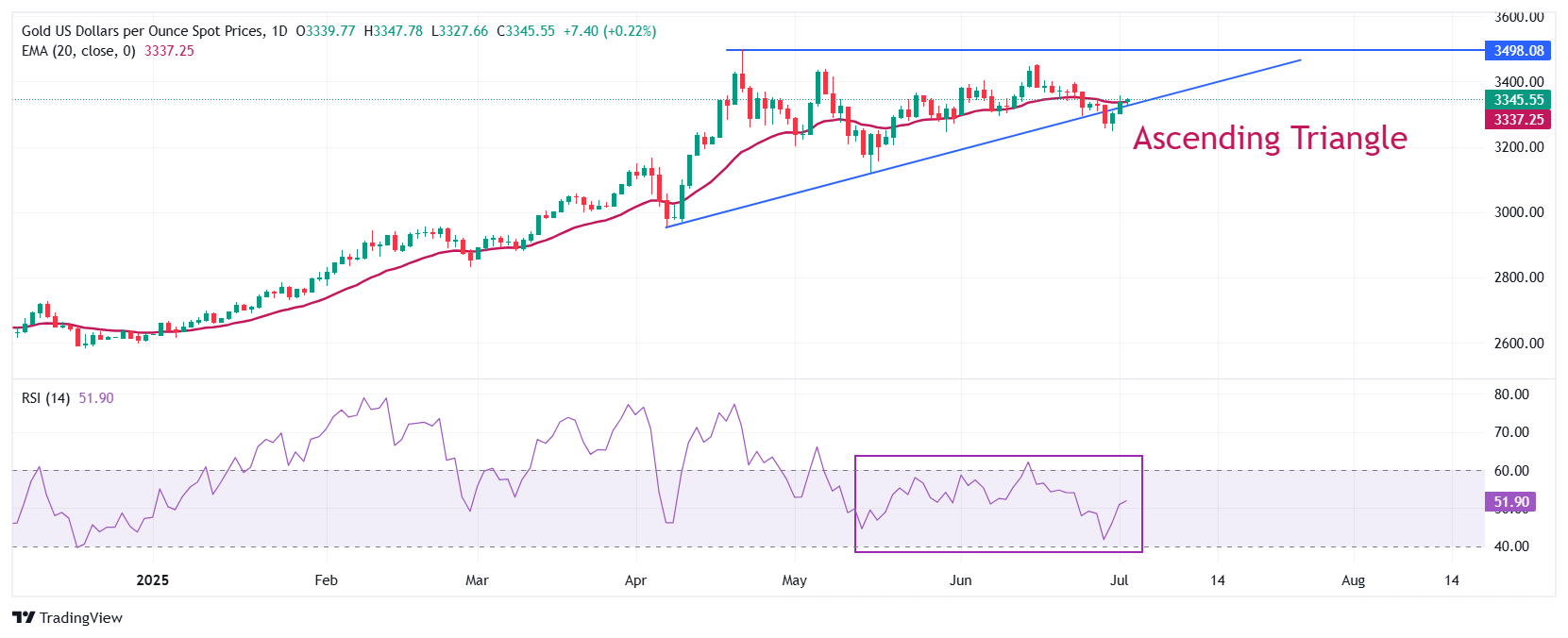
Gold price trades near the upward-sloping trendline of an Ascending Triangle formation on a daily timeframe, which is placed from the April 7 low of $2,957. The horizontal resistance of the above-mentioned chart pattern is plotted from the April 22 high around $3,500. Theoretically, a breakdown of the asset below the upward-sloping trendline results in a sharp downfall.
The precious metal trades wobbles near the 20-day Exponential Moving Average (EMA) around $3,342, suggesting that the near-term trend is uncertain.
The 14-day Relative Strength Index (RSI) oscillates inside the 40.00-60.00 range, indicating a sideways trend.
Looking up, the Gold price would enter in an unchartered territory after breaking above the psychological level of $3,500 decisively. Potential resistances would be $3,550 and $3,600.
Alternatively, a downside move by the Gold price below the May 29 low of $3,245 would drag it towards the round-level support of $3,200, followed by the May 15 low at $3,121.
Gold daily chart
Gold FAQs
Gold has played a key role in human’s history as it has been widely used as a store of value and medium of exchange. Currently, apart from its shine and usage for jewelry, the precious metal is widely seen as a safe-haven asset, meaning that it is considered a good investment during turbulent times. Gold is also widely seen as a hedge against inflation and against depreciating currencies as it doesn’t rely on any specific issuer or government.
Central banks are the biggest Gold holders. In their aim to support their currencies in turbulent times, central banks tend to diversify their reserves and buy Gold to improve the perceived strength of the economy and the currency. High Gold reserves can be a source of trust for a country’s solvency. Central banks added 1,136 tonnes of Gold worth around $70 billion to their reserves in 2022, according to data from the World Gold Council. This is the highest yearly purchase since records began. Central banks from emerging economies such as China, India and Turkey are quickly increasing their Gold reserves.
Gold has an inverse correlation with the US Dollar and US Treasuries, which are both major reserve and safe-haven assets. When the Dollar depreciates, Gold tends to rise, enabling investors and central banks to diversify their assets in turbulent times. Gold is also inversely correlated with risk assets. A rally in the stock market tends to weaken Gold price, while sell-offs in riskier markets tend to favor the precious metal.
The price can move due to a wide range of factors. Geopolitical instability or fears of a deep recession can quickly make Gold price escalate due to its safe-haven status. As a yield-less asset, Gold tends to rise with lower interest rates, while higher cost of money usually weighs down on the yellow metal. Still, most moves depend on how the US Dollar (USD) behaves as the asset is priced in dollars (XAU/USD). A strong Dollar tends to keep the price of Gold controlled, whereas a weaker Dollar is likely to push Gold prices up.
Author

Sagar Dua
FXStreet
Sagar Dua is associated with the financial markets from his college days. Along with pursuing post-graduation in Commerce in 2014, he started his markets training with chart analysis.