Gold price recovers as investors brace for US CPI data
- Gold price recovers some lost ground to around $3,255 in Tuesday’s early European session.
- US and China agreed to de-escalate their trade war by lowering import tariffs on each other's goods for 90 days.
- Traders brace for the US April CPI inflation report, which is due later on Tuesday.

The Gold price (XAU/USD) edges higher to around $3,255 during the early European session on Tuesday. Traders prefer to wait on the sidelines ahead of the US April Consumer Price Index (CPI) report, which is due later in the day. However, optimism over a tariff deal between the United States (US) and China might cap the upside for the precious metal.
Improved risk sentiment following the announcement of a temporary deal between the United States (US) and China to reduce tariffs might drag the safe-haven asset like the Gold price lower. The US will cut extra tariffs it imposed on Chinese imports in April this year to 30% from 145% and Chinese duties on US imports will reduce to 10% from 125%. The fresh measures are effective for 90 days.
Additionally, Reuters reported on Tuesday that the US will cut "de minimis" tariffs on China shipments from 120% to 54%, with a minimum flat fee of $100 to remain. "The de-escalation of tensions between China and the US is reducing the demand for safe haven assets like gold," said Giovanni Staunovo, analyst at Swiss bank and London bullion clearer UBS.
Gold traders brace for the US CPI inflation data on Tuesday, which might offer some hints about the US Federal Reserve's (Fed) policy path. The headline CPI is expected to show an increase of 2.4% YoY in April, while the core CPI is projected to show a rise of 2.8% YoY in the same report period.
Swap markets have priced in the Fed’s first 25 basis points (bps) rate cut for the September meeting, and they expect two additional rate reductions towards the end of the year. Last week, they indicated three cuts this year, with a change likely as soon as July.
India’s Prime Minister Narendra Modi said on Monday that operations against Pakistan have only been kept in abeyance, and the future will depend on their behaviour. Meanwhile, Ukrainian President Volodymyr Zelensky noted he is prepared to meet Russian President Vladimir Putin this week, shortly after Trump urged him to “immediately” accept the Russian leader’s offer to hold peace talks in Turkey. Any signs of escalating geopolitical tensions could boost the safe-haven flows, benefiting the yellow metal.
Gold price retains positive tone in the longer term
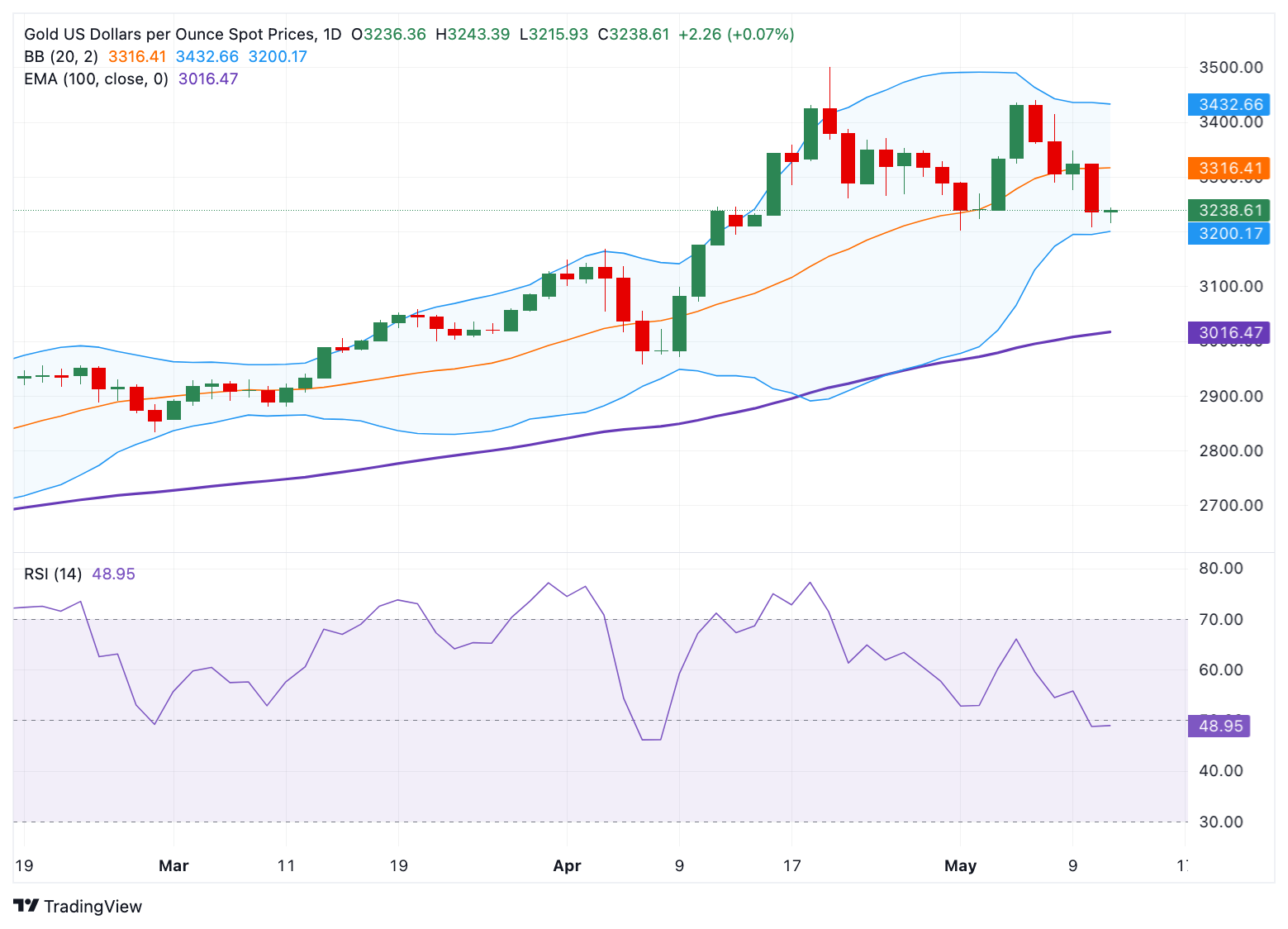
Gold price trades on a positive note on the day. According to the daily timeframe, the constructive outlook of the precious metal remains intact, characterized by the price holding above the key 100-day Exponential Moving Average. However, further consolidation ot temporary sell-off cannot be ruled out as the 14-day Relative Strength Index (RSI) is located below the midline.
On the bright side, the first upside barrier to watch is $3,347, the high of May 9. Any follow-through buying above this level could pave the way to $3,432, the upper boundary of the Bollinger Band. Further north, the next hurdle is seen at the all-time high of $3,500.
In the bearish case, the $3,200 psychological level acts as an initial support level for XAU/USD. The additional downside filter emerges at $3,142, the high of April 2.
Gold FAQs
Gold has played a key role in human’s history as it has been widely used as a store of value and medium of exchange. Currently, apart from its shine and usage for jewelry, the precious metal is widely seen as a safe-haven asset, meaning that it is considered a good investment during turbulent times. Gold is also widely seen as a hedge against inflation and against depreciating currencies as it doesn’t rely on any specific issuer or government.
Central banks are the biggest Gold holders. In their aim to support their currencies in turbulent times, central banks tend to diversify their reserves and buy Gold to improve the perceived strength of the economy and the currency. High Gold reserves can be a source of trust for a country’s solvency. Central banks added 1,136 tonnes of Gold worth around $70 billion to their reserves in 2022, according to data from the World Gold Council. This is the highest yearly purchase since records began. Central banks from emerging economies such as China, India and Turkey are quickly increasing their Gold reserves.
Gold has an inverse correlation with the US Dollar and US Treasuries, which are both major reserve and safe-haven assets. When the Dollar depreciates, Gold tends to rise, enabling investors and central banks to diversify their assets in turbulent times. Gold is also inversely correlated with risk assets. A rally in the stock market tends to weaken Gold price, while sell-offs in riskier markets tend to favor the precious metal.
The price can move due to a wide range of factors. Geopolitical instability or fears of a deep recession can quickly make Gold price escalate due to its safe-haven status. As a yield-less asset, Gold tends to rise with lower interest rates, while higher cost of money usually weighs down on the yellow metal. Still, most moves depend on how the US Dollar (USD) behaves as the asset is priced in dollars (XAU/USD). A strong Dollar tends to keep the price of Gold controlled, whereas a weaker Dollar is likely to push Gold prices up.
Author

Lallalit Srijandorn
FXStreet
Lallalit Srijandorn is a Parisian at heart. She has lived in France since 2019 and now becomes a digital entrepreneur based in Paris and Bangkok.















