Gold Price Forecast: XAU/USD remains bearish, with $3,345 likely to hold bulls
- Gold is on a corrective recovery against the US Dollar with resistances at $3,345 and $3,360.
- Market expectations of a strong GDP and a hawkish Fed keep the Greenback buoyed near highs
- XAU/USD is forming a Bearish Flag pattern, with its measured target at $3,245.

Gold (XAU/USD) is moving higher on Wednesday, favoured by a somewhat softer US Dollar, as investors trim their recent USD long positions ahead of the US Preliminary GDP release and the Fed monetary policy decision, due later today.
The precious metal, however, remains trading within recent ranges, as the strong US macroeconomic figures seen recently and market expectations of a significant recovery of the US Gross Domestic Product are feeding expectations of a “hawkish hold” by the Fed.
Technical analysis: The target of the Bearish Flag is $3,245
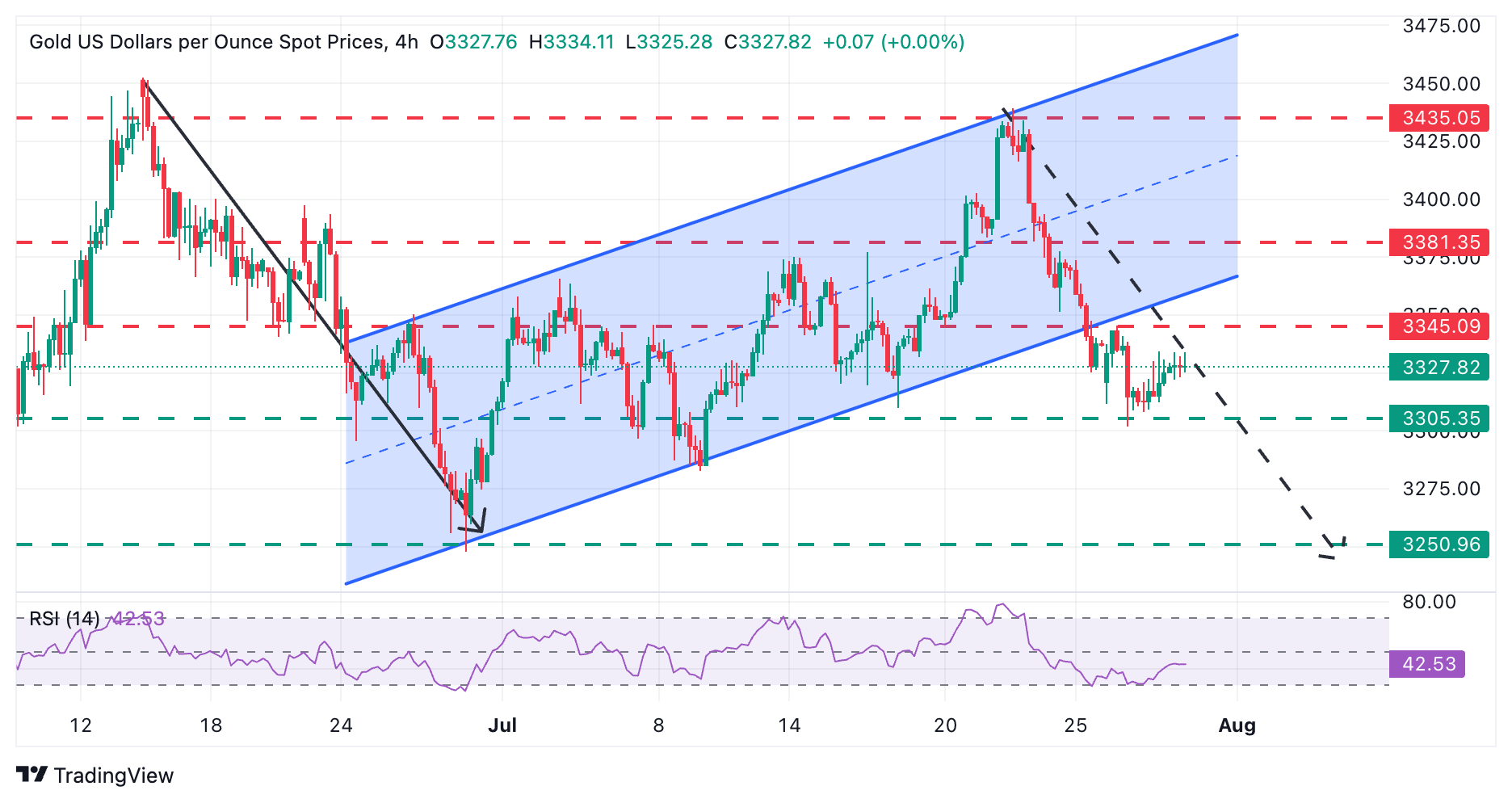
The XAU/USD is showing an increasing bearish momentum. The pair broke below the bottom of the ascending channel from late June lows, highlighting a bearish flag formation. The current rebound is likely to be a corrective reaction from oversold levels on intra-day charts.
Upside attempts are likely to be challenged at Monday’s high of $3.345 and the mentioned trendline support, now turned resistance, at $3,360. The pair needs to return above these levels to break the near-term bearish structure and shift the focus to the July 22 nd 23 lows, at $3,380.
To the downside, further depreciation below Monday’s low, at $3,295, might find support at the June 30 low of $3.245, which is the measured target of the bearish flag.
Gold FAQs
Gold has played a key role in human’s history as it has been widely used as a store of value and medium of exchange. Currently, apart from its shine and usage for jewelry, the precious metal is widely seen as a safe-haven asset, meaning that it is considered a good investment during turbulent times. Gold is also widely seen as a hedge against inflation and against depreciating currencies as it doesn’t rely on any specific issuer or government.
Central banks are the biggest Gold holders. In their aim to support their currencies in turbulent times, central banks tend to diversify their reserves and buy Gold to improve the perceived strength of the economy and the currency. High Gold reserves can be a source of trust for a country’s solvency. Central banks added 1,136 tonnes of Gold worth around $70 billion to their reserves in 2022, according to data from the World Gold Council. This is the highest yearly purchase since records began. Central banks from emerging economies such as China, India and Turkey are quickly increasing their Gold reserves.
Gold has an inverse correlation with the US Dollar and US Treasuries, which are both major reserve and safe-haven assets. When the Dollar depreciates, Gold tends to rise, enabling investors and central banks to diversify their assets in turbulent times. Gold is also inversely correlated with risk assets. A rally in the stock market tends to weaken Gold price, while sell-offs in riskier markets tend to favor the precious metal.
The price can move due to a wide range of factors. Geopolitical instability or fears of a deep recession can quickly make Gold price escalate due to its safe-haven status. As a yield-less asset, Gold tends to rise with lower interest rates, while higher cost of money usually weighs down on the yellow metal. Still, most moves depend on how the US Dollar (USD) behaves as the asset is priced in dollars (XAU/USD). A strong Dollar tends to keep the price of Gold controlled, whereas a weaker Dollar is likely to push Gold prices up.
,
Author

Guillermo Alcala
FXStreet
Graduated in Communication Sciences at the Universidad del Pais Vasco and Universiteit van Amsterdam, Guillermo has been working as financial news editor and copywriter in diverse Forex-related firms, like FXStreet and Kantox.















