USD/MXN trips down towards 17.56 as risk appetite boosts Mexican Peso
- USD/MXN drops 0.74% to 17.56 as improved sentiment lifts the Mexican Peso.
- ISM Services PMI jumps to 56.1 while ADP hiring beats forecasts at 63K.
- Banxico survey sees inflation ending 2026 near 4% with rates projected at 6.50%.

The Mexican Peso recovers some ground on Wednesday due to an improvement in risk appetite even though hostilities in the Middle East, extended for the fifth consecutive day. Solid US economic data was ignored by MXN bulls, as depicted by the USD/MXN pair which trades at 17.56, down 0.74%.
Mexican Peso gains despite strong US data, traders look ahead to key inflation and employment reports
Sentiment turned positive following the release of a solid ISM Non-Manufacturing PMI reading in February, which showed an increase in the New Orders sub-component, hitting its highest level since September 2024. New Orders jumped from 53.1 to 58.6, while the Services index expanded from 53.8 to 56.1, crushing forecasts of 53.5.
Earlier, the ADP National Employment Change report for February revealed that private sector hiring rose by 63K up from January’s downward revised 11K, above market estimates of 50K.
Across the southern border, Mexico’s economic docket is absent, with traders eyeing the release of Gross Fixed Investment on March 5, and February’s final Consumer Price Index (CPI) print on March 9.
On Tuesday, the Bank of Mexico (Banxico) revealed its private analyst’s poll, in which most economists expect inflation to end higher this and the following year.
Headline inflation is projected to end at 4% in 2026 with underlying CPI finishing at 4.17% up from 4.11% in the previous poll. Economic growth is expected to rise from 1.5% to 1.8% in 2026 and to remain unchanged in the following year.
The USD/MXN exchange rate is foreseen to end at 18.10, down from 18.50 from the previous survey and Banxico is expected to reduce rates by 50 basis points to 6.50%.
Regarding this, Banxico Deputy Governor Galia Borja said the central bank has room to reduce rates, citing weaker consumer spending, declining investment, and the appreciation of the Mexican Peso, expected to contain inflationary pressures.
Given the backdrop, the USD/MXN is expected to consolidate above/below the 17.50 area, ahead of the release of US employment data on Thursday and Friday.
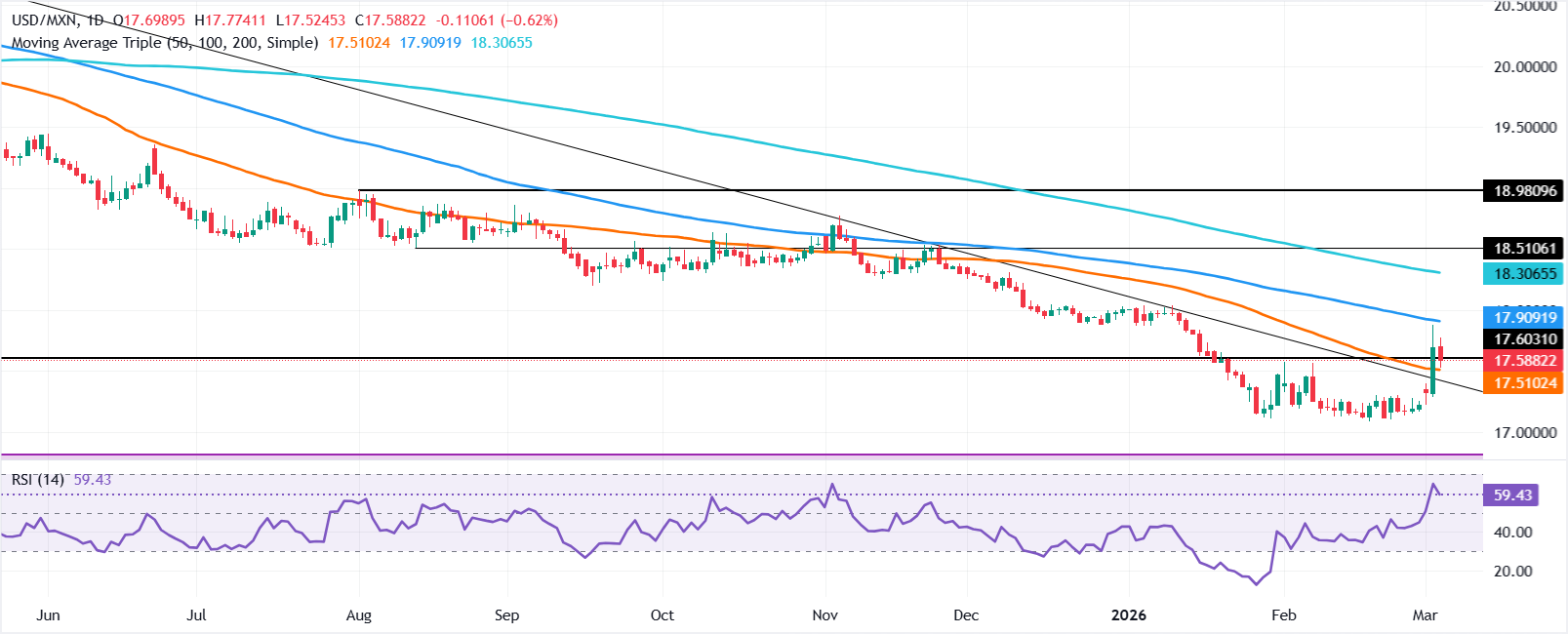
USD/MXN Price Forecast: Downtrend intact unless bulls reclaim 18.00
The USD/MXN technical picture is downward biased, but so far bears seem to loose some strength with the exchange rate sitting above the 20- and 50-day Simple Moving Averages (SMAs) at 17.25 and 17.50, respectively.
The Relative Strength Index (RSI) has been bullish, after spending below its 50-neutrlal level since the end of November 2025, a sign that sellers are losing some strength.
In addition to this, a break of a resistance trendline drawn from around April’s 2025 highs near 21.07 was broken on March 3, an indication that buyers are gathering some steam.
For a bullish resumption, traders must clear the 100-day SMA at 17.91. Once surpassed up next lies 18.00, followed by the 200-day SMA. Downwards lies the 50- and 20-day SMAs ahead of the 17.00 milestone.
Mexican Peso FAQs
The Mexican Peso (MXN) is the most traded currency among its Latin American peers. Its value is broadly determined by the performance of the Mexican economy, the country’s central bank’s policy, the amount of foreign investment in the country and even the levels of remittances sent by Mexicans who live abroad, particularly in the United States. Geopolitical trends can also move MXN: for example, the process of nearshoring – or the decision by some firms to relocate manufacturing capacity and supply chains closer to their home countries – is also seen as a catalyst for the Mexican currency as the country is considered a key manufacturing hub in the American continent. Another catalyst for MXN is Oil prices as Mexico is a key exporter of the commodity.
The main objective of Mexico’s central bank, also known as Banxico, is to maintain inflation at low and stable levels (at or close to its target of 3%, the midpoint in a tolerance band of between 2% and 4%). To this end, the bank sets an appropriate level of interest rates. When inflation is too high, Banxico will attempt to tame it by raising interest rates, making it more expensive for households and businesses to borrow money, thus cooling demand and the overall economy. Higher interest rates are generally positive for the Mexican Peso (MXN) as they lead to higher yields, making the country a more attractive place for investors. On the contrary, lower interest rates tend to weaken MXN.
Macroeconomic data releases are key to assess the state of the economy and can have an impact on the Mexican Peso (MXN) valuation. A strong Mexican economy, based on high economic growth, low unemployment and high confidence is good for MXN. Not only does it attract more foreign investment but it may encourage the Bank of Mexico (Banxico) to increase interest rates, particularly if this strength comes together with elevated inflation. However, if economic data is weak, MXN is likely to depreciate.
As an emerging-market currency, the Mexican Peso (MXN) tends to strive during risk-on periods, or when investors perceive that broader market risks are low and thus are eager to engage with investments that carry a higher risk. Conversely, MXN tends to weaken at times of market turbulence or economic uncertainty as investors tend to sell higher-risk assets and flee to the more-stable safe havens.
Author

Christian Borjon Valencia
FXStreet
Markets analyst, news editor, and trading instructor with over 14 years of experience across FX, commodities, US equity indices, and global macro markets.