Gold Price Forecast: XAU/USD refreshes four-week high as Sino-US trade worries fuel safe-haven demand
- Gold price jumps to near $3,400 on US-China trade uncertainty, a slight increase in Fed dovish bets.
- Poor US ADP Employment and Services PMI data weighs on US Treasury yields.
- The probability for the Fed to cut interest rates in July has slightly increased.

Gold price (XAU/USD) posts a fresh four-week high, advances to near $3,400 during European trading hours on Thursday. The yellow metal strengthens as uncertainty over potential trade deal between the United States (US) and China has accelerated, technically increasing the demand for safe-haven assets.
On Wednesday, US President Donald Trump signaled in a post on Truth.Social that a trade deal with Beijing is very difficult. "I like President Xi of China, always have, and always will, but he is VERY TOUGH, AND EXTREMELY HARD TO MAKE A DEAL WITH!!!" Trump wrote.
Another reason behind strength in the Gold price is the significant decline in the US bond yields. Theoretically, lower yields on interest-bearing assets increase demand for non-yielding assets, such as Gold. 10-year US Treasury Yields have extended their downside to near 4.35%, the lowest level seen in four weeks.
US bond yields tumbled on Wednesday after an array of disappointing US economic data, notable a sharp slowdown in the private sector labor demand. The ADP reported that the private sector added 37K fresh workers, which were lowest since January 2021. Additionally, the ISM Services PMI report indicated an unexpected decline in the service sector activity and poor demand outlook.
Soft US data has led to a slight increase in dovish expectations for the Federal Reserve’s (Fed) July policy meeting. According to the CME FedWatch tool, the probability for the Fed to reduce interest rates in July has increased to 30% from 22.5% seen a week ago.
Lower interest rates by the Fed bode well for non-yielding assets, such as Gold.
Gold technical analysis
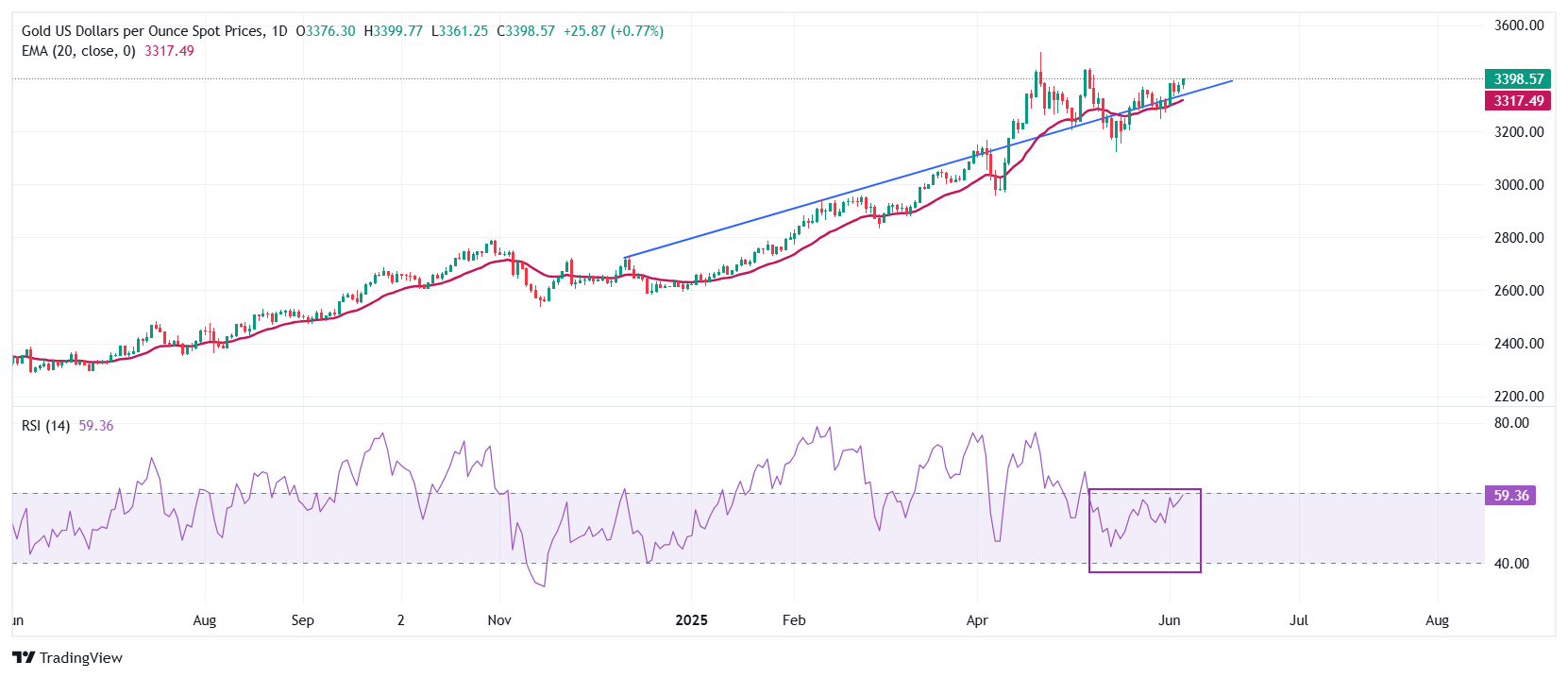
Gold price jumps to near $3,400 on Thursday. The yellow metal gains after stabilizing above the upward-sloping trendline on a daily timeframe around $3,335, which is plotted from December 12 high of $2,726. The near-term trend of the precious metal is bullish as the 20-day Exponential Moving Average (EMA) is sloping higher around $3,317.
The 14-day Relative Strength Index (RSI) rises to near 60.00. A fresh bullish momentum would emerge if the RSI breaks above that level.
Looking up, the Gold price could advance to near the May 7 high around $3,440 and the psychological level of $3,500 after stabilizing above $3,400.
Alternatively, a downside move by the Gold price below the May 29 low of $3,245 would drag it towards the round-level support of $3,200, followed by the May 15 low at $3,121.
Gold daily chart
Gold FAQs
Gold has played a key role in human’s history as it has been widely used as a store of value and medium of exchange. Currently, apart from its shine and usage for jewelry, the precious metal is widely seen as a safe-haven asset, meaning that it is considered a good investment during turbulent times. Gold is also widely seen as a hedge against inflation and against depreciating currencies as it doesn’t rely on any specific issuer or government.
Central banks are the biggest Gold holders. In their aim to support their currencies in turbulent times, central banks tend to diversify their reserves and buy Gold to improve the perceived strength of the economy and the currency. High Gold reserves can be a source of trust for a country’s solvency. Central banks added 1,136 tonnes of Gold worth around $70 billion to their reserves in 2022, according to data from the World Gold Council. This is the highest yearly purchase since records began. Central banks from emerging economies such as China, India and Turkey are quickly increasing their Gold reserves.
Gold has an inverse correlation with the US Dollar and US Treasuries, which are both major reserve and safe-haven assets. When the Dollar depreciates, Gold tends to rise, enabling investors and central banks to diversify their assets in turbulent times. Gold is also inversely correlated with risk assets. A rally in the stock market tends to weaken Gold price, while sell-offs in riskier markets tend to favor the precious metal.
The price can move due to a wide range of factors. Geopolitical instability or fears of a deep recession can quickly make Gold price escalate due to its safe-haven status. As a yield-less asset, Gold tends to rise with lower interest rates, while higher cost of money usually weighs down on the yellow metal. Still, most moves depend on how the US Dollar (USD) behaves as the asset is priced in dollars (XAU/USD). A strong Dollar tends to keep the price of Gold controlled, whereas a weaker Dollar is likely to push Gold prices up.
Author

Sagar Dua
FXStreet
Sagar Dua is associated with the financial markets from his college days. Along with pursuing post-graduation in Commerce in 2014, he started his markets training with chart analysis.