Gold Price Forecast: XAU/USD finishes the week with gains near 1.80%, around $1950s
- The yellow metal spent the week in positive territory but short of the previous cycle high.
- Geopolitical issues would keep influencing gold, and any risk-off market mood should benefit precious metals.
- The energy agreement between the US and EU would make Europe less dependent on Russia’s natural gas.
- XAU/USD Price Forecast: Upward biased, but failure to reclaim $1974 and a horizontal 200-DMA leave gold vulnerable to selling pressure.

Gold (XAU/USD) is set to finish Friday’s session on a lower note, but the week reclaimed some of its brightness, gaining 1.79% as market sentiment fluctuated as the North American session ended. At the time of writing, XAU/USD is trading at $1958.36 a troy ounce, down some 0.19%.
Global equities overnight reflected a mixed market mood, courtesy of Russia’s invasion of Ukraine, high inflation looming, and central bank tightening. Although discussions between Russia and Ukraine provided some advance in secondary matters, negotiations about main issues remain stuck. Meanwhile, once the NATO summit is in the rearview mirror, the US and the Eurozone agreed on natural gas supply deal to cut dependence on Russia.
Late In the North American session, Russia said that it would focus its military efforts on taking complete control of Ukraine’s Dobnbass region, a sign that Moscow may be backing away from taking a more significant stake of Ukraine, as reported by Bloomberg.
Aside from this, the Federal Reserve hawkish pivot keeps weighing on the yellow metal. On Tuesday, Fed Chair Jerome Powell expressed that the Fed would do whatever necessary to return “price stability.” He emphasized that if needed to raise rates more than 25 bps, stated that “[Fed] we will do so.”
XAU/USD traders did react immediately to the headline, pushing the non-yielding towards the weekly low at around $1910 a troy ounce. However, a dampened market mood and US Treasury yields seesawing lifted gold towards the $1950 area.
Friday’s US economic docket featured Pending Home Sales for February, which contracted 4.1% from the expected 1% m/m increase. Furthermore, the University of Michigan Consumer Sentiment Final for March came at 59.4 from 59.7, while inflation expectations stayed at 5.4% vs. 4.9% on the previous report.
XAU/USD Price Forecast: Technical outlook
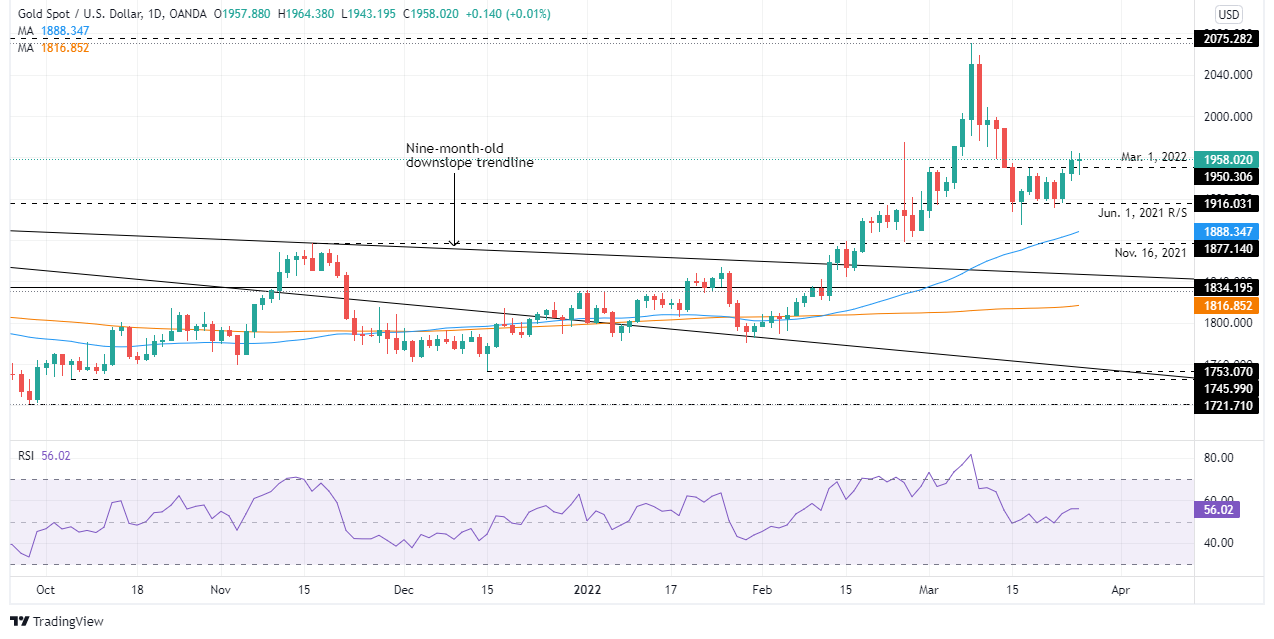
Gold (XAU/USD) bias is still up, but it would remain under selling pressure. Failure to reclaim February 24 daily high at $1974 left the precious metal exposed to selling pressure unless XAU bulls recover the aforementioned. It is worth noting that the 200-day moving average (DMA) at $1816.85, from an upslope, is horizontal, indicating that the steep rally above $2000 might be subject to a further correction lower.
Upwards, XAU/USD’s first resistance would be $1974. Once cleared, the next resistance would be $2000, and the YTD high at $2075.82.
On the flip side, and the most likely scenario, XAU/USD’s first support would be March 20 low at $1950.30. Breach of the latter would expose March 16 daily low at $1895.06, followed by November 16, 2021, low at $1877.14.
Author

Christian Borjon Valencia
FXStreet
Markets analyst, news editor, and trading instructor with over 14 years of experience across FX, commodities, US equity indices, and global macro markets.