Gold Price Forecast: XAU/USD corrects lower with $5,000 on the bears focus
- Gold approaches the $5,000 area after rejection at $5,600 area.
- News that Kevin Warsh will replace Powell as Fed Chair has been welcomed by the market.
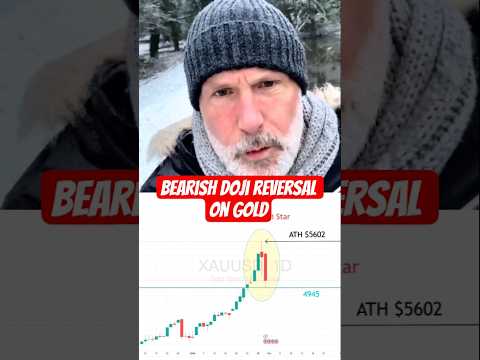
- The Daily chart shows a potential "Evening Star" candle formation, a bearish sign.

Gold’s (XAU/USD) rally came to an abrupt halt on Thursday. The precious metal dropped nearly 10% in less than 24 hours and is trading around $5,080 at the time of writing, with the $5,000 psychological level at a short distance.
US President Trump seems set to name former Fed Governor Kevin Warsh as the next central bank Chairman, which has provided some relief to investors, wary about the Fed’s independence. It is debatable, however, whether that alone can justify the sharp reversal in precious metals, especially given that Trump has launched a new tariff threat against countries supplying oil to Cuba and that tensions in the Middle East remain high.
Technical analysis: Gold's bearish correction is finally here
Gold was rejected a few pips shy of the $5,600 area on Thursday and is forming an impulsive bearish candle in the daily chart on Friday, which, if confirmed, will complete an "Evening Star" candle pattern, a signal that often announces a trend shift.
The 4-hour chart shows prices moving at a short distance from the $5,000 level, with technical indicators trending lower. The Moving Average Convergence Divergence (MACD) line shows a sharp cross below the Signal line and a widening negative histogram, and the Relative Strength Index (RSI) prints at 43.76 (neutral below the midline), reinforcing the bearish momentum.
A confirmation below $5,000 and the January 26 low, at $4,980, would bring the 100-period SMA, now at $4,822, and the January 21 low, near $4,755, to the focus. On the upside, the intra-day high, at $5,450, is likely to close the path towards the all-time highs, at $5,595, hit on Thursday.
(The technical analysis of this story was written with the help of an AI tool.)
Gold FAQs
Gold has played a key role in human’s history as it has been widely used as a store of value and medium of exchange. Currently, apart from its shine and usage for jewelry, the precious metal is widely seen as a safe-haven asset, meaning that it is considered a good investment during turbulent times. Gold is also widely seen as a hedge against inflation and against depreciating currencies as it doesn’t rely on any specific issuer or government.
Central banks are the biggest Gold holders. In their aim to support their currencies in turbulent times, central banks tend to diversify their reserves and buy Gold to improve the perceived strength of the economy and the currency. High Gold reserves can be a source of trust for a country’s solvency. Central banks added 1,136 tonnes of Gold worth around $70 billion to their reserves in 2022, according to data from the World Gold Council. This is the highest yearly purchase since records began. Central banks from emerging economies such as China, India and Turkey are quickly increasing their Gold reserves.
Gold has an inverse correlation with the US Dollar and US Treasuries, which are both major reserve and safe-haven assets. When the Dollar depreciates, Gold tends to rise, enabling investors and central banks to diversify their assets in turbulent times. Gold is also inversely correlated with risk assets. A rally in the stock market tends to weaken Gold price, while sell-offs in riskier markets tend to favor the precious metal.
The price can move due to a wide range of factors. Geopolitical instability or fears of a deep recession can quickly make Gold price escalate due to its safe-haven status. As a yield-less asset, Gold tends to rise with lower interest rates, while higher cost of money usually weighs down on the yellow metal. Still, most moves depend on how the US Dollar (USD) behaves as the asset is priced in dollars (XAU/USD). A strong Dollar tends to keep the price of Gold controlled, whereas a weaker Dollar is likely to push Gold prices up.
Author

Guillermo Alcala
FXStreet
Graduated in Communication Sciences at the Universidad del Pais Vasco and Universiteit van Amsterdam, Guillermo has been working as financial news editor and copywriter in diverse Forex-related firms, like FXStreet and Kantox.