Gold Price Forecast: XAU/USD remains poised to extend losses below $1,750 on renewed USD gains
- Gold is under pressure on the charts as the US dollar remains firm.
- $1,760 is a key resistance and the bears are lurking below.
- XAU/USD remains vulnerable amid hawkish Fed outlook
- Gold, Chart of the Week: XAU/USD bearish bias forecast below $1,760

Update: Gold prices continue to trade pessimistically following the previous session’s downside momentum. The prices found some buying interest on the worries over China’s Evergrande debt crisis on Monday as investors ditched riskier assets. Nevertheless, the gains were short-lived on a higher US dollar. The greenback traded strongly near 92.50 on looming interest rate hikes expectations following hawkish Fed’s officials and uncertainties over China’s property giant Evergrande default risk. The US Fed Chair Jerome Powell is expected to talk about “upside risk” to inflation as bottlenecks, hiring difficulties, and other drivers of price pressures, but has remained firm on his stance to consider these pressures as transitory in his remarks prepared for the Senate Banking Committee to be delivered on Tuesday. A higher USD valuation makes gold expensive for the other currencies holders.
The price of gold on Tuesday is in the hands of the US dollar that has been benefiting from higher US yields following the latest comments from Federal Reserve officials which include Fed chair Jerome Powell's. At the time of writing, XAU/USD is sitting near $1,750 and remains in the bearish territory while below $1,760.
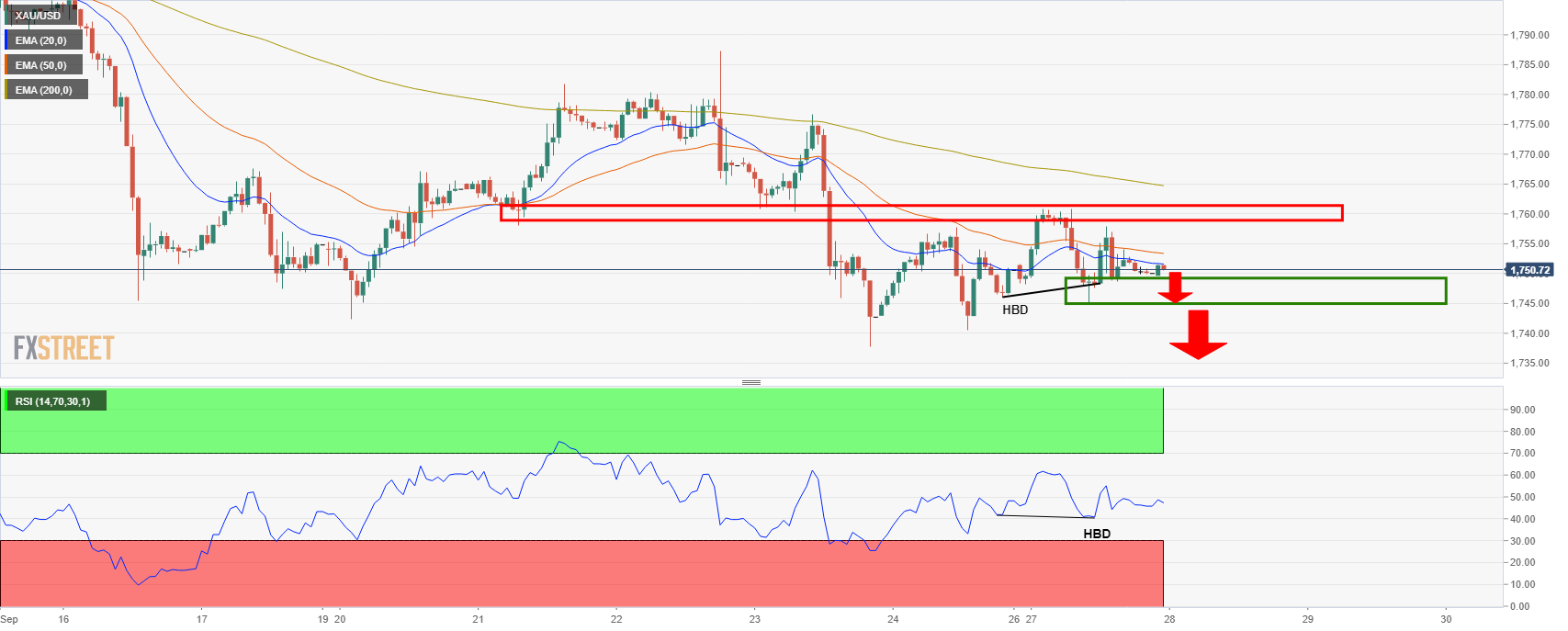
Gold has recently enjoyed some hidden bullish divergence on the hourly time frame which has given the yellow metal some support in the US session. Gold on Wall Street travelled between a low of $1,744.88 and $1,760.91 on the day so far. Nevertheless, the pressure is on for the bulls with the price technically bearish below the 4-hour 200, 50 and 20 EMAs that are aligned bearishly with RSI below 50. See more on that below under, Gold, technical analysis.
All eyes on the Fed
Meanwhile, the fundamentals driving the markets stem from hawkish rhetoric from Federal Reserve speakers following last week's hawkish Federal Reserve statement, dot plot and Powell's presser. In this regard, this could be led by Fed Chair Jerome Powell, who will join Treasury Secretary Janet Yellen in speaking before Congress on Tuesday.
The US dollar advanced for a second straight session on Monday, bolstered by the rise in Treasury yields ahead of a slew of Federal Reserve speakers this week who could affirm expectations of the start of asset purchase reduction before the end of the year. US benchmark 10-year Treasury yields hit a three-month high of $1.515%. The dollar index DXY, which measures the US currency against six major rivals, rose 0.1% to 93.37.
US yields climbed to their highest since late June in anticipation of interest rate increases that may follow sooner than expected. Fed officials on Monday and Tuesday in Asia have echoed Fed's Powell's comments last week surrounding tapering of the Fed's monthly bond purchases to continued job growth. This makes next week's September employment report a massive event for financial markets as it is now seen as a potential trigger for the central bank's bond taper.
"As much as taper in and of itself is not a surprise, an earlier end to its program will reinforce that downside risks to the US dollar have diminished," Mazen Issa, senior FX strategist at TD Securities said.
"If the last taper cycle was any indication, about half of the US dollar's cyclical upswing was observed three months after taper," he added.
Meanwhile, a report compiled by a collective of the TD Securities analysts explained a cleaner discretionary and trend-following positioning slate in gold should keep any weakness from morphing into a rout.
''With that said, we still expect silver to underperform gold on a risk-adjusted basis, as a normalization in industrial demand further weighs on the white metal, while flow effects have not yet been priced.''
''Looking forward, the 'stagflation' narrative is still capturing the market's share of mind, as participants look to a period of high inflation and slowing growth, but this has yet to translate into additional interest for gold,'' the report ended with.
Gold technical analysis
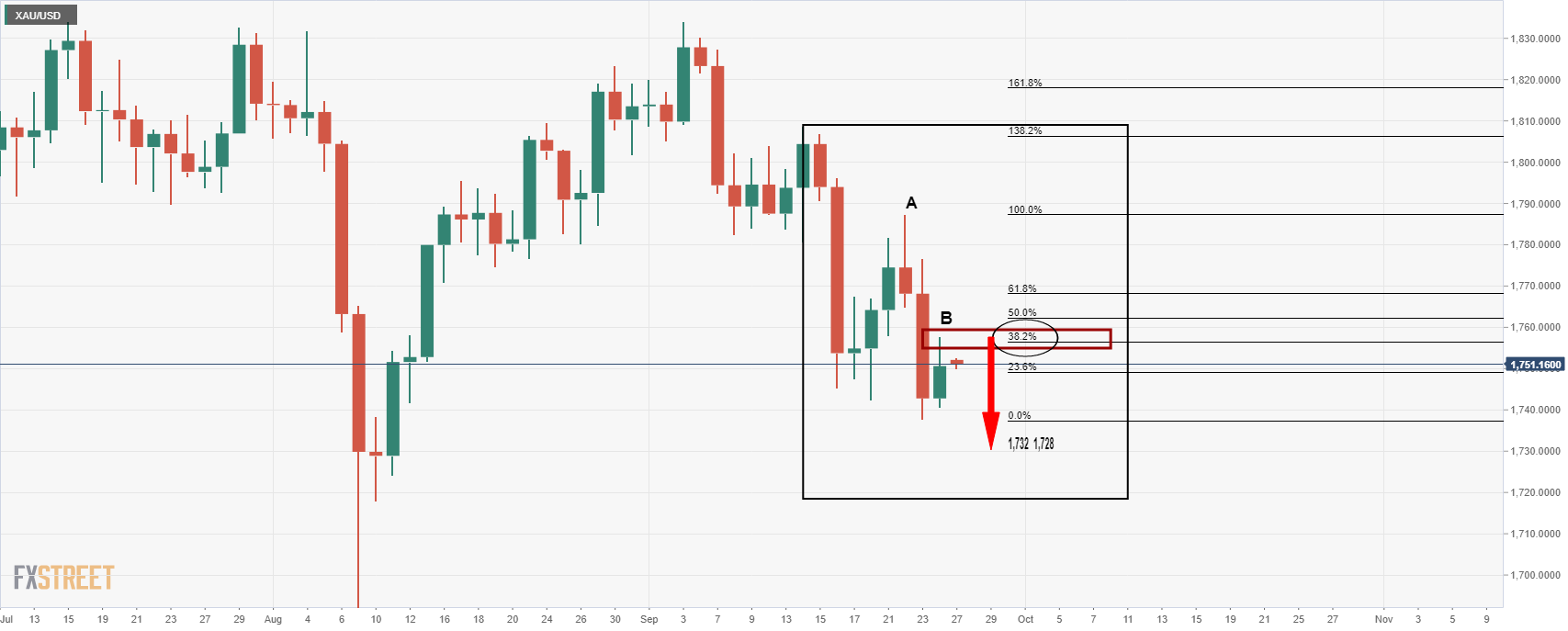
Should the price fails to overcome $1,760 on a closing basis in the coming sessions, this could give rise to further supply and a downside extension. The corrections, as illustrated as A and B on the chart above, show their targets based on the -272% Fibonacci retracements of the correction's ranges. These come in at $1,732 and $1,728:
Meanwhile, from an hourly basis, despite the hidden bullish divergence, the price is pressured below critical moving average bearish divergences as follows:
For a comprehensive analysis of the gold price, see more here:
Author

Ross J Burland
FXStreet
Ross J Burland, born in England, UK, is a sportsman at heart. He played Rugby and Judo for his county, Kent and the South East of England Rugby team.
















