Gold Price Forecast: XAU/USD hangs near monthly low, seems vulnerable around $1,785 area
- Gold remains on the back foot for fourth consecutive day, keeps downside break of 100-DMA previous support from August.
- Market sentiment dwindles amid indecision over the pace of Fed’s March rate hike after Friday’s US Employment Cost Index.
- US Treasury yields fail to recall USD buyers amid a sluggish start to the NFP week.
- Gold Weekly Forecast: XAU/USD poised for further losses on Fed's hawkish stance

Update: Gold struggled to capitalize on Friday's late recovery from the $1,780 area, or the lowest level since December 16 and met with a fresh supply on the first day of a new week. The XAU/USD remained depressed through the early European session and was last seen trading near the daily low, around the $1,785 region.
The prospects for a faster policy tightening by the Fed, along with an uptick in the US Treasury bond yields turned out to be a key factor that acted as a headwind for the non-yielding gold. Apart from this, a recovery in the global risk sentiment – as depicted by a generally positive tone around the equity markets – further undermined the safe-haven precious metal. This marked the fourth day of a negative move, through modest US dollar weakness could help limit further losses for the dollar-denominated XAU/USD.
Investors might also prefer to wait on the sidelines ahead of this week's key central bank event risks and important US macro data scheduled at the beginning of a new month. The Reserve Bank of Australia is scheduled to announce its policy decision on Tuesday amid rising bets for an earlier rate hike. This will be followed by the Bank of England and the European Central Bank duo on Thursday. Investors will further take cues from the release of the US monthly jobs report (NFP) before placing fresh directional bets around gold.
Previous update: Gold (XAU/USD) prices drop for the fourth day in a row, refreshing intraday bottom around $1,786 heading into Monday’s European session.
In doing so, the yellow metal fails to cheer the US dollar pullback as the US Treasury yields stay firmer and stock futures fail to extend Friday’s rebound.
The reason could be linked to the market’s indecision ahead of the March month Federal Reserve (Fed) meeting, as well as this week’s US jobs report. It should be noted that the geopolitical fears surrounding Russia add to the risk-off mood and drown gold prices to justify the technically bearish confirmation.
the US Dollar Index (DXY) tracks downbeat Treasury yields to extend Friday’s pullback from the highest levels since July 2020. Behind the moves could be the market’s indecision over the pace of the Fed’s rate hike in March after the recently downbeat wage price data.
Although the Fed’s hawkish halt drowned gold prices the last week, the US Q4 Employment Cost Index (ECI) raises challenges for the Fed policymakers who expect 0.50% rate hikes. Though, strong readings of the Fed’s preferred gauge of inflation, namely Core PCE Price Index for December rose to 4.9%, versus 4.8% forecast and 4.7% prior, keeping the Fed hawks on the table.
Following the US data release, Federal Reserve Bank of Minneapolis President Neel Kashkari said that he expects Fed to raise rates at the March meeting. Though, the policymaker emphasized the importance of incoming data while also saying, “Have to see how data plays out.”
On the same line was Raphael Bostic, President of the Fed’s Atlanta branch who reiterated his call for three Fed rate lifts in 2022 in an interview with the Financial Times (FT), with the first coming in March. “If the data say that things have evolved in a way that a 50 basis point move is required or [would] be appropriate, then I’m going to lean into that . . . If moving in successive meetings makes sense, I’ll be comfortable with that,” said Fed’s Bostic per FT.
Elsewhere, the US Senate's aggression towards passing a law to levy economic sanctions on Russia also weighs on the risk appetite. “US senators are very close to reaching a deal on legislation to sanction Russia over its actions on Ukraine, including some measures that may take effect before any invasion, two leading senators said on Sunday,” said Reuters.
Moving on, a light calendar on Monday may challenge gold traders but major attention will be given to Friday’s US jobs report, as well as Treasury yields for fresh impulse.
Technical analysis
Gold prices stay below the $1,795-96 resistance confluence, including 100-DMA and an ascending trend line from August, while portraying a four-day downtrend of late.
The metal’s declines also take clues from bearish MACD signals and downbeat RSI, not oversold.
As a result, the 61.8% Fibonacci retracement (Fibo.) of April-June 2021 upside, near $1,770, can act as immediate support to watch for the gold sellers.
Following that, December’s bottom surrounding $1,753 will be crucial as it holds the key to the quote’s further downside towards September’s low of $1,721.
Alternatively, a daily closing beyond $1,796 will need validation from the $1,800 threshold to again aim for the yearly resistance line, around $1,845.
Even if the gold buyers manage to cross the $1,845 resistance, the monthly high near $1,853 will be crucial for the metal’s further upside.
Gold: Daily chart
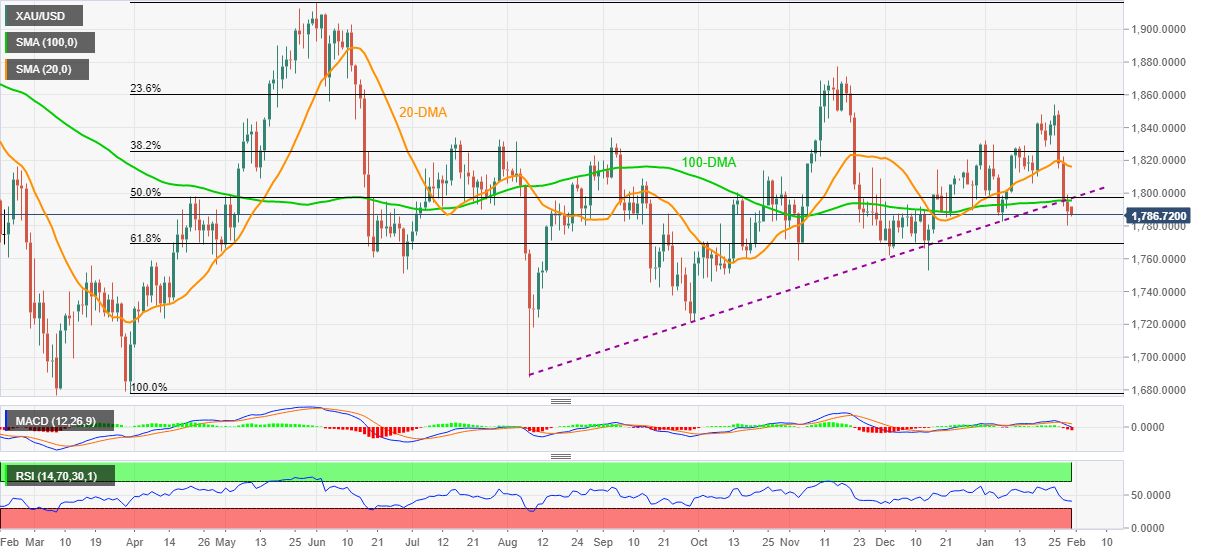
Trend: Further weakness expected
Author

Anil Panchal
FXStreet
Anil Panchal has nearly 15 years of experience in tracking financial markets. With a keen interest in macroeconomics, Anil aptly tracks global news/updates and stays well-informed about the global financial moves and their implications.